Automate Insurance Adjuster Status Calls at a Collision Center
Hello, and here’s to the day the adjuster’s voicemail box stops being your second office.
Every body shop owner I read about describes the same call: Hi, it’s Main Street Collision again, about claim 123-456.
I spent a day with the Vermont Department of Financial Regulation’s December 31, 2025 study of auto insurance practices, plus the trade reporting around it, to see how big that call really is.
Its shops said supplements are required 95% of the time, and the average delay they cause is 7.32 days. In a Minnesota shop’s own tracking of 100 jobs, adjusters took 4.2 days to answer a first supplement, and under a day on DRP jobs.
Short answer: You can automate insurance adjuster status calls at a collision center. A server reads each open supplement from your shop management system, phones the adjuster’s claims line on a schedule, asks one question, records the answer on the file, and texts the car owner. An estimator takes over the moment the adjuster disputes a line.
What is an insurance adjuster status call?
An adjuster status call is a short phone call from a collision center to an insurer asking where an estimate, supplement or payment stands.
- Who makes it: the estimator, a supplement writer or the service advisor.
- What it asks:
Has supplement 1 on claim 123-456 been reviewed, and when will it be?
- Where it ends: a voicemail, a hold queue, a reviewer who says
tomorrow
, or an approval. - What it leaves behind: usually a note someone meant to write on the file.
The call itself takes about one minute. The cost is the redialing, the hold time and the notes nobody has time to type.
Why does a supplement turn into so many phone calls?
Because the answer comes from the insurer’s side, and the only lever a shop has is how often and how clearly it asks.
- 95%
- The average share of repairs that required supplements, as reported by responding Vermont body shops in the DFR Act 32 report (December 31, 2025).
- 7.32 days
- The average delay to repairs caused by supplements in that same report.
- 4.2 days
- The average insurer response to a first supplement across 100 jobs at LaMettry’s Collision, per Autobody News.
CCC says the way out is improved communication and process efficiency between shops and insurance carriers
(Crash Course Q4 2025).
Here’s the catch: sources disagree on how long the wait is (4.2 days in one shop, 7.32 in a state survey), so measure your own. A call log is the easiest way to get that number.
How much time do adjuster status calls cost a collision center?
About 9 to 29 hours a month for a shop closing 30 to 100 repairable jobs, if each supplement takes three status calls by hand.
| Repairable jobs a month | Supplements (95%) | Calls by hand (hours) | With automated calls (hours) | Hours back | Value at $25 an hour |
|---|---|---|---|---|---|
| 30 | 29 | 8.7 | 1.0 | 7.7 | $193 |
| 60 | 57 | 17.1 | 1.9 | 15.2 | $380 |
| 100 | 95 | 28.5 | 3.2 | 25.3 | $633 |
Assumptions: 95% of jobs need a supplement (the Vermont shop average); 3 status calls per supplement at 6 minutes each, counting hold, redials and typing the note; with automation, 1 in 4 supplements reaches a person for 8 minutes. These are our round numbers, not a survey. Time your own calls for a week and swap them in.
The table in one line: a 60-job shop gets back roughly 15 hours a month, nearly two working days.
How does an automated adjuster status call work?
Your server watches the shop system for open supplements, places the call at the scheduled time, and writes the result back to the file.
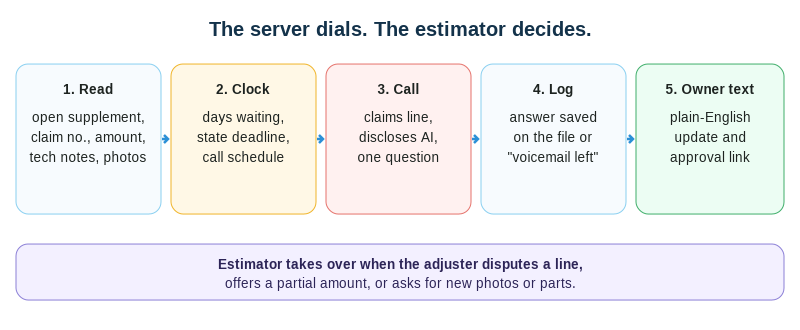
The diagram, as text:
- Read. The server pulls open repair orders and supplements, with claim number, insurer, adjuster contact, amount and sent date.
- Look at the photos and notes. It reads the technician’s inspection notes and photos so the call and the owner text describe the real damage.
- Call. On the schedule you set, it phones the number the insurer gave for the claim.
- Log. It saves a transcript or summary of the answer: approved, reviewing, needs photos, denied, or no answer.
- Tell the owner. It sends a plain-English text with an approval link when the owner needs to decide something.
- Hand off. Any
we’ll only pay part
or a request for new documents goes to the estimator at once.
This sits next to the schedule in our guide to insurance supplement follow-up, which covers the email steps and state deadlines. This page is about the phone leg.
What should an automated call to an adjuster say?
It should name itself, the shop, the claim and the supplement in the first sentence, then ask exactly one question.
| Moment | What it says | Why |
|---|---|---|
| Opening | This is an automated assistant calling for Main Street Collision about claim 123-456, supplement 1, for $1,840. | Discloses it is automated and lets the reviewer find the file |
| The question | Has this supplement been reviewed, and when will we have an answer? | One question gets one clear answer |
| If a person answers | I can connect you to our estimator now, or take your answer. | A human is always one step away |
| Closing | Thank you. I’ll note that on the file. | Confirms the answer will be logged |
The assistant never accepts a reduction, agrees to an aftermarket part or promises a completion date.
Where does the call get the claim number and amount?
From your shop management or estimating system, through its API or the integration route its maker allows.
A status call is a small courtesy that gets repeated a hundred times. Letting a helper make the repeats frees your estimator for the one conversation that needs a real voice.
| System | What a server can read | How access works |
|---|---|---|
| Tekmetric | Repair orders and status, jobs, inspection and estimate share dates | Partner API with OAuth2; credentials are requested and approved by Tekmetric |
| CCC ONE | Workfile and supplement data, in the CIECA BMS standard | CCC Secure Share, switched on per app by the shop |
| Mitchell Connect | Supplement status and the job’s Journals notes | Ask Mitchell which integrations your account allows |
Where no integration is open yet, a simple form works: the estimator pastes the claim number and amount when the supplement is sent, and the calls start from there.
Shops on Tekmetric can see what the software already sends on its own in our guide to Tekmetric automated customer messaging.
Is it legal to use an AI voice and record calls to adjusters?
Often yes with care: AI voices fall under the TCPA, and recording needs the right consent in your state.
The FCC’s Declaratory Ruling of February 8, 2024 recognizes calls made with AI-generated voices are “artificial” under the Telephone Consumer Protection Act (TCPA)
.
- Disclose the AI in the first sentence, as in the script.
- Call the claims or desk number the insurer gave, not a personal cell.
- Recording: federal law needs one party’s consent, but California’s Penal Code section 632 and Washington’s RCW 9.73.030 require the other side’s consent too.
- Safe default: announce
this call may be recorded
at the start.
Sources disagree on how many states are all-party: several 2026 guides list 9 to 13, depending on how they treat Connecticut, Delaware and Michigan. If your adjusters are in another state than you, treat the call as all-party.
What happens when the adjuster doesn’t pick up?
The call detects the voicemail, waits for the beep, leaves the same one-question message and logs “no answer”.
Calling platforms like Twilio can detect an answering machine. With the DetectMessageEnd setting, Twilio holds the result until the greeting finishes, so the message doesn’t play over it, and returns values such as human, machine_end_beep and unknown.
Twilio notes that a result of unknown appears if detection times out. Treat that as “maybe a person” and keep the script short and polite either way.
The log line then reads something like Day 2, 10:14 a.m., voicemail left
, which also feeds your escalation to the supervisor on day 3.
When should an estimator take over the call?
Whenever the adjuster starts negotiating, denies a line, or asks for something new.
We’ll approve part of it
or any reduced amount.- A request for an aftermarket or used part.
- A request for a reinspection or extra photos.
- A question about the owner’s coverage or deductible.
- An angry or confused reviewer.
The assistant says it will connect the estimator, sends the estimator a text with the claim and the last answer, and stops. Your people keep the judgment calls, which is where their experience pays.
How do you start automating adjuster status calls this week?
Log your calls by hand first, then automate the first call of each supplement.
- Day 1: write down every open supplement, with claim number, adjuster number and days waiting.
- Day 2: count the calls your estimator made, and how many ended in voicemail.
- Day 3: switch on automated calls for the day 2 follow-up only, with disclosure and recording notice.
- Day 4: add the owner text after each logged answer.
- End of week: compare days waited by insurer, and keep that list for your next DRP talk.
The aim isn’t to call adjusters more. It is to stop forgetting any, so your estimator can spend the day on the supplement that needs arguing.
How we researched this
- Read November 28, 2026: the Vermont DFR Act 32 report, Autobody News on supplement response times, CCC Crash Course Q4 2025, the FCC’s February 8, 2024 ruling, Twilio’s answering machine detection docs, California Penal Code 632, Washington RCW 9.73.030, and the Tekmetric API portal listing.
- Compared: response times from two sources (they differ), recording-law lists from several 2026 guides (they differ), and which systems allow outside access.
- Our own calculation: the hours table, with assumptions stated.
- Searched for r/AutoBody and trade-forum threads on adjuster status calls; the search returned none we could use, so we quote none.
- Not done: no hands-on testing of any calling product, and we have not installed anything in a shop.
Count this week’s calls to adjusters first, and you’ll know exactly which one to hand over.
Sources and further reading
- Vermont Department of Financial Regulation: Act No. 32 (2023) study of automobile insurance business practices (December 31, 2025)
- Autobody News: Everyone in the collision repair process plays a part in solving problems with supplements
- CCC Intelligent Solutions: Crash Course Q4 2025
- CCC Secure Share for repairers
- Mitchell Connect Help: Add a supplement
- Tekmetric API portal
- FCC: AI-generated voices under the TCPA (February 8, 2024)
- Twilio: Answering Machine Detection
- California Penal Code section 632
- Washington RCW 9.73.030: intercepting or recording private communications
- Recording Law: two-party consent states (2026 guide)
Questions and answers
Can I use AI to automate insurance adjuster status calls at my collision center?
Yes. A server can read open supplements from your shop system, phone the adjuster’s claims line, ask one question, log the answer and text the owner. It should say it is automated, and your estimator takes over any negotiation or denied line.
Is it legal to use an AI voice to call insurance adjusters?
The FCC ruled on February 8, 2024 that AI-generated voices are artificial under the TCPA, which carries consent rules. Disclose the AI, call the claims line the insurer gave you, and check your approach with an attorney.
Do I need permission to record calls with adjusters?
Federal law needs one party’s consent, but California and Washington require all parties to consent. Sources list 9 to 13 all-party states, so announce that the call may be recorded.
What happens if the adjuster doesn’t answer an automated call?
The call detects the voicemail, waits for the beep, leaves a short one-question message and logs no answer. If unanswered after day 3, it escalates to the supervisor or the carrier’s supplement inbox.
How many hours would automated adjuster calls save?
By our estimate, about 15 hours a month for a shop closing 60 repairable jobs, assuming 3 manual status calls of 6 minutes per supplement. Time your own calls for a week to get your number.