Automated Eligibility Check for Dental Practices: Every Patient, Overnight
Hello, and a warm welcome to every front desk that has waited eleven minutes on hold to hear one word: active.
If your morning starts with a list of names and a phone on hold, this guide is for you.
Most dental offices still confirm coverage one patient at a time, even though the payer could answer a computer in seconds.
An automated eligibility check asks every payer about every scheduled patient overnight, so the front desk arrives to answers instead of calls.
Short answer: An automated eligibility check for a dental practice sends an electronic X12 270 request for every scheduled patient, usually overnight, reads the payer’s 271 answer, and marks each appointment verified, missing detail, data error or inactive. Open Dental, Dentrix, Eaglesoft and clearinghouses like DentalXChange can run it; your team only works the exceptions.
- What it asks
- Is this patient’s plan active on the visit date, and what does the payer say about deductibles and maximums?
- When it runs
- Nightly, for appointments 1 to 4 business days out, plus a real-time check when a new patient books
- How fast a CORE-certified payer must answer
- 20 seconds in real time; batches sent by 9:00 p.m. Eastern back by 7:00 a.m. Eastern the next business day (CAQH CORE rule vEB.2.0)
- Cost of one manual dental check
- $6.52 in provider labor, against $2.53 fully electronic (2024 CAQH Index)
What is an automated eligibility check for a dental practice?
An automated eligibility check for a dental practice is a scheduled job that asks each patient’s insurance company whether the plan is active, with no person dialing or logging in.
The job reads the appointment book, builds one electronic request per insured patient, sends the batch through the office’s clearinghouse and reads every answer that comes back.
The request is the X12 270 and the answer is the 271. HIPAA names this pair as the standard for eligibility questions in 45 CFR Part 162, Subpart L, which is why nearly every dental payer can answer it.
The useful part is the sorting. By morning, each appointment carries one of five results, and the front desk only opens the ones that need a human.
How is a dental eligibility check different from a full benefits breakdown?
A dental eligibility check answers is the plan active today?
, while a full benefits breakdown answers what will it pay for this crown?
The eligibility check is fast and almost always available electronically. The breakdown needs frequencies, waiting periods, history and out-of-network percentages, which many payers still keep on their portals or phone lines.
Open Dental’s own manual says it plainly: Most carriers still send very sparse data, frequently nothing more than single yes or no response
(Open Dental, Electronic Eligibility and Benefits).
So automate the eligibility check first, for every patient. Then send only the patients with big treatment on the schedule to the deeper breakdown, which our guide to automated dental insurance verification software walks through.
What does each eligibility check cost a dental office?
Each dental eligibility check costs a provider about $6.52 in staff time when done by phone, fax or email, $4.37 through a portal, and $2.53 fully electronic, according to the 2024 CAQH Index.
CAQH collects these numbers from dental and medical plans and providers every year. Its note matters: the costs include the labor time required to conduct the transaction, not the time and cost associated with gathering information for the transaction and follow-up.
| Mode | Provider cost per check | Provider saving if switched to electronic |
|---|---|---|
| Manual (phone, mail, fax, email) | $6.52 | $3.99 |
| Partially electronic (web portal, phone menu) | $4.37 | $1.84 |
| Fully electronic (X12 270/271) | $2.53 | - |
The same report puts the time saved at 8 minutes per check for dental providers, and counts 1.2 billion dental eligibility checks in 2023, up 24 percent. Eligibility was 30 percent of all dental administrative spending, about $2.1 billion.
Here is what that means for one office. We multiplied CAQH’s per-check costs by a practice’s monthly check count.
| Checks a day | Checks a month (21 workdays) | All manual | All by portal | All electronic | Staff hours saved vs manual or portal (8 min each) |
|---|---|---|---|---|---|
| 10 | 210 | $1,369 | $918 | $531 | 28 |
| 20 | 420 | $2,738 | $1,835 | $1,063 | 56 |
| 30 | 630 | $4,108 | $2,753 | $1,594 | 84 |
Assumptions: one check per appointment, 21 working days a month, CAQH’s average labor costs, and no software fees. A 20-check day done by phone costs about $1,676 a month more than the same checks done electronically.
Those are averages across the country. Your real number depends on your payers and your pay rates, but the gap between the rows rarely closes.
How does an automated dental eligibility check run, step by step?
An automated dental eligibility check runs in five steps, starting the moment a patient books and finishing before the office opens.
- At booking. The SMS assistant texts the patient a link for a photo of the front and back of the card, plus the subscriber’s name and birth date if the patient is a dependent.
- Read the card. An AI vision service, such as Microsoft’s Azure AI Document Intelligence health insurance card model, returns the payer, member ID with its prefix, and group number as fields. Blurry photos get a polite retake request.
- Night batch. At about 8:30 p.m., the job builds a 270 for every insured patient seen in the next 1 to 4 business days and sends the batch to the clearinghouse.
- Sort the answers. Each 271 is read and sorted into one of five lanes (the diagram below).
- Write back. The result goes into the practice software: a verified mark on the appointment, the effective date and the deductible and maximum where the payer sent them.
Real-time checks still matter for same-day bookings. Under the CAQH CORE infrastructure rule, a CORE-certified payer must return a real-time 271 within 20 seconds for 90 percent of requests in a month.
What do the codes in a 271 eligibility answer mean?
A 271 eligibility answer either describes the coverage or carries an AAA reject code that says why the payer could not answer.
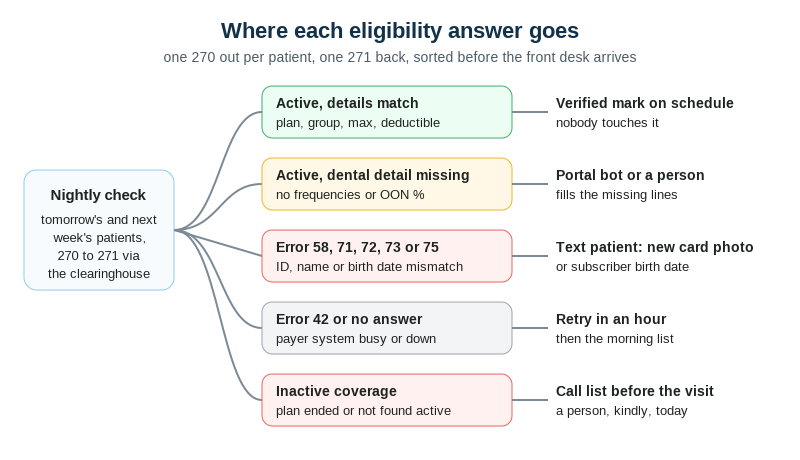
In words, the diagram shows: the nightly check sends one 270 per patient through the clearinghouse. Active answers that match the chart get a verified mark, and active answers without dental detail go to a portal bot or a person.
Codes 58, 71, 72, 73 or 75 trigger a text asking the patient for a new card photo or birth date. Code 42 or silence retries in an hour, and inactive coverage goes on a call list.
The AAA codes come from the X12 standard. This table uses the wording of the Blue Cross and Blue Shield of Texas 270/271 companion guide (February 2026); dental payers use the same code list.
| Code | Meaning | What the automation does |
|---|---|---|
| 42 | Unable to Respond at current time | Retries later; after two misses, puts the patient on the morning list |
| 50 / 51 | Provider Ineligible for Inquiries / Provider Not on File | Alerts the office manager: the NPI or enrollment needs fixing, not the patient |
| 58 | Invalid/Missing Date of Birth | Texts the patient for the subscriber’s birth date |
| 62 | Date of Service Not Within Allowable Inquiry Period | Re-sends closer to the visit |
| 71 | Patient Date of Birth Does Not Match That for the Patient on the Database | Compares chart and card; texts the patient if they differ |
| 72 | Invalid/Missing Subscriber/Insured ID | Asks for a new card photo; checks the prefix |
| 73 | Invalid/Missing Subscriber/Insured Name | Checks spelling, hyphenated and married names |
| 75 | Subscriber/Insured Not Found | Asks whether the plan changed; then a person calls |
The automation never tells a patient your insurance is invalid.
It asks a friendly question and lets a person handle anything that sounds like bad news.
Why do automated eligibility checks fail on patients who really are covered?
Automated eligibility checks fail on covered patients mostly because of small data mismatches, not because the coverage is gone.
These five causes come straight from payer and software documentation, and they rarely appear in the vendor guides we read for this question.
| Cause | Where it is documented | The fix in an automated setup |
|---|---|---|
| A dash in the group number | Open Dental’s Ins Batch Verify: Dashes or hyphens are considered (e.g. 123-567 will not match 123567). | Store the group number exactly as the payer returns it |
| Missing three-character prefix | BCBSTX: all 270 inquiries require the prefix before the member ID, with exceptions for Texas Medicaid and FEP | Have the card reader keep the prefix as part of the ID |
| A visit next month | BCBSTX answers future dates only through the last day of the current month; later dates get code 62 | Re-check month-end bookings on the 1st |
| Dependent checked under their own name | Codes 58, 71 and 73 point at birth date and name mismatches | Collect the subscriber’s name and birth date at booking; the card rarely shows a birth date |
| One service type per question | BCBSTX supports one service type code per 270; others fall back to code 30, plan coverage | Ask with code 35 (Dental Care) first, then a specific code like 38 (Orthodontics) only when needed |
The month-end rule catches offices every December. A batch run on November 30 for a December 2 visit may get code 62 back from a payer that follows it, so the job simply tries again on December 1.
The service type codes are public on X12’s service type code list: 23 Diagnostic Dental, 24 Periodontics, 25 Restorative, 26 Endodontics, 35 Dental Care, 36 Dental Crowns, 38 Orthodontics, 39 Prosthodontics, 40 Oral Surgery and 41 Preventive Dental.
Which dental software runs eligibility checks automatically?
Open Dental, Dentrix, Dentrix Ascend and Eaglesoft all offer electronic eligibility, and clearinghouses such as DentalXChange sit underneath them; how automatic each one is differs.
Most of those answers were ready in seconds. They only needed someone to ask the computer instead of the phone tree.
| Tool | Runs on its own? | What the maker says |
|---|---|---|
| Open Dental Ins Batch Verify | Yes, as a Scheduled Process | Patients whose insurance matches the 271 leave the Insurance Verification List; carriers must be marked Is trusted for real-time eligibility; known eligibility partners are ClaimConnect (DentalXChange), EDS and Trojan |
| Dentrix Eligibility Pro | Status shows on the schedule | Pulls from multiple payor sources, populates deductibles, maximums and co-insurance into coverage tables, color-coded “E” icons |
| Dentrix Ascend Eligibility Essentials and Pro | Yes, every three hours | Checks appointments within the lead days you set, and right after an appointment is booked unless the patient was verified in the past 30 days; before Eligibility Pro, batches ran nightly |
| Eaglesoft Real-Time Eligibility | On demand | A paid eServices option; responses saved to the patient’s account |
| DentalXChange Eligibility | Real time, one dashboard | Checks across hundreds of payers; plan benefits, deductible, co-insurance and limitations where the payer sends them |
Read the table as a map, not a ranking. The deciding question for your office is plain: does the tool run without a click, and does it write the answer where your team already looks?
A custom layer helps when the built-in batch stops at “trusted” carriers. It can read card photos, run the night batch through your clearinghouse, text patients about codes 58 to 75, and write results back through the practice software’s API.
Will dental eligibility answers get more detailed?
Yes, slowly: a 2025 CAQH CORE rule asks dental plans to return frequency limits, waiting periods, age limits and remaining maximums in the 271, if they want to be CORE-certified.
The CORE Eligibility & Benefits Data Content Rule vEB.2.1 was built with the National Dental EDI Council and the American Dental Association. When a 270 includes a dental procedure code, the plan must return frequency limitations for procedure codes that align with CORE-required dental categories of service, when applicable.
Today’s trust problem is real. A dental practice told CAQH for the 2024 Index:
When it comes to eligibility and benefits, I don’t have an automated tool that I can trust, so I don’t use it.
A dental practice, quoted in the 2024 CAQH Index
| Index year | Fully electronic (270/271) | Portal or phone menu | Manual |
|---|---|---|---|
| 2022 | 75% | 19% | 6% |
| 2023 | 79% | 16% | 5% |
| 2024 | 82% | 15% | 3% |
| 2025 | 80% | not in the executive report | not in the executive report |
The dip in the 2025 CAQH Index has a stated cause: after the 2024 Change Healthcare cyberattack, many organizations put system stability ahead of new automation. The same report says provider AI use is focused on administrative tasks such as eligibility checks.
Does a cash-pay or out-of-network dental office need eligibility checks?
Yes, a cash-pay or out-of-network dental office still benefits from eligibility checks, because patients ask what their plan will send back.
An “inactive” answer two days early saves an awkward reimbursement promise. An “active” answer starts the conversation about the plan’s out-of-network percentage, which usually needs the deeper breakdown.
What does HIPAA require for automated eligibility checks?
HIPAA requires the X12 270/271 standard for electronic eligibility questions, and a signed business associate agreement with every vendor that handles the patient data.
The HHS sample business associate agreement provisions show what that contract covers. It applies to the clearinghouse, the card-reading AI service and the texting service alike.
Why do the time numbers for eligibility checks disagree?
The time numbers disagree because vendors count the whole task, while CAQH counts only the labor of the transaction itself.
Vendor pages such as Intake.dental put a check at 12 to 20 minutes by portal and 30 to 45 minutes with a phone call and hold time. CAQH says electronic saves dental providers 8 minutes per check, without gathering information or follow-up.
Some vendor pages also quote CAQH’s medical figures as if they were dental. The dental row is $6.52 manual, $4.37 portal and $2.53 electronic; the higher numbers you may see belong to medical practices.
Our reading: CAQH is the floor and the vendor numbers are the busy-day ceiling. Your own count, taken over one week, beats both.
How do you switch on automated eligibility checks in one week?
Switch it on in shadow mode: the night batch runs while your team keeps checking by hand, and you compare the two for a week.
- Day 1: list your top ten payers and mark which ones answer electronically through your clearinghouse.
- Day 2: turn on the built-in batch (Open Dental Scheduled Processes, Dentrix Ascend’s batch job for insurance eligibility, or your clearinghouse’s) for those payers.
- Days 3 to 5: compare the batch answers with manual checks on a sample, and note every AAA code.
- Days 6 and 7: add the card-photo text at booking and the five-lane sorting; count minutes saved.
- Card photo collected at booking, front and back
- Subscriber name and birth date for every dependent
- Group numbers stored exactly as the payer writes them
- Month-end bookings re-checked on the 1st
- Signed business associate agreement with every vendor
If the batch clears most of your schedule by 7 a.m. after a week, keep it. If it only clears a few payers, that tells you where a portal step or a custom layer belongs.
Either way, your front desk gets to greet the first patient of the day instead of the payer’s hold music.
How we researched this
- Read the 2024 CAQH Index full report (dental cost per check by mode, time saved, volume, spend, adoption and the dental practice quote) and the 2025 CAQH Index executive report on November 28, 2026.
- Read the CAQH CORE Eligibility & Benefits Infrastructure Rule vEB.2.0 (response times) and the Data Content Rule vEB.2.1 (dental benefit limitations).
- Read the Blue Cross and Blue Shield of Texas 270/271 companion guide (February 2026) for AAA codes, date limits, prefixes and service type rules, and X12’s service type code list.
- Read Open Dental’s Electronic Eligibility and Benefits and Scheduled Processes pages, and the Dentrix, Dentrix Ascend Eligibility Essentials and Pro, Eaglesoft and DentalXChange eligibility pages.
- Searched Reddit and Dentaltown for front desk discussions of eligibility checks; no threads were reachable for us this time, so the practice view comes from the CAQH Index quote.
- Built the monthly cost table ourselves from CAQH’s dental per-check costs and stated assumptions.
- What we did not do: we did not run eligibility batches, test any vendor’s accuracy or measure verification times in a practice.
Turn on the night batch for your top payers, read the morning list for a week, and let the green marks show you what your team no longer has to dial.
Sources and further reading
- CAQH: 2024 CAQH Index Report, From Transactions to Trust (dental cost per transaction, time saved, adoption)
- CAQH: 2025 CAQH Index Executive Report
- CAQH CORE: Eligibility & Benefits (270/271) Infrastructure Rule vEB.2.0
- CAQH CORE: Eligibility & Benefits (270/271) Data Content Rule vEB.2.1 (2025)
- Blue Cross and Blue Shield of Texas: 270/271 Companion Guide v1.1 (February 2026)
- X12: Service Type Codes
- eCFR: 45 CFR Part 162 Subpart L, Eligibility for a Health Plan
- Open Dental Manual: Electronic Eligibility and Benefits
- Open Dental Manual: Scheduled Processes (Ins Batch Verify)
- Dentrix: Eligibility Pro
- Dentrix Ascend: Eligibility Essentials and Pro
- Patterson Eaglesoft: eServices eligibility
- DentalXChange: Eligibility
- Microsoft Learn: Document Intelligence health insurance card model
- HHS: Sample business associate agreement provisions
- Intake.dental: minutes per verification (vendor claim)
Questions and answers
Can I use AI to run eligibility checks for my dental practice automatically?
Yes. AI can read the insurance card photo a patient texts at booking, the system can send nightly 270 eligibility requests for every scheduled patient, and AI can sort the 271 answers and text patients when a code like 72 or 75 points to a data mismatch. Keep a person on inactive results and plans with missing dental detail, and use only vendors that sign a business associate agreement.
How far ahead should a dental office run eligibility checks?
One to four business days before the visit works for most offices; Dentrix Ascend’s default look-ahead was four business days, and its newer Eligibility Pro lets each location set its own lead days. Some payers, such as Blue Cross and Blue Shield of Texas, only answer future dates through the end of the current month, so re-check month-end bookings on the 1st.
How long does an electronic dental eligibility check take?
Seconds. Under the CAQH CORE infrastructure rule, a CORE-certified payer must return a real-time 271 within 20 seconds for 90 percent of requests, and batches sent by 9:00 p.m. Eastern come back by 7:00 a.m. Eastern the next business day. CAQH says going electronic saves dental providers 8 minutes per check.
What does code 75 mean on a dental eligibility response?
AAA code 75 means Subscriber/Insured Not Found: the payer could not match the member ID, name and birth date to a member. Check the ID prefix, the spelling of the name and whether the patient is a dependent checked under their own name, then ask the patient whether the plan changed.
Does an active eligibility result mean the dental claim will be paid?
No. Active only means the plan is in force on that date. Frequencies, waiting periods, age limits and remaining maximums decide payment, and many dental payers still leave those out of the 271. The 2025 CAQH CORE rule vEB.2.1 asks CORE-certified plans to send them when a dental procedure code is included.