How to Reduce Dental Clinic No-Shows With SMS (and Who to Call)
Hello, and a warm welcome to every front desk that has watched a clean hygiene chair sit empty at 9:15 in the morning.
Picture Thursday at 9:15 a.m., a hygienist standing by a clean, empty chair, and a short-notice list that nobody had time to call.
Most dental offices already send a reminder text, and patients still miss visits.
This guide shows how to reduce dental clinic no-shows with SMS by asking for a reply, reading every answer and calling only the patients who stay silent.
Short answer: To reduce dental clinic no-shows with SMS, send a short sequence instead of one reminder: a text at booking, a reminder 7 days out, a reply C to confirm
request 2 days out and a morning-of text. Rebook anyone who asks right away, and call everyone who has not replied within 24 hours. They are the high-risk group.
- Texts vs no reminder
- Attendance 78.6% vs 67.8% across 7 randomized trials, 5,841 people (Cochrane review, 2013)
- Reminders in orthodontics
- Patients with reminders were less likely to miss visits, risk ratio 0.39 (European Journal of Orthodontics, 2018)
- Texts vs voice calls, one dental trial
- No-shows 17.7% with texts vs 8.2% with voice messages, 318 families (JADA, 2011)
- FCC limit for health care texts
- 1 a day, 3 a week, 160 characters each (47 CFR 64.1200(a)(9)(iv))
- Open Dental texting price (US)
- $0.04 per outgoing text, eConfirmations $25 a month per location (Open Dental fees, checked Nov 28, 2026)
Why do dental patients still no-show after a reminder text?
Dental patients still no-show after a reminder text because a one-way reminder tells the office nothing: the patient may never read it, may mean to reschedule later, or may forget again by Thursday.
The gap is silence. A text that says See you Thursday at 9
gets no answer from the patient who plans to come and no answer from the patient who plans to skip. The front desk can’t tell them apart until the chair is empty.
Front desk teams describe the same loop on trade forums like Dentaltown: many patients won’t pick up a confirmation call but will text back. So the call list grows, voicemails pile up, and the reminders that went out don’t shorten it.
Here’s the catch: the fix is not more reminders. It is a reminder that asks for a reply, plus someone, or something, that acts on every reply and every silence.
Do SMS reminders really reduce dental no-shows?
Yes, SMS reminders reduce missed appointments compared with no reminder at all, but in dentistry the evidence is thinner and more mixed than most vendor pages suggest.
The strongest general evidence is the 2013 Cochrane review by Gurol-Urganci and colleagues. Across 7 randomized trials with 5,841 people, attendance was 78.6% with text reminders against 67.8% with none (risk ratio 1.14). Most of those trials were in medical clinics, not dental offices.
The same review found texts about as effective as phone call reminders, and in two studies the cost per attendance was 55% and 65% lower for texts than for calls.
The dental-only evidence comes from orthodontics. A 2018 systematic review in the European Journal of Orthodontics by Mohammed and colleagues pooled 14 randomized trials. Orthodontic patients who got reminders by SMS, mail, automated call or app were less likely to miss appointments (risk ratio 0.39).
Where do the dental studies on text reminders disagree?
The dental studies on text reminders disagree on one big point: whether a text works as well as a voice call. A randomized trial in Seattle found texts did worse, while an orthodontic practice found them slightly better, though not by a statistically significant margin.
| Study | Setting and size | What was compared | Result |
|---|---|---|---|
| Gurol-Urganci et al., Cochrane 2013 | 8 randomized trials, 6,615 people, mostly medical clinics | Text vs no reminder; text vs phone call | Attendance 78.6% with texts vs 67.8% with none; 80.3% with calls, about equal |
| Mohammed et al., Eur J Orthod 2018 | 14 randomized trials, 2,078 orthodontic patients | Any reminder (SMS, mail, automated call, app) vs none | Fewer missed appointments with reminders, risk ratio 0.39 |
| Nelson et al., JADA 2011 | University of Washington pediatric dentistry clinic, 318 families, randomized | Text vs voice message | No-shows 17.7% with texts vs 8.2% with voice |
| Prasad and Anand, Int Dent J 2012 | Dental college clinics in Uttar Pradesh, India, 206 patients | Text vs no reminder | On-time attendance 79.2% vs 35.5% |
| Wegrzyniak et al., Angle Orthod 2018 | Private orthodontic office, 1,193 appointments, retrospective | Patient-chosen text, email or phone | No-shows 1.90% text, 2.68% email, 3.49% phone (not significant) |
| Stephenson, Univ. of Kentucky 2016 | Pediatrics and internal medicine clinic, 577 appointments (not dental) | Patients who confirmed by text vs those who didn’t | 82% vs 58% attended |
The Seattle trial’s authors drew a careful conclusion. Texts were not as effective as voice reminders for patients in a dental school pediatric dentistry clinic
, they wrote, and younger caregivers missed more often.
The orthodontic practice, where patients chose their own channel, landed on the same practical advice: let patients pick text, email or a call. Read together, the studies say a text works best as the first touch, not the only one.
What none of these studies tested is a modern two-way sequence that rebooks by text and calls the silent patients. That design rests on the reply pattern in the next section.
Which dental patients are most likely to no-show?
The patients most likely to no-show are the ones who don’t answer a confirmation text. In the Kentucky clinic pilot, 42% of non-responders missed their visit, against 18% of patients who confirmed.
That pilot by Cameron Stephenson at the University of Kentucky (2016) texted patients for 577 routine appointments at a pediatrics and internal medicine practice. 39% replied to confirm and 61% did not. It is a medical clinic, so treat the numbers as a pattern, not a dental benchmark.
| Group | Patients | Attended | No-shows | Share of all no-shows |
|---|---|---|---|---|
| Replied to confirm | 39 | 32.0 (82%) | 7.0 | 21.5% |
| Did not reply | 61 | 35.4 (58%) | 25.6 | 78.5% |
| All patients texted | 100 | 67.4 | 32.6 | 100% |
About 4 of every 5 no-shows came from the silent group. That is the case for text-first confirmation: the texts sort the schedule, and the front desk spends its calls where the risk actually is.
The pilot clinic’s overall no-show rate was high. In the orthodontic office above it was 2.43%. Plug in your own rate, but the shape usually holds: silence is the warning sign.
What text sequence reduces dental no-shows?
A four-text sequence works well for dental appointments: a save-the-date at booking, a reminder 7 days before, a reply C to confirm
request 2 days before, and a short text the morning of the visit.
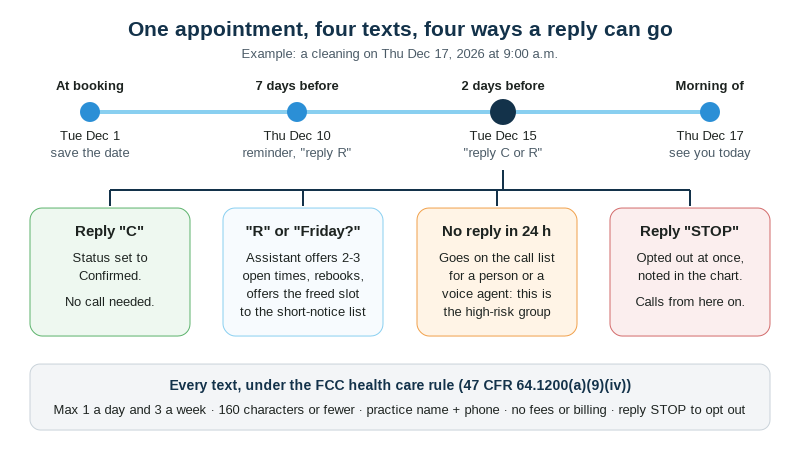
In words, the diagram follows one cleaning on Thursday, December 17, 2026 at 9:00 a.m.:
- Text 1, at booking on Tuesday, December 1: save the date.
- Text 2, 7 days before on Thursday, December 10: a reminder that offers
reply R to reschedule.
- Text 3, 2 days before on Tuesday, December 15:
reply C to confirm or R to reschedule.
- Text 4, the morning of Thursday, December 17: see you today, with the address.
- Reply C: the appointment is marked Confirmed and nobody calls.
- Reply R or “Friday?”: an assistant offers 2 or 3 open times, rebooks, and offers the freed slot to the short-notice list.
- No reply within 24 hours: the patient goes on the call list for a person or a voice agent.
- Reply STOP: texting ends at once, the opt-out is noted, and calls take over.
The 2-day request is the one that matters most. It leaves a full working day to fill the slot, and the 7-day text gives early movers a painless way out.
Open Dental’s own rules add one wrinkle: eConfirmation messages are not sent for appointments created same day
, per its Edit Rule manual page. Same-day bookings need only the morning-of text anyway.
What happens when a patient replies with more than “C”?
What happens to a free-text reply depends on your software. Open Dental only recognizes the exact confirmation code, Weave says it reads plain replies like “Sounds good,” and anything about rescheduling still needs someone to act.
The Open Dental manual is blunt: The patient must only reply with the confirm code.
It adds that any additional text causes Open Dental not to recognize the response.
So C see you then!
lands in the texting inbox, and the appointment stays unconfirmed.
Weave says a reply like “Sounds good” is automatically recognized as a confirmation, while “I’ll be busy” flags staff to follow up. Dentrix Patient Engage says patient responses flow directly into Dentrix.
| Tool | ”C” or a link | ”Sounds good” or C see you then! | Can I come Friday instead? |
|---|---|---|---|
| Open Dental eConfirmations | Sets the Confirmed status | Not recognized; waits in the inbox | Waits for staff |
| Weave reminders | Confirms | Recognized as a confirmation, per Weave | Flags staff to follow up |
| Dentrix Patient Engage | Confirms; responses flow into Dentrix | Not specified on the product page | Patients can reschedule; details not public |
| AI SMS assistant on top | Writes Confirmed back | Reads intent and confirms | Offers open times and rebooks |
The last column is where the hours hide. Every “Friday instead?” is a slot about to open and a patient willing to keep their care. If it sits in an inbox until afternoon, both chances shrink.
How does an AI SMS assistant reduce dental no-shows?
An AI SMS assistant reduces dental no-shows by answering every reply within minutes, rebooking patients who can’t make it, offering the freed slot to the short-notice list, and handing the front desk only the silent patients and the questions that need a person.
A confirmation text is really a question. The answers sort your schedule for you, and the silence tells you exactly who to call.
In Open Dental, the connection is the official API. Its appointments API includes GET Slots for open times, PUT Confirm, which updates appointment.Confirmed for a specified appointment
, and GET ASAP for the short-notice list.
- Trigger: a patient texts back, or 24 hours pass after the 2-day request with no answer.
- Read: the assistant reads the reply and the appointment: date, provider, visit type and length.
- Confirm: a yes in any wording sets the appointment to Confirmed through the API.
- Rebook: a “can’t make it” gets 2 or 3 open times of the right length; the patient’s pick is booked and the old slot freed.
- Refill: the freed slot is offered to patients on the ASAP list. Open Dental’s own Web Sched ASAP texts them a link to claim it.
- Call: silent patients go to a call list for a person, or to a voice agent that confirms or rebooks by phone.
- Tell: the front desk gets a short morning summary: confirmed, rebooked, refilled, still unreached, and anything handed to a person.
What stays human: pain, swelling or any clinical question, cost and payment questions, an unhappy patient, and anyone who asks for a person. Those land on a short list with the conversation attached.
For Dentrix offices the same layer connects through Henry Schein One’s authorized integration program. Our guide to the Dentrix automated recall system explains that authorized vendor list.
How much does text-first confirmation cost compared with calling every patient?
Text-first confirmation costs less than calling every patient, even after texting fees. In our example of 400 appointments a month, it saves about 8 to 15 staff hours, depending on how many patients reply.
| Approach | Calls made | Staff hours | Staff cost at $22/hour | Texting fees | Monthly total |
|---|---|---|---|---|---|
| Call every patient | 400 | 20.0 | $440 | $0 | $440 |
| Text-first, 39% confirm (Kentucky pilot rate) | 244 | 12.2 | $268 | $94 | $362 |
| Text-first, 60% confirm | 160 | 8.0 | $176 | $94 | $270 |
| Text-first, 75% confirm | 100 | 5.0 | $110 | $94 | $204 |
Assumptions: 3 minutes per confirmation call including a voicemail and a note, $22 an hour as a rough loaded front desk cost, and up to 4 texts per appointment. Fees use Open Dental’s published US prices: $0.04 per outgoing text, eConfirmations at $25 and an assigned texting number at $5 a month per location.
Open Dental lists eReminders as free for customers on support and incoming texts at no cost. An AI assistant’s own fee sits on top; it is quoted per practice, so ask for it in writing.
The bigger number is not in the table: each confirmed reschedule two days out is a chair hour you can still fill. Use your own hourly production figure to see what one saved slot a week is worth.
What FCC and HIPAA rules apply to dental no-show texts?
Dental no-show texts fall under the FCC’s health care exemption for automated messages and under HIPAA, which treats appointment reminders as part of treatment.
The FCC rule at 47 CFR 64.1200(a)(9)(iv) covers health care texts and calls only if every condition is met:
- Sent only to the wireless number the patient gave you.
- The practice’s name and contact information in every message.
- Purposes such as appointment reminders only, with no advertising, billing, debt collection or other financial content.
- 160 characters or fewer per text, and about one minute or less per voice call.
- At most 1 message a day and 3 a week per patient, counting texts and calls together.
- An easy opt-out (for texts, replying STOP), honored immediately.
- The message is not charged to the patient or counted against their plan.
Here’s the gap most guides miss: the limit counts automated calls and texts together. In the December example, the 2-day text, a voice agent’s no-reply call and the morning-of text land in one week. That is exactly 3, so nothing else automated can go out that week.
On HIPAA, HHS FAQ 286 answers plainly: Yes, appointment reminders are considered part of treatment of an individual and, therefore, can be made without an authorization.
Any vendor that handles the replies still needs a signed business associate agreement.
Should a cash-pay dental clinic put its no-show policy or fee in a text?
No. A cash-pay or out-of-network dental clinic should keep its no-show texts about the visit only, and put its no-show policy and any fee in the intake paperwork and the booking email, not in a warning text.
The reason is the FCC condition above: health care texts under the exemption carry no billing or other financial content. A line like a $75 fee applies to missed visits
turns a reminder into a financial message.
Cash-pay offices often lean on deposits or fees, and those policies are a business choice. The text’s job is simpler: make confirming and rescheduling so easy that nobody needs the fee.
A cash-pay patient usually gets no nudges from an insurance plan either, so your sequence is often the only reminder they see. That makes a fast, friendly Friday instead? Sure, 2:30 or 4:00?
worth more than a stern warning.
What should you check before you switch on no-show texts?
Check consent, contact details, the reply handling and the call list first, because a confirmation sequence repeats every gap in them on every appointment.
- The intake form asks for consent to texts about appointments and care, and records the mobile number the patient gave.
- Mobile numbers are marked as wireless; landlines get calls or email instead.
- Every template is 160 characters or fewer and names the practice and its phone number.
- No template mentions fees, balances, offers or promotions.
- The sequence sends at most 1 automated message a day and 3 a week, voice-agent calls included.
- Free-text replies are read within minutes during business hours, by a person or an assistant.
- Rebooking offers only slots of the right length and provider.
- The short-notice (ASAP) list is current, so freed slots have somewhere to go.
- Every texting, voice and AI vendor that sees patient data has signed a business associate agreement.
- One named person owns the call list for silent patients and clears it every afternoon.
How do you start text-first confirmations in the first month?
Start text-first confirmations by turning on the confirmation request in week 1, adding reply handling in week 2, and only then adding calls or a voice agent for silent patients.
- Week 1: switch on the 2-day “reply C” request and the morning-of text, read every reply by hand, and start posting the ADA tracking codes D9986 (missed appointment) and D9987 (cancelled appointment), as the Dentrix Enterprise blog suggests, so no-shows show up in a report.
- Week 2: add the booking and 7-day texts, plus an assistant or a set routine for “R” and free-text replies.
- Week 3: call every patient who stayed silent for 24 hours, and note how many of them actually come in.
- Week 4: count confirmed, rebooked, refilled, silent and no-show visits, plus staff minutes, then decide whether a voice agent should take the silent list.
After a month you will know your own reply rate and your own silent-group no-show rate. Those two numbers tell you exactly where the next hour of front desk time should go.
And Thursday’s 9 a.m. chair either has the patient who confirmed, or the patient from the short-notice list who got the slot two days ago.
How we researched this
- Read the abstracts of the Cochrane review (Gurol-Urganci et al., 2013), Nelson et al. (JADA, 2011) and Prasad and Anand (International Dental Journal, 2012) through NCBI’s PubMed E-utilities, and the Wegrzyniak et al. full text on PMC, on November 28, 2026.
- Searched PubMed for dental or orthodontic studies of text reminders and attendance: 22 records matched “randomized”; we read the titles and the relevant abstracts, including a summary of the Mohammed et al. orthodontic review (Evidence-Based Dentistry, 2019).
- Read the University of Kentucky pilot (Stephenson, 2016) and did the no-show share arithmetic ourselves from its published rates.
- Read Open Dental’s eConfirmations, Edit Rule, Appointment Texts, Web Sched ASAP, appointments API and fee pages, Weave’s and Dentrix Patient Engage’s product pages, the FCC rule text at Cornell LII, HHS FAQ 286 and Twilio’s HIPAA page.
- Looked for front desk discussions on Reddit and Dentaltown; Reddit threads were not reachable for us this time, so the trade view comes from Dentaltown articles.
- Built the cost table from stated assumptions and Open Dental’s published US prices.
- What we did not do: we did not run a texting campaign, test any vendor’s reply reading, or measure no-show rates in a practice.
Start with the two-day request, read every reply the same morning, and let your calls go only where they are needed.
Sources and further reading
- Gurol-Urganci I et al. Mobile phone messaging reminders for attendance at healthcare appointments. Cochrane Database of Systematic Reviews, 2013
- Mohammed H et al. Reminders improve oral hygiene and adherence to appointments in orthodontic patients: a systematic review and meta-analysis. European Journal of Orthodontics, 2018
- Nelson TM et al. Assessing the effectiveness of text messages as appointment reminders in a pediatric dental setting. JADA, 2011
- Prasad S, Anand R. Use of mobile telephone short message service as a reminder: the effect on patient attendance. International Dental Journal, 2012
- Wegrzyniak LM et al. Measuring the effectiveness of patient-chosen reminder methods in a private orthodontic practice. Angle Orthodontist, 2018
- Stephenson CM. Text Messaging Appointment Reminders to Reduce No-Shows: A Pilot Study. University of Kentucky, 2016
- Open Dental Manual: eConfirmations
- Open Dental Manual: Edit Rule (timing and confirm code)
- Open Dental Manual: Appointment Texts (patient replies and opt-outs)
- Open Dental Manual: Web Sched ASAP
- Open Dental API: Appointments
- Open Dental: Fees for Software, Support, and Services
- Weave: Dental Appointment Reminder Software
- Dentrix: Patient Engage Suite
- Dentaltown: Confirmation Calls — What You Say Is Not as Important as What You Hear
- 47 CFR 64.1200: FCC rules for automated calls and texts, health care messages
- HHS HIPAA FAQ 286: Are appointment reminders allowed without authorization?
- Twilio: HIPAA and the Business Associate Addendum
- Dentrix Enterprise Blog: Why You Should Document Missed Appointments (D9986 and D9987)
Questions and answers
Can I use AI to reduce dental clinic no-shows by text?
Yes. An AI SMS assistant can send the confirmation sequence, read replies in any wording, confirm or rebook through your practice software’s authorized API, offer freed slots to the short-notice list and hand silent patients to a person or a voice agent. Use a vendor that signs a business associate agreement, and keep clinical and cost questions with your team.
How many days before a dental appointment should you send a confirmation text?
Two days before works well for the confirmation request, because it leaves a full working day to refill the slot. Add a reminder 7 days out and a short text the morning of the visit, and keep the total within the FCC limit of 1 automated message a day and 3 a week.
Are text reminders better than phone calls for dental patients?
Not always. A Cochrane review of mostly medical trials found texts about as effective as calls and cheaper, but a randomized trial at the University of Washington pediatric dental clinic found 17.7% no-shows with texts against 8.2% with voice messages. Texting first and calling non-responders uses both.
Does Open Dental recognize a reply like "C see you then"?
No. Open Dental’s manual says the patient must reply with only the confirm code, and any additional text causes Open Dental not to recognize the response. Those replies wait in the texting inbox, so a person or an assistant connected through the Open Dental API has to read them and set the Confirmed status.
Can a dental office mention its no-show fee in a reminder text?
It is safer not to. The FCC health care exemption at 47 CFR 64.1200(a)(9)(iv) excludes billing and other financial content from these automated texts. Put the cancellation or no-show fee policy in the intake paperwork and the booking email, and keep the text about the visit.