Dental and Cash-Pay Clinic Automation in Austin, Texas (2026)
Every Austin office I read about says the city keeps growing, and none of their pages say who answers the newcomer’s first text.
Every Austin dentist I read about says the city keeps filling up, and almost none of their websites explain what happens at the front desk when a newcomer asks, do you take my plan?
I read the Census growth tables, the Bureau of Labor Statistics wage release for the Austin area and the insurance pages of three Austin practices so you don’t have to.
Three things stood out: the metro added about 147 people a day, health care workers are a smaller share of its jobs than in the country as a whole, and even careful office pages disagree with themselves.
Short answer: Austin dental and cash-pay clinics can automate the growth that lands on the front desk: a text assistant collects the insurance card photo, a reader pulls payer and member ID for a person to confirm, an estimate goes out in writing, and the booking is saved. DHMO patients, costs and pain stay human.
- Place
- Austin-Round Rock-San Marcos metro, Texas
- Growth
- 2,620,945 people on July 1, 2025, up 53,796 in a year
- The pain
- Hold-music benefit checks and slow replies to newcomers
- The fix
- Card photo reading, estimates by text, SMS scheduling
Why is Austin’s growth a front desk problem for dental and specialty clinics?
Austin’s growth is a front desk problem because every net new resident is a possible new patient who has not yet chosen a dentist, and the Austin metro gained 53,796 people in the year to July 1, 2025.
The Census Bureau’s Vintage 2025 release (March 26, 2026) lists the Austin-Round Rock-San Marcos metro at 2,620,945 people. Austin was the fastest-growing of the 25 largest US metros, at about 2.1 percent.
| Measure | Value | Source or method |
|---|---|---|
| Population, July 1, 2025 | 2,620,945 | Census Bureau, March 26, 2026 |
| Gain, July 2024 to July 2025 | 53,796 | Same table |
| Percent growth in the year | about 2.1% | 53,796 divided by 2,567,149 |
| Net new residents per day | about 147 | 53,796 divided by 365 |
| Growth since April 2020 | 337,554, about 14.8% | Against the 2020 estimates base of 2,283,391 |
In short: about 147 more people a day, and some share of them need a dentist before they have found one.
What does a new Austin resident with an out-of-network plan ask first?
A new resident with an out-of-network or cash-pay situation asks three things before booking: whether you take their plan, what they will pay, and how soon they can be seen.
Each of those is an answer your office already has, but only after someone reads a card, calls a payer and checks a schedule. That sequence is what makes the first reply slow.
The fix is not a chatbot that guesses. It is a short text exchange that gets the card photo on day one.
The person who confirms the data then has everything in one place. We cover the reading step in extracting insurance info from a photo of a card and the lookup behind it in automated dental insurance verification.
What do Austin out-of-network dental offices tell patients about insurance?
Austin offices that stay out of network tell patients the same three things: payment is theirs, the office can file the claim, and some plans never pay.
Lake Travis Dentistry calls itself an out-of-network practice and says that is a deliberate choice
. It does not accept HMO, Medicaid or CHIP plans, and says an advance estimate from the insurer can take a few weeks.
Austin City Dental’s financial policy says Payment in full is required at each appointment.
It can file out-of-network claims, but If you have a DHMO or DMO dental insurance plan, we are unable to file a claim.
| Practice | Network stance | Stated detail that automation must carry |
|---|---|---|
| Lake Travis Dentistry | Out-of-network by choice | No HMO, Medicaid or CHIP; membership $457 a year; financing through CareCredit, Cherry and Sunbit |
| Austin City Dental | Fee for service | Payment in full each visit; files out-of-network claims; no claims for DHMO or DMO plans |
| Austin Lifetime Dental | Non-contracted with all plans, per its page | Each office runs its own in-house membership plan |
In one line: each office has a few rules a patient needs on day one, and a text assistant can repeat them correctly every time.
Where do Austin office pages disagree with themselves?
Austin office pages sometimes disagree with themselves, and an assistant that reads them will repeat the wrong version.
The Lake Travis page says the membership gets 20 percent off other services in one place and 10 percent in its FAQ. It also says the office files your primary insurance in one sentence and both primary and secondary in another.
That is not a criticism of one office; most small practice sites grow by pasting. It is the reason an assistant needs one approved fact sheet: the price, the discount, what you file, who you do not take. Fix the page, then let the assistant read it.
The payer side has the same gap. Of the pages we read, only Lake Travis mentions timing for an insurer’s advance estimate, and it says it can take a few weeks.
How does automation take a new Austin patient from first text to a booked visit?
Automation takes a new patient from first text to a booked visit in five steps, with a person confirming the insurance data before anything is sent to a payer.
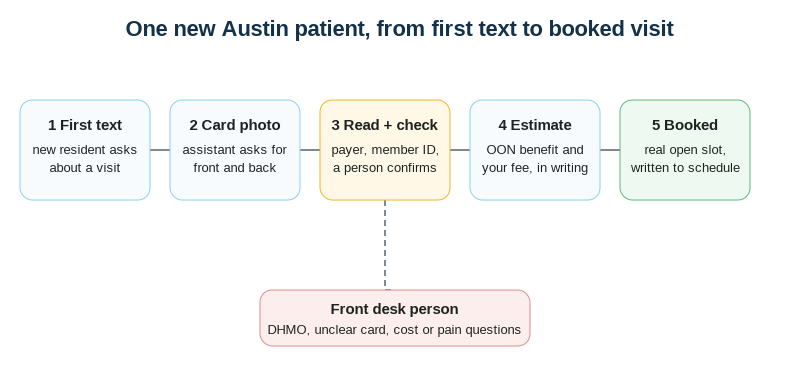
The data in the picture, as text: the patient texts or calls; the assistant asks for a photo of the card front and back; a reader pulls payer, member ID and group number; a person confirms them.
Then an estimate of the out-of-network benefit and your own fee goes back in writing, and the patient picks one of 2 or 3 real open slots.
- Trigger. A text or missed call from a number you do not have on file.
- Read. A vision model reads the card photo; a blurry one gets a polite retake request.
- Check. Staff confirm the fields, then the eligibility request or benefits call goes out.
- Write. The estimate, the answer and a note are saved to the chart through a connection your software maker allows.
- Tell. The patient gets the estimate and the slots; a person gets only the exceptions.
How much front desk time do out-of-network benefit checks take in Austin?
In our example, 25 new out-of-network patients a week take about 36 front desk hours a month by hand and about 5 hours when the card is read and checked by a person.
The reading and the texting are the easy part. One true fact sheet and a person who confirms the card are what make an estimate safe to send.
| New patients a week | Manual hours a month (20 min each) | Cost at $22/hour | Hours with card reading (3 min each) |
|---|---|---|---|
| 10 | 14.4 | $318 | 2.2 |
| 25 | 36.1 | $794 | 5.4 |
| 50 | 72.2 | $1,588 | 10.8 |
Assumptions: 20 minutes of desk time per benefit check including hold, 3 minutes for a person to confirm a read card, $22 an hour as a rough loaded desk cost and 4.33 weeks a month. These are our assumptions, not measurements from an office. Software and texting fees are extra.
Swap in your own count. If your desk spends 5 minutes, the gap shrinks; if it spends 40, it doubles.
Which patients and questions should a person keep in Austin?
A person should keep DHMO and DMO patients, cost disputes, pain or swelling, and anyone who asks for a human.
A DHMO patient cannot get out-of-network benefits filed at an office like Austin City Dental, so the honest first text says so before a visit is booked. A cost question at a cash-pay office is a conversation about money and trust.
Health care roles are also thin on the ground here. The BLS release for the Austin area (August 13, 2026, May 2025 data) puts healthcare practitioners and technical occupations at 4.8 percent of local employment, against 6.3 percent nationally.
That is a share of jobs, not a headcount of dentists, but it says why the desk you have is worth protecting from hold music.
What text and privacy rules apply to a Texas dental office?
A Texas dental office sending automated texts follows the federal FCC health care rule and HIPAA, and a vendor that handles replies needs a business associate agreement.
The rule at 47 CFR 64.1200 lets health care providers send appointment reminders to the number the patient gave, at most 1 message a day and 3 a week, with an easy opt-out. A promotion is a different message with a different rule.
The HHS business associate guidance covers the vendor. We did not research Texas statutes beyond these federal rules, so ask your attorney about any state-specific text or privacy rule.
Where should an Austin dental office start with automation?
An Austin dental office should start with the first reply and the card photo, because that is where a growing city’s new patients wait longest.
| Step | Effort | What changes first |
|---|---|---|
| 1. One approved fact sheet | An afternoon | Every reply says the same true thing |
| 2. Card photo by text | A week | Benefit checks start before the visit |
| 3. Estimate by text | A few weeks | The patient sees a number first |
| 4. Reactivation of dormant patients | After the above | Old charts become booked chairs, see reactivation texts |
One caution on local supply. A Dentagraphics guide counts 3,247 residents per general practice in the metro and 5,102 in Hays County, against a US average of 3,853, but it does not state the years of its data. Treat it as a rough picture, not a count.
How we researched this
- Read the Census Bureau’s Vintage 2025 metro press release and Table 10 figures for Austin-Round Rock-San Marcos on November 28, 2026, and did the percent and per-day arithmetic ourselves.
- Read the BLS Austin-Round Rock-San Marcos occupational employment and wages release (August 13, 2026) for the health care share of employment.
- Read the insurance and financial policy pages of Lake Travis Dentistry and Austin City Dental, and noted where one page disagrees with itself. The Austin Lifetime Dental row comes from a search summary of its insurance page, which we did not open in full.
- Read 47 CFR 64.1200 and the HHS business associate guidance.
- Read the Dentagraphics Austin guide for practice counts; it does not give years, so we flagged it.
- Could not retrieve BLS dentist-level counts for Austin or any Reddit threads this time.
- Built the cost table from stated assumptions.
- What we did not do: we did not run any benefit checks, test a vendor or measure a front desk in Austin.
Start with the first reply and the card photo, check every read for a month, and count how many new patients booked before you called them.
Sources and further reading
- Census Bureau: Vintage 2025 metro, micro and county population estimates (March 26, 2026)
- BLS: Occupational Employment and Wages in Austin-Round Rock-San Marcos, May 2025
- Lake Travis Dentistry: Insurance and financing
- Austin City Dental: Financial policy
- Austin Lifetime Dental: Dental insurance
- Dentagraphics: Starting a dental practice in Austin (years of data not stated)
- 47 CFR 64.1200: FCC rules for automated calls and texts
- HHS: Business associates
Questions and answers
Can I use AI to automate a dental or cash-pay clinic in Austin, Texas?
Yes, the repetitive front desk parts. AI can text new patients, read an insurance card photo, prepare an out-of-network benefit estimate for a person to confirm, answer scheduling replies and write the booking to your software. Use a vendor that signs a business associate agreement, and keep DHMO, cost and clinical questions with your staff.
Why is Austin a good market for out-of-network dental clinics?
Because it is growing fast. The Census Bureau’s Vintage 2025 estimates put the Austin metro at 2,620,945 people, up 53,796 in a year, the fastest rate among the 25 largest US metros. More newcomers means more patients choosing a dentist and more cards to check.
How many new people move to Austin each day?
About 147 net new residents a day. We divided the Census Bureau’s 53,796 gain for July 2024 to July 2025 by 365. That is net growth, after people leaving, not the number of people arriving.
Do out-of-network offices in Austin still file insurance claims?
Some do. Austin City Dental says it can file out-of-network claims but not for DHMO or DMO plans, and requires payment in full at each visit. Lake Travis Dentistry says it files claims for patients and does not take HMO, Medicaid or CHIP plans. Check each office’s own policy.
What can automated texts say to patients under the FCC health care rule?
Appointment reminders and similar health care messages to the number the patient gave, at most 1 a day and 3 a week, 160 characters or fewer, with your name, contact details and an easy opt-out. No advertising or billing in them. The text is in 47 CFR 64.1200.