AI Receptionist for Electrical Contractors: Catch Calls From the Ladder
Hello to every electrician whose phone always seems to ring when both hands are inside a panel.
Picture the phone buzzing in your pocket while you’re halfway into a 200 amp panel, and a receptionist picking it up on the second ring.
Electricians miss calls for a simple reason: both hands are busy, often on something live.
The caller doesn’t know that, so they dial the next shop on the list.
An AI receptionist answers for you, asks the right electrical questions, and books the job or wakes the right person.
Short answer: An AI receptionist for electrical contractors is a voice agent that answers every call in about two rings, asks whether there is smoke, sparks or a burning smell, sorts the call into danger, urgent or routine, books routine work into ServiceTitan or Jobber, escalates no-power emergencies to your on-call electrician, and texts you a summary.
- What it answers
- Overflow calls while you work, lunch and after-hours calls, and weekends
- What it decides by itself
- Only what your written rules allow: book a routine slot, run the emergency ladder, or take a message
- What never waits
- Smoke, sparks, a burning smell or a downed line: the caller is told to get out and call 911 or the utility, and a person is connected
- Ready-made options
- Jobber Receptionist, Housecall Pro CSR AI, ServiceTitan’s AI Voice Agent (residential shops only), or a custom line on Twilio
What is an AI receptionist for electrical contractors?
An AI receptionist for electrical contractors is software that picks up your business line, talks with the caller in plain speech, and does what a good office person would do with the call.
It turns the caller’s words into text, works out what they need, and answers back in a natural voice. Then it writes the result where your team will see it: a booked job, a new request, or an alert on the on-call phone.
The difference from a voicemail box is the outcome. Voicemail collects a problem for later. An AI receptionist ends the call with a time, a next step, or a person on the line.
Why do electricians miss so many calls?
Electricians miss calls because the work happens on ladders, in attics, in crawlspaces and inside energized gear, where grabbing a phone is slow or unsafe.
Contractors have said this plainly for years. In a May 2008 thread on the Mike Holt forums, an Indianapolis electrician explained that if I am with a customer I am not going to answer my phone
, and promised callers a callback within 15 minutes instead.
Another contractor in the same thread passed on a Washington, DC contractor’s rule: after the 3rd ring they are calling the competition.
The same poster warned that a friend’s answering service often let calls ring 7 to 10 times before picking up.
The problem hasn’t gone away. In a February 2024 Mike Holt thread on call answering services, an electrical contractor wrote that after two swamped weeks he had Missed two job because I got back to them to late.
Replies in that thread made a sharp point: answering only helps if the caller hears a real time. Telling someone “three weeks” can lose the job just as surely as voicemail. That’s why a good AI receptionist books an actual slot instead of taking a message.
How much are unanswered calls worth to an electrical shop?
For a small electrical shop, the gap between booking 30% and 58% of calls can be worth thousands of dollars a month, even counting off-hours calls alone.
ServiceTitan’s Call Trends in the Trades data (May 1, 2025 to July 31, 2026) says trades businesses get 10.7% to 12.1% of their calls outside normal business hours
. It also found shops with more than 50 technicians booked 58% of calls, against 30% for shops with 10 or fewer.
| Inbound calls a month | Off-hours calls at 11% | Jobs at 30% booked | Jobs at 58% booked | Extra jobs | At a $500 average ticket |
|---|---|---|---|---|---|
| 200 | 22 | 6.6 | 12.8 | 6.2 | $3,080 |
| 400 | 44 | 13.2 | 25.5 | 12.3 | $6,160 |
| 800 | 88 | 26.4 | 51.0 | 24.6 | $12,320 |
Assumptions: 11% sits inside ServiceTitan’s 10.7% to 12.1% range. The 30% and 58% are ServiceTitan’s booking rates by shop size for all calls, not off-hours calls only. The $500 ticket is a round example; put in your own average.
ServiceTitan itself says the data comes from a de-identified sample of its customers and should not be read as representative of specific trades. Treat the table as a way to size your own leak, then check it against your call log.
Where do the after-hours call numbers disagree?
The after-hours call numbers disagree by a factor of two or three, depending on whether they come from measured call logs or from marketing roundups.
- Measured, all trades: ServiceTitan’s call data puts off-hours calls at 10.7% to 12.1%, nearly 1 in 8.
- Measured, HVAC only: ServiceTitan’s State of the Trades HVAC data runs from 9.8% (October) to 14.1% (June).
- Often repeated: 25% to 40% for the trades. An AInora statistics roundup says that figure
is off by roughly two and a half to three times.
- Electrical alone: no measured figure was published that we could find. The same roundup lists ServiceTitan’s off-hours share for electrical as “Not published”.
So nobody can honestly tell you an electrical shop’s after-hours share from the outside. Your own phone log can, in about ten minutes. Count calls outside your hours last month, then count how many became jobs.
What should an AI receptionist ask an electrical caller?
An AI receptionist should ask an electrical caller four things, in this order: is anything dangerous, how much power is out, who the customer is, and where to send someone.
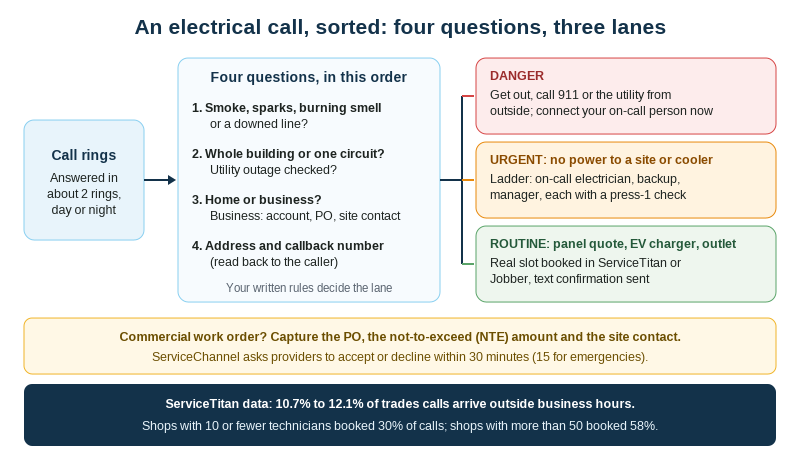
- Danger first.
Is there smoke, sparks, a burning or rubbery smell, or a power line down?
A yes ends the intake and moves the call into the danger lane. - How much is out.
Is the whole building dark, or one room or circuit? Are the neighbors out too?
A street-wide outage is the utility’s job, and saying so kindly saves a truck roll. - Who it is. Home or business? For a business, the account name, PO number, site contact and how to get in after hours.
- Where and how to reach them. The service address and a callback number, read back to the caller so a wrong digit gets caught.
The diagram’s text, for anyone who can’t see it: four questions lead to three lanes. Danger means get out and call 911 or the utility, then a person is connected. Urgent means the escalation ladder. Routine means a booked slot and a text.
How does an AI receptionist tell an electrical emergency from a routine call?
An AI receptionist tells an electrical emergency from a routine call by matching what the caller describes against the rules you write, not by guessing.
| What the caller says | Lane | What the line does |
|---|---|---|
| Smoke, sparks, burning smell, a hot or melting panel, a line down | Danger | Tells them to leave and call 911 or the utility from outside, then connects your on-call person at once |
| Whole building out, neighbors have power | Urgent | Runs the on-call ladder and gives the caller an honest arrival window |
| A restaurant, store or walk-in cooler without power | Urgent | Same ladder, and marks it commercial with the site contact |
| Breaker keeps tripping, no heat or smell | Next day | Books the first slot and says not to keep resetting it |
| Panel upgrade, EV charger, lighting, a quote | Routine | Books an estimate visit and texts a confirmation |
Write the rules in your own words and keep the list short. An AI model follows a clear list well; it follows “use your judgment” badly.
How is a commercial electrical call different from a residential one?
A commercial electrical call usually comes from a facility or property manager, on an account, with a purchase order, a spending limit and a deadline to respond.
Here’s the kind truth about a missed caller: they aren’t impatient with you, they’re standing in a dark kitchen or a closed store and just need to hear what happens next. A calm voice and a real time is what keeps them from dialing the next shop.
Facility platforms make that deadline explicit. ServiceChannel’s Trade Partner Guide says each work order lists the scope, location, the customer’s required SLA and a not-to-exceed (NTE) amount.
The same guide asks providers to Accept or decline within 30 minutes
, and faster for emergencies, (within 15 minutes for emergencies).
If a fix will go over the NTE, the guide says to call for approval before proceeding with the work.
Here’s the gap most AI receptionist pages skip: those work orders arrive in a portal or by email, not by phone. A phone agent alone won’t see them.
- Calls from commercial accounts: match the caller ID to the account, capture the PO, NTE and site contact, and flag it commercial.
- Portal work orders: a small watcher reads the new-work-order email and pings the on-call phone, so the 15-minute clock isn’t missed.
- Site access: after-hours gate codes, loading docks and escort rules belong in the intake, not in a callback.
Which AI receptionists work with ServiceTitan, Jobber and Housecall Pro?
Jobber, Housecall Pro and ServiceTitan each sell their own AI receptionist, but ServiceTitan’s is built for residential shops, so commercial electrical contractors need to check fit first.
| Option | Who it’s for | Books into | Emergencies | Published price |
|---|---|---|---|---|
| ServiceTitan AI Voice Agent | Residential home services companies in the US and Canada | New jobs in ServiceTitan | Escalates to a live agent on request, frustration or a keyword | Billed based on usage |
| Jobber Receptionist | Jobber users in the US, Canada and the UK | Requests and appointments in Jobber | Escalation policy on words you choose: a text or an immediate transfer | Included on Plus; $99 a month add-on with 100 conversations, then $0.79 each |
| Housecall Pro CSR AI | Trades including electrical | Answers calls and books jobs 24/7 | Not described on the page | Sold separately; not listed |
| Custom line on Twilio ConversationRelay | Any shop, residential or commercial | ServiceTitan or Jobber through their APIs | Your own ladder with a press-1 check | Twilio usage plus the build |
ServiceTitan’s FAQ is direct: This AI voice agent is designed for residential home services companies in the US and Canada
. It also requires the Essentials or The Works package with Basic Phones or Phones Pro.
Jobber’s one trap: the escalation contact needs a number different from your business line. Housecall Pro says texting is “coming soon” for CSR AI, so plan the text confirmation separately for now.
How does a custom AI receptionist book jobs into ServiceTitan or Jobber?
A custom AI receptionist books jobs by turning the call into structured fields and writing them through your field software’s API, with every step logged.
- Route. Your carrier forwards calls after a few rings, or around the clock after hours, to a Twilio number.
- Listen and speak. ConversationRelay handles the speech. Twilio says it does
the heavy lifting of speech recognition, text-to-speech, and voice synthesis
, while your program and its AI model decide what to say. - Sort. The model runs the four questions and your triage list, and fills in fields: lane, address, account, PO, callback.
- Book. Routine work goes in through ServiceTitan’s CRM API as a booking or through ServiceTitan’s Leads Integration Platform. In Jobber, it goes in as a request through the Jobber GraphQL API.
- Escalate. Urgent calls ring the on-call electrician, then a backup, then a manager, each asked to press 1 so a voicemail can’t accept.
- Text. The caller gets a confirmation and the electrician gets the address and notes. Business texting from a local number needs A2P 10DLC registration first.
- Report. A morning summary lists every call, its lane and anything a person still has to do.
Booking into ServiceTitan’s Bookings list, rather than straight onto the dispatch board, lets your office confirm the slot. That’s a sensible start for the first few weeks. Our guide to stopping missed after-hours service calls walks through the ladder timing step by step.
How much does an AI receptionist cost an electrical contractor?
An AI receptionist costs an electrical contractor from about $99 a month on Jobber’s add-on, while a custom line’s Twilio voice charges run tens of dollars a month before the AI model and the build.
| Answered calls a month | Jobber Receptionist add-on | Twilio voice + ConversationRelay (custom line) |
|---|---|---|
| 50 | $99 | $12.93 |
| 100 | $99 | $24.70 |
| 200 | $178 | $48.25 |
Assumptions: Jobber counts conversations, and spam or no-conversation calls don’t count. Its add-on sits on top of a paid Core, Connect or Grow plan, and Plus includes it with unlimited conversations.
The Twilio column assumes 3 minutes a call at Twilio’s listed rates: $0.0085 a minute inbound plus $0.07 a minute for ConversationRelay, plus $1.15 a month for the number. It leaves out the AI model’s fees, texts, the build and upkeep, so the real total is higher.
ServiceTitan publishes no rate for its AI Voice Agent; its FAQ says all calls count toward the bill regardless of outcome. Compare any of these against the table in the section above: one extra booked job a month usually covers the line.
What should a person still handle?
A person should still handle danger calls, upset customers, commercial pricing and anything that needs a license or a site visit to judge.
- Safety calls: the AI receptionist gets the caller safe and connects a person; it never diagnoses.
- Quotes: a service upgrade or a tenant fit-out needs eyes on the panel, so the AI books the visit and doesn’t name a price.
- NTE overruns: approval calls with a facility manager stay with your office.
- Unhappy callers: a quick transfer beats a perfect script.
How do you set up an AI receptionist in the first week?
Start in overflow mode for one week, so the AI receptionist only takes calls you don’t pick up, and read every transcript.
- Day 1: write your triage list, your service area, your hours and the on-call ladder on one page.
- Day 2: make five test calls from your cell: a burning smell, a whole-building outage, a tripping breaker, a panel quote and a commercial PO.
- Days 3 to 5: turn on forwarding after four or five rings and read each transcript that evening.
- Days 6 and 7: add after hours, then check the bookings Monday morning against what callers asked for.
Keep the morning numbers simple: calls answered, jobs booked, emergencies escalated and minutes to a press 1. If the numbers don’t improve on your own calls in that week, it isn’t worth keeping.
If your daytime calls already ring out, a ServiceTitan missed call text back is a quick first net while you set this up. HVAC shops will find the same idea in our HVAC answering service that books appointments guide.
The goal is the one the forum contractors described years ago: answer before the third ring, give a real time, and never let the ladder decide who gets the job.
How we researched this
- Read ServiceTitan’s AI Voice Agent FAQ, its Leads Integration Platform help page, its developer CRM reference and its Call Trends in the Trades and State of the Trades data on November 28, 2026.
- Read Jobber’s Receptionist help article (updated November 26, 2026), Jobber’s developer docs and Housecall Pro’s AI Team page the same day.
- Read ServiceChannel’s Trade Partner Guide for commercial work-order rules, and Twilio’s US voice pricing, ConversationRelay and A2P 10DLC pages.
- Read two Mike Holt forum threads by electrical contractors (May 2008 and February 2024) and quoted them word for word, typos included. Reddit was not readable by our tools, so no Reddit posts are quoted.
- Compared the measured after-hours call shares with a widely repeated vendor figure, and calculated booking value and monthly cost from the stated assumptions.
- We did not install or test any of these receptionists in a live account.
Write your four questions tonight, make five test calls from your cell, and let the next call that rings on a ladder get answered anyway.
Sources and further reading
- Mike Holt forums: Answering Service?? (electrical contractor thread, May 2008)
- Mike Holt forums: Call answering services (electrical contractor thread, February 2024)
- ServiceTitan: Call Trends in the Trades (off-hours calls and booking rates)
- ServiceTitan State of the Trades: HVAC off-hours summer call spike
- AInora: HVAC, plumbing and electrical service call statistics (2026 roundup)
- ServiceTitan Help: AI Voice Agent for Basic Phones and Phones Pro FAQ
- ServiceTitan Help: Leads Integration Platform
- ServiceTitan developer docs: CRM API (Bookings)
- Jobber Help: Receptionist powered by Jobber AI
- Jobber Developer Center (GraphQL API)
- Housecall Pro: AI Team and CSR AI
- ServiceChannel: Trade Partner Guide (work orders, NTE, response times)
- Twilio Docs: ConversationRelay
- Twilio: US voice pricing
- Twilio Docs: A2P 10DLC registration
Questions and answers
Can I use AI to answer the phone for my electrical contracting business?
Yes. An AI receptionist can answer every call, ask about smoke, sparks and outages, book routine work into ServiceTitan or Jobber, and ring your on-call electrician for urgent calls. Keep a person for safety calls, quotes, upset callers and commercial pricing, and read the transcripts during the first weeks.
Does ServiceTitan’s AI Voice Agent work for commercial electrical contractors?
ServiceTitan’s FAQ says its AI Voice Agent is designed for residential home services companies in the US and Canada, on the Essentials or The Works package with Basic Phones or Phones Pro. Commercial shops should ask ServiceTitan directly or use a custom line that books through the API.
How much does an AI receptionist cost for electricians?
Jobber’s Receptionist add-on is $99 a month with 100 conversations, then $0.79 each, and it is included on the Plus plan. A custom Twilio line costs about $0.0785 a minute for voice and speech plus $1.15 a month for the number, before AI model fees and the build.
What happens when an AI receptionist gets an electrical emergency?
It should stop the intake, tell the caller to get away from smoke, sparks or a downed line and call 911 or the utility from outside, then connect your on-call person right away. It never coaches the caller through electrical work.
Can I keep my business phone number with an AI receptionist?
Yes. Your carrier forwards calls to the AI line after a few rings or after hours, and customers keep dialing the number they know. Jobber’s Receptionist uses a dedicated number behind the forward, and Jobber suggests turning off its own ring delay when you forward.