How to Reduce HVAC Technician Paperwork Time (Without Dropping Records)
Good evening to every tech still typing notes in the truck while dinner goes cold.
Every HVAC office knows the sight of a good tech, done with the day’s last call, typing notes on a phone in a driveway at dinnertime.
I spent an afternoon in the Bureau of Labor Statistics’ HVAC page, ServiceTitan’s booking help and Twilio’s recording documentation to see which parts of that paperwork a machine can really take.
The BLS says these techs must keep records of the work they perform. That part stays. The retyping around it does not have to.
Short answer: To reduce HVAC technician paperwork time, stop the same facts being typed twice. Capture name, address and problem once on the first call, let techs speak their job notes and review a drafted summary, and send estimate and invoice follow-ups automatically. The tech still checks and approves the record.
What paperwork can actually leave a technician’s evening?
Three kinds: details that were already said out loud, notes the tech can speak instead of type, and chasing messages that follow a fixed pattern.
| Paperwork job | Who types it today | What takes it over | Still a person’s job |
|---|---|---|---|
| Name, address, problem | CSR or tech, again | 24/7 voice and text intake that books into the schedule | Check unusual or safety calls |
| End-of-job notes | Tech, at night | Spoken note, transcript, drafted summary | Review and approve every draft |
| Estimate follow-up | Office, when remembered | Scheduled texts and emails that stop on a yes | Answer replies, price changes |
| Invoice reminders | Owner or office | Scheduled reminders that stop when paid | Disputes, special terms |
In short: the paperwork that repeats can be automated, and the paperwork that is a judgment stays with a person.
Why do HVAC technicians end up with so much paperwork?
Because the job record is built in pieces by different people at different times, and the tech is the last person left holding the blanks.
The BLS Occupational Outlook Handbook lists keeping records of work performed among these technicians’ duties, including the time taken and the parts and equipment used.
A voicemail gets half an address. A dispatcher fixes it. The tech finds a different unit on site. Then the tech types what happened. Each hand-off is a place to retype, and the last retype lands in the evening.
How much does technician paperwork cost a shop?
At 10 minutes a job, five jobs a day and the BLS median wage, it is about $513 a month per tech, or $4,106 a month for eight.
| Minutes of paperwork per job | Hours a month per tech | Cost per tech | Cost for 8 techs |
|---|---|---|---|
| 5 | 8.75 | $257 | $2,053 |
| 10 | 17.5 | $513 | $4,106 |
| 15 | 26.25 | $770 | $6,160 |
Assumptions: 5 jobs a day, 21 workdays a month, and the median hourly wage with no overhead added, so the true cost is higher. The minutes per job are our guess, so use your own count.
The bigger loss is outside the table. An emergency call that goes to voicemail while everyone is typing can cost a $500 to $5,000 job.
How do you stop retyping the address and problem?
Answer every overflow and after-hours call with a voice or text intake that asks the questions once and writes the answers into the schedule.
A cloud pipeline, such as a Twilio number with real-time speech-to-text and text-to-speech, can ask for name, address, equipment and what is wrong, judge urgency by your rules, and offer open slots. ServiceTitan documents booking jobs through its call booking screen, where the customer, location, job type and appointment window are the fields to fill.
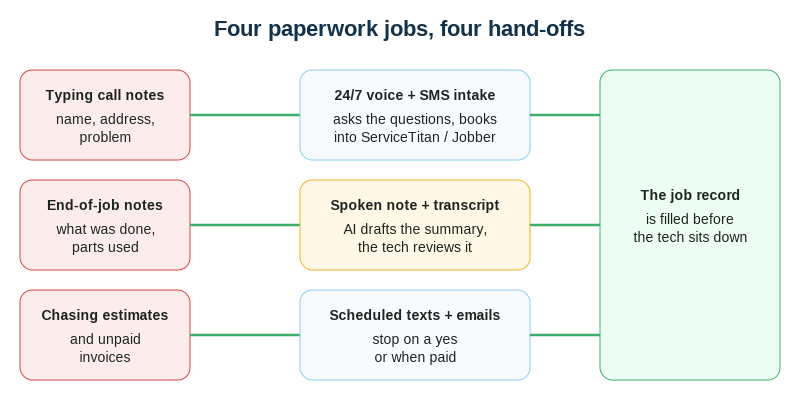
The diagram in text: call notes go to a 24/7 voice and SMS intake; end-of-job notes go to a spoken note and drafted summary; estimate and invoice chasing go to scheduled texts and emails; all four fill the job record before the tech sits down.
We cover the full call flow in how to convert voicemail to a service ticket for calls that still roll over to a recording.
Can technicians dictate job notes instead of typing them?
Yes, with a small build: the tech calls or texts a voice note, it is transcribed, and an AI drafts a summary the tech approves.
Here’s the kind part: a tech who rushes the notes isn’t careless, they’re tired. Taking the retyping away gives them the evening back without lowering the standard of the record.
Twilio’s Record verb captures a call, and the transcript can go to an AI model that returns work done, parts used and follow-up needed. That draft becomes the job summary in your software.
Here is the catch: we found no ServiceTitan or Jobber page describing this as built in, so treat it as custom work. Confirm the exact fields and permissions in each product’s developer pages.
Can estimate and invoice chasing send itself?
Yes, and it is the safest place to start because the messages follow a fixed pattern and stop on an outcome.
Jobber documents invoice reminders and automations. Our guides show the schedules: automate HVAC estimate follow-up and Jobber automated invoice reminders.
- Every message carries the approval or pay link.
- Approved, booked, paid or replied ends the sequence the same day.
- Replies land with a person, not a bot.
- Texts go only to customers who can receive them.
What paperwork must a person still read?
Anything that is a record of work, a price, a safety call or a signature.
Let automation draft; let a human approve. A wrong part number in a warranty claim, or a missed gas smell on an emergency call, costs more than the minutes saved. Route safety words straight to a person, as in how to stop missing after-hours service calls.
How do you start reducing paperwork this week?
- Day 1: time one tech’s paperwork for a day, per job.
- Day 2: list the three fields retyped most often.
- Day 3: switch on estimate follow-up or invoice reminders in your software.
- Day 4: have one tech speak five job notes and compare them with the typed versions.
- Day 5: count minutes saved and notes corrected.
The goal is modest: one tech whose evening starts an hour earlier.
How we researched this
- Read the BLS HVAC mechanics and installers page for median pay ($29.33 an hour, May 2025) and the records duty, on November 29, 2026.
- Read ServiceTitan’s Book Jobs help page for the booking fields, and Jobber’s invoice reminders and automations pages, plus Twilio’s Record documentation.
- Found no ServiceTitan or Jobber page describing voice notes becoming job summaries by themselves; this may change.
- Our cost table is a calculation with stated assumptions, not a measurement. We could not read Reddit threads this time and did not install or test any tool.
Pick one tech, one week and one kind of note, and see how much sooner they get home.
Sources and further reading
Questions and answers
Can I use AI to reduce HVAC technician paperwork time?
Yes, for the repeating parts. AI can take the first call’s details, draft a job summary from a spoken note and send estimate and invoice follow-ups. A technician should still review every record before it is saved.
How much time do HVAC techs spend on paperwork?
We found no reliable public figure, so we did not invent one. Time your own techs for a day. At 10 minutes a job and five jobs a day, it is about 17.5 hours a month per tech.
Do HVAC technicians have to keep records of their work?
Yes. The BLS lists keeping records of work performed as part of the job, including time taken and parts and equipment used. Automation can draft those records but not replace the tech’s check.
Can ServiceTitan technicians book jobs from the field?
Yes. ServiceTitan’s help page says a technician can book a job from the mobile app, and the job then appears on the office dispatch board.
What is the safest paperwork to automate first?
Invoice reminders and estimate follow-ups, because they follow a fixed schedule and stop when the customer pays or approves. Voice-note summaries come second, with a human review.