Guides › Draw weight, FPS and kinetic energy
Crossbow Draw Weight, FPS and Kinetic Energy Explained
Disclosure: this guide contains Amazon affiliate links. As an Amazon Associate we earn from qualifying purchases, at no extra cost to you.
Crossbow boxes advertise draw weight and fps. Hunters talk about kinetic energy and momentum. They are all related, but none of them alone tells you how a crossbow will perform with the bolt you actually hunt with. To get real numbers you need your bolt's weight and its measured speed - a grain scale and an archery chronograph (both on Amazon) make that easy, or an archery shop can do it for you.
Short answer: kinetic energy (ft-lb) = bolt grains × fps² ÷ 450,240. A commonly cited guideline calls for about 25-41 ft-lb minimum for deer-sized game, and most modern hunting crossbows deliver well above that at normal ranges. Draw weight alone doesn't tell you the energy.
Draw weight and power stroke
Draw weight is the peak force (in pounds) needed to pull the string back to the latch. Power stroke is the distance (in inches) the string travels from the latch to rest. The energy a crossbow stores is roughly the area under its force-draw curve - so it depends on both the force and the distance, and on the cam design. That is why a reverse-draw crossbow with a long power stroke can match or beat a higher-draw-weight crossbow with a short one.
Speed (fps) and why advertised numbers run high
Manufacturers measure speed with the lightest bolt they allow. A heavier bolt leaves the same crossbow more slowly but usually carries slightly more energy and noticeably more momentum. Treat the advertised fps as a ceiling; your real speed with a heavier hunting bolt and broadhead will be lower. A chronograph at an archery shop is the only way to know your real number.
Kinetic energy
Kinetic energy (KE) is the energy the bolt carries, in foot-pounds. With bolt weight in grains (including the point and nock) and speed in feet per second:
KE (ft-lb) = bolt weight (grains) × speed² (fps) ÷ 450,240Worked examples:
| Bolt weight | Speed | Kinetic energy |
|---|---|---|
| 400 grains | 350 fps | 400 × 350² ÷ 450,240 ≈ 109 ft-lb |
| 425 grains | 330 fps | 425 × 330² ÷ 450,240 ≈ 103 ft-lb |
| 450 grains | 300 fps | 450 × 300² ÷ 450,240 ≈ 90 ft-lb |
Because speed is squared, KE rises quickly with speed - but faster setups also tend to be louder, harder on equipment, and more sensitive to tuning.
Momentum
Momentum describes how hard a moving bolt is to stop, and many bowhunters consider it a better predictor of penetration than KE:
Momentum (slug-ft/s) = bolt weight (grains) × speed (fps) ÷ 225,400A 450-grain bolt at 300 fps has about 0.60 slug-ft/s of momentum; a 400-grain bolt at 350 fps has about 0.62. Heavier bolts close the gap even when they are slower. Penetration also depends heavily on broadhead design, sharpness and shot angle.
How much energy for which game? (rule of thumb)
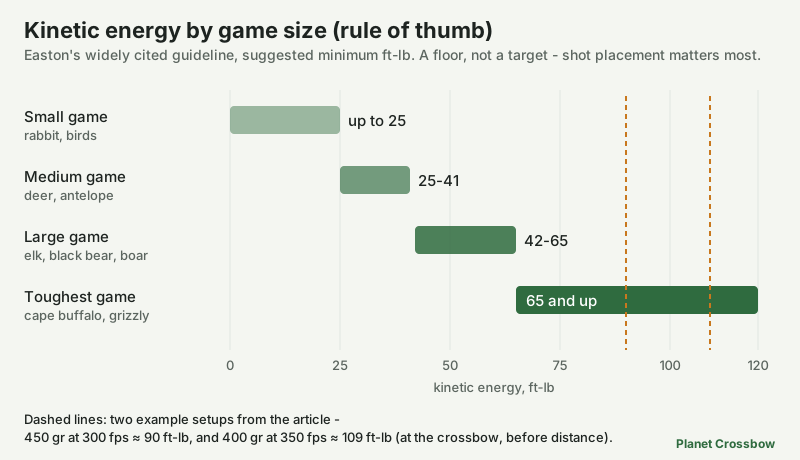
A guideline published by arrow maker Easton - and repeated widely in bowhunting references - suggests these minimum kinetic energies:
| Game | Suggested minimum KE |
|---|---|
| Small game (rabbits, birds) | up to about 25 ft-lb |
| Medium game (deer, antelope) | about 25-41 ft-lb |
| Large game (elk, black bear, wild boar) | about 42-65 ft-lb |
| Toughest game (cape buffalo, grizzly) | 65 ft-lb and up |
Modern hunting crossbows usually exceed these figures by a wide margin at short range. The chart is a floor, not a target: a well-placed shot with a sharp broadhead matters far more than extra energy. Energy also drops with distance, which is one reason most crossbow hunters keep shots within the ranges they have practiced.
Energy at distance
Every number above is measured at the crossbow. A bolt starts slowing the moment it leaves the rail - air drag depends on the bolt's shape, its fletching and especially the broadhead - so it arrives at 30 or 40 yards with less speed, and because energy depends on speed squared, noticeably less energy. Heavier bolts generally hold their energy and momentum better than light ones over the same distance. You can't calculate the exact loss without measuring downrange speed, which is one more reason to keep a generous margin above the guideline rather than aiming to just clear it, and to keep shots within the distances you have practiced and confirmed on target.
Estimating your own setup
- Weigh one complete hunting bolt (shaft, insert, nock, broadhead) on a grain scale, or add the weights from the packaging.
- Get its real speed from a chronograph, or estimate conservatively below the advertised speed.
- Apply the KE and momentum formulas above.
- Stay above the manufacturer's minimum total bolt weight - going lighter can damage the crossbow and may void the warranty. See our bolts and broadheads guide.
Whatever the numbers, accuracy comes first: practice from the positions you will hunt from, and sight in with the bolts you will hunt with.
Frequently asked questions
How much kinetic energy do you need to kill a deer with a crossbow?
Easton's widely cited guideline suggests about 25-41 ft-lb as a minimum for medium game such as deer. It is a floor, not a target; sharp broadheads and good shot placement matter most.
Is a higher draw weight always more powerful?
No. Stored energy depends on draw weight, power stroke length and cam design together, so a long-stroke crossbow at a lower draw weight can match a short-stroke one at a higher draw weight.
Why is my crossbow slower than advertised?
Advertised speeds are measured with the lightest bolt the maker allows. A heavier hunting bolt with a broadhead leaves more slowly - usually with similar or slightly more energy and more momentum.
Sources and further reading
- Easton Archery - publisher of the widely cited kinetic-energy guideline
- TenPoint arrow and bolt FAQs - manufacturer guidance on bolts, weights and broadheads
- List of U.S. state fish and wildlife agencies - check minimum draw weight rules
How this guide was written: Based on the standard physics formulas used across archery, Easton's widely published kinetic-energy guideline, and manufacturer specifications practice. Rules of thumb are labeled as such.