Guides › Crossbow bolts and broadheads
Crossbow Bolts and Broadheads: Length, Weight, Nocks and Heads
Disclosure: this guide contains Amazon affiliate links. As an Amazon Associate we earn from qualifying purchases, at no extra cost to you.
Using the wrong bolt is one of the easiest ways to damage a crossbow or get hurt. The good news: your crossbow's manufacturer tells you exactly what to use. This guide explains what those specifications mean and how to choose within them, so you can shop crossbow bolts on Amazon or anywhere else with confidence.
Short answer: use the bolt length, minimum total weight and nock type your crossbow's manual specifies; choose broadheads made for crossbow speeds and legal where you hunt; and check that they hit with your field points before the season.
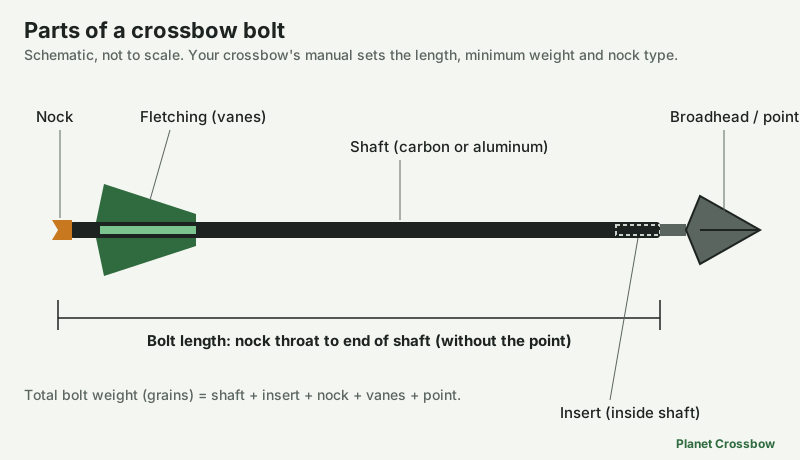
Start with the manual
Look up three specifications for your exact crossbow model:
- Bolt length (usually in inches, measured without the point). The bolt must be long enough that the point sits safely past the front of the rail and limbs.
- Minimum total bolt weight in grains, including point, insert and nock. Lighter bolts let the crossbow transfer less energy into the bolt and more into the limbs and string - effectively a partial dry-fire. Going under the minimum can damage the crossbow and usually voids the warranty.
- Nock type. Many crossbows require a specific nock - flat, half-moon, capture or a proprietary design - so the string engages the bolt correctly. The wrong nock can cause a dry-fire.
Carbon or aluminum?
- Carbon bolts are the most common today: durable, consistent in weight and spine, and they either stay straight or break (inspect them - see below).
- Aluminum bolts are usually less expensive and heavier; they can bend, so check them for straightness after hard impacts.
Either works when it meets your manufacturer's length, weight and nock specifications.
Straightness and consistency
Bolt makers list a straightness tolerance (for example ±.003 inch) and a weight tolerance. Tighter tolerances help groups at longer distances. More important than buying the tightest tolerance: hunt with bolts from the same batch, all the same weight, and number them so you can spot one that flies differently.
Fletching
Most crossbow bolts use three vanes. Follow your crossbow's instructions for how the bolt sits on the rail - often with one vane (the "cock vane", sometimes a different color) pointing down into the flight groove. Damaged or loose vanes affect accuracy; replace them or retire the bolt.
Inspect every bolt
Before every shot, flex carbon shafts gently while listening and feeling for cracks, check nocks for chips and cracks, and make sure inserts and points are tight. A cracked carbon bolt can shatter on release. Retire any bolt you are unsure about - and never "test" one by shooting it.
Broadheads: fixed or mechanical
- Fixed-blade heads are simple and durable, and they never fail to open. At crossbow speeds some fly differently from field points, so check them at the range.
- Mechanical (expandable) heads fly much like field points because their blades are closed in flight, then open on impact. Use models designed for crossbow speeds - and check whether mechanical heads are legal where you hunt.
- Hybrid heads combine a small fixed blade with expanding blades.
Whatever you choose, keep the blades sharp, and confirm they hit with your field points before the season (broadhead check). Practice with field points of the same weight and use dedicated practice broadheads or a broadhead target for checks.
100 or 125 grain?
Most crossbow broadheads come in 100 or 125 grains. The heavier head adds front weight - more momentum and often slightly better flight stability - at the cost of a little speed and more drop at longer distances. Choose the weight your total bolt weight and your manufacturer's minimum allow, then sight in with field points of the same weight. Changing head weight means re-checking your zero.
A simple buying list
- Bolts matching your crossbow's length, weight and nock spec - compare carbon crossbow bolts on Amazon and check each listing against your manual.
- Field points in the same weight as your broadheads.
- Broadheads suited to crossbow speeds and legal where you hunt - crossbow broadheads on Amazon.
- A broadhead-rated target for checking flight.
To see how bolt weight changes energy and momentum, try the formulas in draw weight, FPS and kinetic energy explained.
Frequently asked questions
Can I use any crossbow bolt in my crossbow?
No. Use the length, minimum weight and nock type your manufacturer specifies. The wrong nock or a too-light bolt can cause a dry-fire, damage the crossbow and void the warranty.
Are 100 or 125 grain broadheads better for a crossbow?
Both work. 125 grains adds front weight and momentum at the cost of a little speed and more drop. Choose what keeps your total bolt above the manufacturer's minimum, and sight in with matching field points.
How do I know if a carbon bolt is cracked?
Flex it gently while listening and feeling for cracking, and look for splits near the nock and insert. If in doubt, retire it - a cracked carbon bolt can shatter when shot.
Sources and further reading
- TenPoint arrow and bolt FAQs - manufacturer bolt and broadhead guidance
- Easton Archery - arrow and bolt maker
- List of U.S. state fish and wildlife agencies - check whether mechanical broadheads are legal where you hunt
How this guide was written: Based on crossbow manufacturers' bolt specifications and warnings, arrow-maker technical guidance and hunter-education material. Your crossbow's manual overrides any general advice here.