Guides › Crossbows for small and young hunters
Crossbows for Small-Framed and Youth Hunters: Weight, Length of Pull and Cocking Effort
Disclosure: this guide contains Amazon affiliate links. As an Amazon Associate we earn from qualifying purchases, at no extra cost to you.
Most hunting crossbows are built around an average-sized adult. If you're smaller - or you're setting up a crossbow for a teenager - the wrong fit makes everything harder: it's heavy to hold, hard to cock and tough to shoot accurately. The good news is that a few checks sort it out, whether you're at a shop or comparing crossbows with adjustable stocks on Amazon.
Short answer: start with the legal and safety basics - your state's age and hunter-education rules and a model the shooter can cock safely. Then fit it: an adjustable stock so the length of pull matches the shooter, a weight they can hold steady, a trigger they reach without stretching, and a scope they see through without craning their neck. A crank cocker often matters more than anything else.
First: the legal and safety basics
- Age and hunter education. Minimum ages, supervision rules and hunter-education requirements for crossbow hunting vary a lot by state and province. Check your wildlife agency before you buy.
- Minimum draw weight. Many places set a minimum draw weight for hunting big game. Some light "youth" or target crossbows don't meet it - fine for the backyard, not for deer season.
- Supervision. A young hunter should learn cocking, loading, unloading and the "fingers below the rail" rule with an adult right there, every time.
- A hunter-ed course. Even where it isn't required yet, it's worth it.
Length of pull
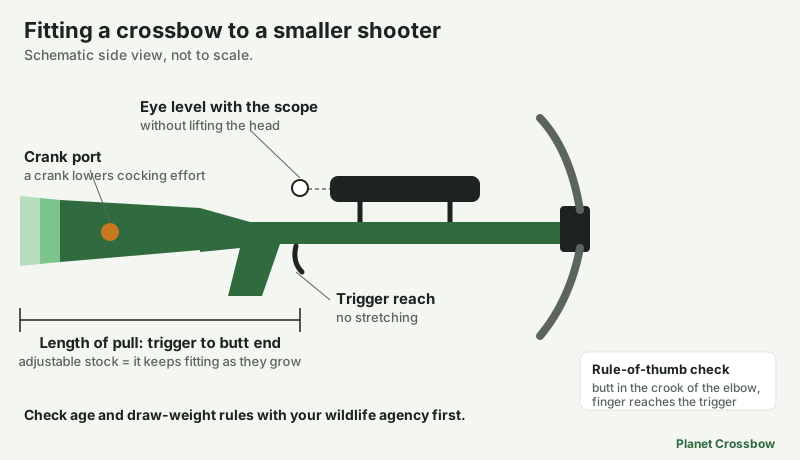
Length of pull is the distance from the trigger to the end of the butt stock. Too long, and a smaller shooter has to stretch their arm and push their head forward - which makes accuracy and eye position all over the place.
- Look for an adjustable stock. Many crossbows let you shorten or lengthen the stock in steps. For a growing teenager, that means the crossbow keeps fitting.
- A quick fit check: a common rule of thumb borrowed from rifle fitting is to rest the butt in the crook of the shooter's elbow - their trigger finger should reach the trigger comfortably. It's a starting point, not an exact measurement.
- The real test: shoulder it (uncocked). The shooter should hold it without leaning back or stretching, with the trigger finger resting naturally on the trigger.
Weight and balance
A heavy, front-heavy crossbow is tiring to hold on target. For a small-framed shooter:
- compare weights with the scope and quiver on, as you'll actually hunt;
- check the balance - a crossbow that tips forward wears your arms out fast;
- plan to shoot from a rest - shooting sticks or a bipod make any weight manageable on stand or in a blind (ground blind tips).
Cocking effort
This is where many young and smaller hunters get stuck. Cocking a hunting crossbow by hand takes real strength, and doing it unevenly can push shots sideways.
- A rope cocker roughly halves the effort and works for any hand.
- A crank lets almost anyone cock even a heavy crossbow - slowly, quietly and evenly. Many models have built-in or matched cranks; add-on cranks must fit your exact model (crank cocking devices on Amazon - check the compatibility list).
- Have the shooter cock it themselves in the store, with the cocking aid they'll use. If they can't do it safely and consistently, it's not the right setup.
Trigger reach and scope position
- Trigger reach: a smaller hand should reach the trigger without shifting the grip - and keep thumbs and fingers well below the rail.
- Eye height: when they rest their cheek on the stock, their eye should line up with the scope without lifting their head. An adjustable comb or cheek piece helps.
- Eye relief: they shouldn't have to push their face forward to see the full picture. If the scope can slide on its mount, adjust it to the shooter.
Then sight it in with the shooter behind it - the zero depends on how they hold it (sighting in at 20, 30 and 40 yards).
A simple shop checklist
- Legal for their age and your season? Draw weight above any minimum?
- Can they cock it safely with the cocking aid you'll use?
- Does the stock adjust so the length of pull fits them?
- Can they hold it steady with the scope on (or on a rest)?
- Does the trigger sit naturally under their finger, and the scope at their eye?
Buying it as a gift? See our crossbow gift guide for what else to include, and how to choose a crossbow for the rest of the specs.
Frequently asked questions
What age can kids use a crossbow for hunting?
It depends on where you live. Minimum ages, supervision rules and hunter-education requirements vary by state and province - check your wildlife agency's current regulations.
What is length of pull on a crossbow?
The distance from the trigger to the end of the butt stock. A shorter, adjustable length of pull helps smaller shooters and growing kids hold the crossbow comfortably and aim consistently.
Are youth crossbows strong enough for deer?
Some are and some aren't. Light youth or target crossbows may not meet the minimum draw weight for big game where you hunt. Check your state's rules and the crossbow's specs.
How can a small person cock a crossbow?
Use a rope cocker (about half the effort) or a crank, which lets almost anyone cock slowly and evenly. Make sure the crank fits the exact model.
Sources and further reading
- List of U.S. state fish and wildlife agencies - age, supervision and draw-weight rules
- Hunter-ed.com official hunter education courses - required for new hunters in many states
- TenPoint: how to safely handle and shoot a crossbow - safety basics
- National Bowhunter Education Foundation (NBEF) - bowhunter education
How this guide was written: Based on general crossbow and firearm stock-fit principles, manufacturer safety guidance, and hunter-education requirements. We don't rank youth models; specs and legal ages vary, so check the model's manual and your wildlife agency.