Guides › Crossbow maintenance
Crossbow Maintenance: Waxing, Rail Lube, Inspection and Storage
Disclosure: this guide contains Amazon affiliate links. As an Amazon Associate we earn from qualifying purchases, at no extra cost to you.
A crossbow stores a lot of energy in its limbs, string and cables. A few minutes of regular care - mostly string wax and rail lube (see crossbow maintenance kits on Amazon) - keeps it accurate, extends the life of the string, and catches problems before they become dangerous. Always follow your crossbow's manual - schedules and products differ between makers.
Short answer: lube the rail where the string slides, wax the string and cables (not the center serving unless your manual says so), inspect before every session, never dry-fire, store it uncocked, and replace the string and cables on your maker's schedule - TenPoint and Ravin both say every two years (Ravin: or 400 shots, whichever comes first).
Never dry-fire
Releasing the string without a correctly seated bolt sends all the stored energy into the limbs, string and cables. It can break limbs, derail or break strings and cables, and injure you. If a crossbow is dry-fired, don't cock it again until a qualified technician has inspected it. Most warranties do not cover dry-fire damage.
Rail lube
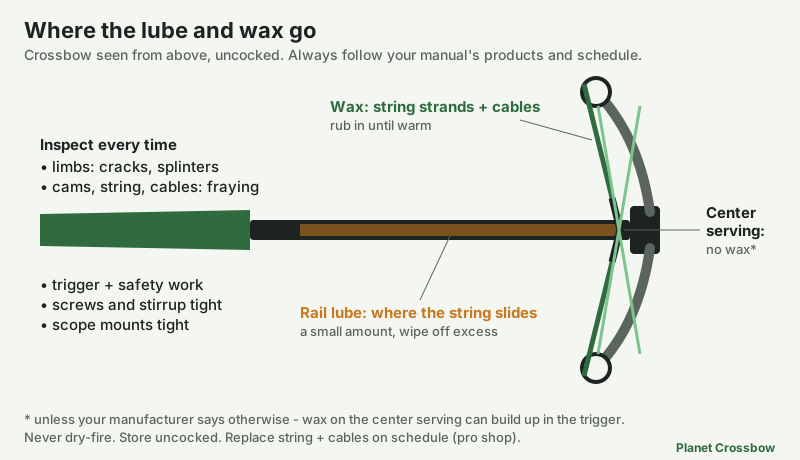
The string slides along the flight rail on every shot. Most manufacturers recommend applying a small amount of rail lube to the rail where the string travels - typically every few shots or according to the manual - to reduce wear on the string's center serving. Use the product your manufacturer recommends (crossbow rail lube on Amazon), and wipe off excess so it doesn't collect grit.
String and cable wax
Wax keeps string and cable fibers lubricated and resists moisture and fraying. Apply a thin coat to the strands (not the center serving that rides on the rail, unless your manual says otherwise), then rub it in with your fingers until it warms and penetrates. Many manuals suggest doing this every few dozen shots or when the string looks dry or fuzzy. String wax on Amazon.
Inspection checklist (before every session)
- String and cables: frayed or broken strands, fuzzing, serving that is separating, especially at the center and where cables wrap the cams.
- Limbs: cracks, splinters or delamination. Stop using the crossbow if you find any.
- Cams and axles (compound): cams intact, string and cables seated in their grooves, no wobble.
- Bolts in the quiver: cracked shafts, damaged nocks, loose inserts (see inspecting bolts).
- Scope and mounts: rings and screws tight; recheck your zero if anything moved.
- Trigger and safety: the safety engages when cocked and the anti-dry-fire works as described in the manual.
- Bolts and screws: stirrup, stock and limb pocket hardware tight (use the torque or method in your manual).
When to replace the string and cables
Strings and cables stretch and wear. Many manufacturers recommend replacing them on a schedule - often every couple of years or after a set number of shots - and immediately if you see damage. On compound crossbows, replacement usually needs a crossbow press and correct cam timing, so an archery pro shop or the manufacturer's service center is the right place for it. After any string or cable change, sight in again (how to sight in).
Cocking and de-cocking with care
Consistent, centered cocking protects your accuracy and the string. Use a rope or crank cocker if you have trouble cocking evenly. Don't leave the crossbow cocked longer than necessary: unload it at the end of each hunt using the method your manual allows - shooting a bolt into a target or the ground with a discharge bolt, or a de-cocking crank where the design permits it.
Storage and transport
- Store it uncocked, in a case, somewhere dry and away from extreme heat (a hot vehicle can damage strings and limbs).
- Use a padded or hard case for travel; a knock can move your scope's zero.
- Remove broadheads from bolts in the quiver during transport, or use a quiver that covers them completely.
- Before the season, do a full inspection, apply wax and lube, and recheck your zero.
When to see a professional
Take the crossbow to an archery pro shop or the manufacturer if you see limb damage, cam problems, a derailed string, worn cables, or after any dry-fire - and for string and cable replacement on compound designs. These jobs need the right tools and specifications.
Shopping for a new crossbow instead? See how to choose a crossbow.
Frequently asked questions
How often should I wax my crossbow string?
Follow your manual; many suggest every few dozen shots, before the season, and whenever the string looks dry or fuzzy. Keep wax off the center serving unless your manufacturer says otherwise, because it can build up in the trigger.
How often should crossbow strings be replaced?
TenPoint recommends changing the string and cables every two years; Ravin says every two years or 400 shots, whichever comes first (200 for some models). Replace them immediately if you see damage.
Can I use WD-40 or gun oil on the rail?
Use the rail lube your manufacturer recommends. Other products may not suit the string serving or may attract grit, and some can affect the trigger.
Sources and further reading
- TenPoint: how often to change the string and cables - manufacturer schedule
- Ravin Crossbows FAQ - string/cable intervals, cocked time, service
- TenPoint: how to safely de-cock a crossbow - manufacturer de-cocking guidance
How this guide was written: Based on crossbow manufacturers' owner's manuals and maintenance instructions. Intervals vary by model - your manual's schedule takes priority.