Guides › Center serving separating
Crossbow Center Serving Separating or Fraying: What It Means and What to Do
Disclosure: this guide contains Amazon affiliate links. As an Amazon Associate we earn from qualifying purchases, at no extra cost to you.
The center serving is the tightly wrapped section in the middle of your crossbow string - the part that slides along the rail and gets caught by the latch every time you cock. It takes a beating, and when it starts to separate or fray, it's telling you something. Before the next hunt, get a close look with a flashlight and magnifier, and have rail lube (both on Amazon) on hand if your manual calls for it.
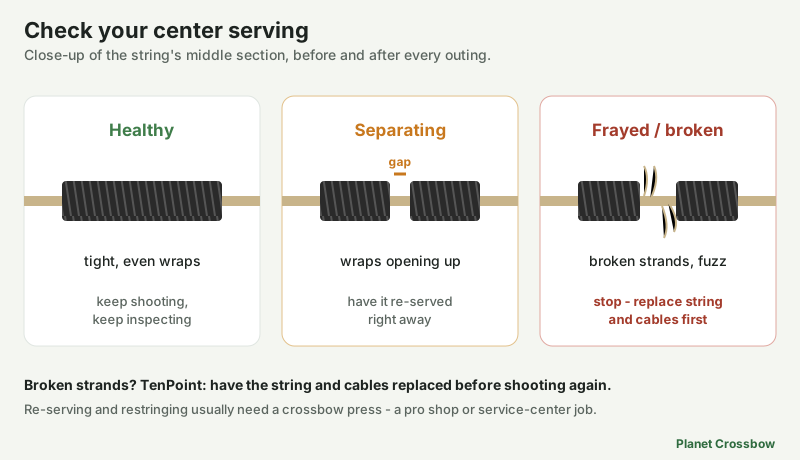
Short answer: any separation or fraying in the center serving needs attention before you keep shooting. If you see broken strands in the string or the serving, TenPoint's advice is to have the string and cables replaced before shooting again. If the serving is just starting to separate with no broken strands, have it re-served right away. Check the serving before and after every outing.
How to inspect it
- Make sure the crossbow is uncocked and pointed in a safe direction.
- Use good light - a flashlight raking across the string shows gaps and fuzz much better than room light.
- Look at the whole serving, especially the spot where the latch holds it and where it slides on the rail.
- Run a fingernail gently along it. Wraps should feel tight and even; a gap or a soft spot is a warning.
- Check the string and cables beyond the serving for fuzz or broken strands too.
Make it a habit: a quick look before you leave for the stand and again when you get home.
What the center serving does
A crossbow string is made of many strands. The serving is a tough thread wrapped tightly around the middle to protect those strands where they rub on the rail and get held by the latch. Without it, the string itself would wear through fast.
Separating vs fraying
- Separating: the wraps start to open up, leaving a gap where you can see the string underneath. Crossbow Magazine's editor, writing for Sportsman's Guide, explains it can mean the serving is just loosening - or that a strand inside it has broken.
- Fraying: fuzzy, broken fibers on the serving or the string. This is wear, and it can lead to broken strands.
What to do
| What you see | What to do |
|---|---|
| Tight, even, smooth wraps | Keep shooting; keep inspecting. |
| Wraps starting to separate, no broken strands | Have it re-served right away (archery pro shop or your manufacturer). |
| Broken strands in the serving or string, or heavy fraying | Stop. Have the string and cables replaced before shooting again - TenPoint's advice. |
On most crossbows, re-serving and string replacement need a crossbow press and the right specs, so it's a job for a pro shop or the manufacturer's service center.
What causes it
- Normal wear. Every shot slides the serving down the rail and snaps it from the latch.
- A dry-fire. TenPoint warns that even with its anti-dry-fire lever, the string hitting it can be enough to fray or break the center serving. After any dry-fire, inspect before shooting.
- Rough latch or claws. Owners on crossbow forums report that burrs on the latch or rough edges where the string rides can chew up serving - a new string wears out the same way unless that's fixed.
- Twisting the string the wrong way. TenPoint's restringing manual says twisting a string opposite to the way the serving is wound can cause serving separation.
- Uneven cocking that drags the string along one side of the rail.
- Age. Strings and cables have a service life - TenPoint and Ravin both recommend replacing them every two years (Ravin: or 400 shots, whichever comes first). See crossbow maintenance.
How to make serving last
- Inspect before and after every outing.
- Lube the rail as your manual says - it reduces friction where the serving slides.
- Keep wax off the center serving unless your manual says otherwise; wax on the serving can soften it and build up in the trigger.
- Cock straight and even - a cocking device helps.
- Never dry-fire.
- Don't leave it cocked for long (cocked-time limits).
Frequently asked questions
Can I keep shooting with a separating center serving?
It's not a good idea. Have it re-served right away. If there are any broken strands, TenPoint says to have the string and cables replaced before shooting again.
Should I wax my crossbow's center serving?
Usually not - most manuals say wax the string strands and cables, not the center serving, and lube the rail instead. Follow your manual.
Can I re-serve a crossbow string myself?
Re-serving and string replacement usually need a crossbow press and exact specs, so most owners have a pro shop or the manufacturer do it.
Why does my center serving keep fraying?
Common causes are a rough latch or claw, uneven cocking, a past dry-fire, or an old string. Have the latch checked when you replace the string.
Sources and further reading
- TenPoint: is it safe for me to dry-fire my crossbow? - serving can fray or break; replace string and cables if strands are broken
- TenPoint: restringing the recurve crossbow (PDF) - twist direction vs serving separation
- Sportsman's Guide: string serving awareness on crossbows - Crossbow Magazine editor: inspect every outing, re-serve at any separation
- TenPoint: how often to change the string and cables - every two years
- Ravin Crossbows FAQ - two years or 400 shots
How this guide was written: Based on TenPoint's safety FAQ and restringing manual, guidance from Crossbow Magazine's editor published by Sportsman's Guide, and owner experience on crossbow forums. Your manufacturer's manual and service center have the final say.