Guides › Quieting a loud crossbow
Why Is My Crossbow So Loud? String Suppressors, Limb Dampeners and Bolt Weight
Disclosure: this guide contains Amazon affiliate links. As an Amazon Associate we earn from qualifying purchases, at no extra cost to you.
Crossbows are loud. All that stored energy has to go somewhere when you pull the trigger, and the part that doesn't go into the bolt shakes the limbs, string and stock - and vibration is noise. The good news: a few changes make a real difference, starting with things like string suppressors and limb dampeners (both on Amazon), and the bolt you shoot.
Short answer: the noise comes from vibration. The biggest single fix is usually a heavier bolt - still within your manufacturer's weight and length specs - because more energy goes into the bolt and less into the crossbow. After that, add string suppressors, limb dampeners and dampeners on the bolt-retention spring, keep every screw tight, and learn to work the safety quietly.
Why the noise matters
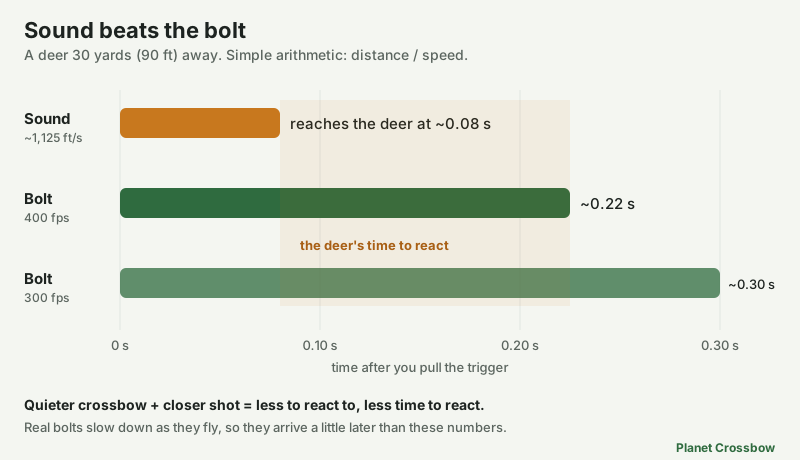
Here's the physics. Sound travels at roughly 1,125 feet per second. A crossbow bolt flies at something like 300 to 400 feet per second. So at 30 yards (90 feet):
- the sound of the shot reaches the deer in about 0.08 seconds;
- the bolt takes about 0.22 to 0.30 seconds - a bit longer in practice, since it slows down as it flies.
That leaves the deer a fraction of a second to react. As Deer & Deer Hunting points out, a bolt can't outrun the crossbow's sound, and a deer's first reaction is often to drop down to load its legs - which is how a perfect aim turns into a high hit. A quieter crossbow gives it less to react to.
1. Shoot a heavier bolt (within spec)
Most hunters and writers agree this is the biggest fix. A heavier bolt takes more of the crossbow's energy with it, leaving less to rattle the limbs and string. You'll lose a little speed and get a little more drop at long range, but energy and momentum usually hold up well (see draw weight, FPS and kinetic energy).
2. String suppressors and string stops
A string suppressor (or string stop) catches the string at the end of its travel so it doesn't keep vibrating. Many newer crossbows come with them built in; for others, makers and aftermarket brands sell kits. If you add string silencers that go on the string itself, Deer & Deer Hunting notes they have to sit between the strands, or they'll fly off.
3. Limb, spring and stirrup dampeners
- Limb dampeners soak up limb vibration. Placement changes the effect, so follow the maker's instructions.
- The bolt-retention spring can buzz on the shot - a small dampener there helps.
- The stirrup, quiver and accessories can rattle too; dampen or tighten them.
Not every source agrees on how much these add-ons help, and anything on the string or limbs can cost a few feet per second. Check with your manufacturer before adding anything, because some changes can affect the warranty.
4. Tighten and maintain
Every shot sends vibration through the crossbow, and that can slowly loosen screws. A loose scope ring, quiver bracket or stirrup bolt rattles. Check them regularly, and keep the string waxed and the rail lubed as your manual says (crossbow maintenance). A worn string or cable can be noisier too.
5. Quiet habits
- The safety click: push it off slowly with your thumb pressed against it - quieter, though not silent.
- Crank cocking: some cranks click; cock before the deer are close.
- The quiver: take bolts out slowly, and pad any metal-on-metal spots.
- Shoot within your range. The farther the shot, the longer the deer has to react after hearing it.
Test it
Change one thing at a time and shoot a few bolts. A free phone decibel app gives you a rough before-and-after comparison - not lab-accurate, but good enough to tell what helped on your crossbow. Then re-check your zero, especially after changing bolt weight.
Frequently asked questions
Why is my crossbow so loud?
Energy that doesn't go into the bolt turns into vibration in the limbs, string and stock, and vibration is noise. Light bolts, loose parts and no string stop make it worse.
Do heavier bolts make a crossbow quieter?
Usually, yes - a heavier bolt takes more of the energy, leaving less vibration. Stay within your manufacturer's specs and re-check your zero after switching.
Do string suppressors slow down a crossbow?
They can cost a few feet per second, and how much they quiet things varies by model. Many newer crossbows have string stops built in.
Can a deer really react before the bolt arrives?
Yes. Sound travels much faster than a bolt, so at 30 yards the deer hears the shot a fraction of a second before the bolt gets there and can start to drop.
Sources and further reading
- Deer & Deer Hunting: how to reduce vibration and noise in crossbows - dampeners, heavier bolts, safety click, deer reaction
- Bowhunting.com: four ways to quiet your crossbow - dampening options
- TenPoint arrow and bolt FAQs - stay within manufacturer bolt specs
- National Bowhunter Education Foundation (NBEF) - shot ethics and range
How this guide was written: Based on basic physics (speed of sound vs bolt speed), advice published by Deer & Deer Hunting and Bowhunting.com, and manufacturer bolt specifications. How much each fix helps varies from crossbow to crossbow - test yours.