Guides › Crossbow vs compound bow
Crossbow vs Compound Bow: Which Is Right for You?
Disclosure: this guide contains Amazon affiliate links. As an Amazon Associate we earn from qualifying purchases, at no extra cost to you.
Both crossbows and compound bows are effective hunting tools within their ranges. The right choice depends on your strength, how much time you can practice, how and where you hunt - and on the rules where you hunt. You can compare current crossbows and compound bows on Amazon, but first, here are the real trade-offs.
Short answer: a crossbow is quicker to learn and needs no holding at full draw, but it is heavier, louder and slower to reload. A compound bow is lighter and quieter and is legal in every archery season, but it takes more practice to shoot well. Effective hunting ranges are similar.
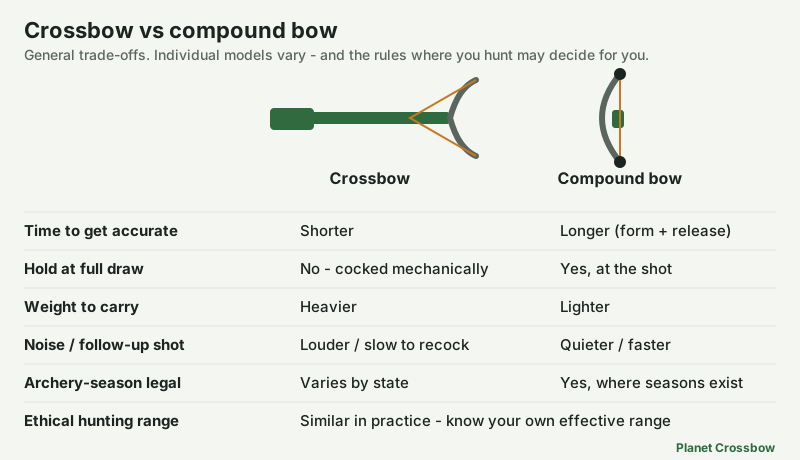
At a glance
| Crossbow | Compound bow | |
|---|---|---|
| Learning curve | Shorter - aimed and shot like a rifle from a stock and scope. | Longer - needs consistent form, anchor point and release to shoot accurately. |
| Holding at full draw | None - it stays cocked mechanically. | You draw and hold at the moment of the shot; let-off makes holding easier but movement can spook game. |
| Physical demand | Cocking takes strength, made easier with a rope or crank cocker. | Drawing takes strength every shot; draw weight can be set lower for many shooters. |
| Weight and handling | Usually heavier and bulkier. | Lighter and easier to carry and maneuver. |
| Follow-up shots | Slow - recocking takes time and movement. | Faster - nock another arrow and draw. |
| Noise | Generally louder. | Generally quieter. |
| Effective range | Similar ethical ranges in practice; crossbow bolts lose speed quickly because they are short and heavy. | Similar; depends on the archer's skill and setup. |
| Maintenance | Rail lube, string and cable wax, scope checks; string changes often need a bow press. | String wax, tuning; string changes need a bow press. |
| Season rules | Varies widely by state and province. | Legal in archery seasons everywhere archery seasons exist. |
Learning curve and accuracy
A crossbow's biggest advantage is how quickly a new shooter becomes accurate at short range: no anchor point to learn, no holding at full draw, and a magnified scope. A compound bow rewards practice - good archers are extremely accurate - but the first season usually requires more range time. If you can only practice occasionally, a crossbow will usually make you accurate sooner.
Range: the myth to avoid
Crossbows are often described as having rifle-like range. They don't. Crossbow bolts are short and heavy, they lose speed relatively quickly, and the drop between 40 and 60 yards is large. Many experienced crossbow hunters keep shots within distances similar to those of good bowhunters. Know your own effective range from practice - see sighting in at 20, 30 and 40 yards.
Hunting from blinds, stands and on foot
From a ground blind, a crossbow's lack of draw movement is a real advantage, but its width can be awkward in small windows. In a tree stand, both work; a crossbow can be steadier on a rest. For spot-and-stalk hunting on foot, the lighter compound bow is easier to carry all day.
Accessibility
For hunters who cannot draw a bow - because of age, injury, shoulder problems or disability - a crossbow can keep them hunting. Many jurisdictions also have accommodations that allow crossbows in seasons where they are otherwise restricted. Check the specific rules with your wildlife agency.
Practice and keeping your skill
With a compound bow, regular practice through the year keeps your form, strength and anchor consistent; many bowhunters shoot a few arrows most days in the weeks before the season. A crossbow holds its accuracy with less practice, but it still needs it: you should know exactly where your bolts hit at each distance, how to range a deer quickly, and how to shoot from a stand, a blind and kneeling. Each crossbow shot also takes more time and effort to recock, and every practice bolt has to be pulled from a dense target, so crossbow sessions are usually shorter. Either way, practicing from your real hunting positions matters more than the number of shots.
Cost
Both range from budget to premium. Remember to count the whole setup: for a crossbow, a scope, bolts, broadheads, a crossbow-rated target and a cocking aid; for a compound, a sight, rest, release, arrows, broadheads and often a pro-shop setup. Our crossbow buying guide lists what to check in a package.
Legal status
This is often the deciding factor. Some places allow crossbows throughout archery season, some only during firearms seasons or for certain hunters, and rules change over time. Always check your state or provincial wildlife agency's current regulations before you decide.
Which should you choose?
- Choose a crossbow if you want accuracy with limited practice time, hunt mostly from blinds or stands, or can't comfortably draw a bow.
- Choose a compound bow if you want a lighter, quieter tool, enjoy practicing archery form, hunt on foot, or your seasons restrict crossbows.
Many hunters end up owning both. If you are leaning toward a crossbow, start with how to choose a crossbow and what draw weight and speed really mean.
Frequently asked questions
Is a crossbow easier to shoot than a compound bow?
For most new shooters, yes: there is no draw to hold and you aim through a scope from a stock, so short-range accuracy comes quickly. Compound bows reward practice with form and release.
Can I use a crossbow during archery season?
It depends entirely on where you hunt - some states allow crossbows for all archery hunters, some restrict them to certain hunters or seasons. Check your state or provincial wildlife agency's current regulations.
Does a crossbow shoot farther than a compound bow?
Not in an ethical hunting sense. Crossbow bolts are short and heavy and drop quickly past 40 yards, so most experienced hunters keep crossbow shots within ranges similar to bowhunters.
Sources and further reading
- List of U.S. state fish and wildlife agencies - check crossbow season rules
- American Hunter: shoulder issues? Crossbows keep you in the game - accessibility
- National Bowhunter Education Foundation (NBEF) - bowhunter education
How this guide was written: A neutral comparison based on how the two designs work, manufacturer guidance and hunter-education material. Neither is "better" in general - it depends on the hunter and the hunt.