Hunting games › Tracks, droppings and sign
Tracks, Droppings and Sign: How Tracking Works in Hunting Games
Disclosure: this page contains Amazon affiliate links. As an Amazon Associate we earn from qualifying purchases, at no extra cost to you.
Tracking is the part of a hunting game that feels most like real hunting: you find a print, then droppings, then a fresher print, and slowly close the gap on an animal you haven't seen yet. Each game handles it a little differently. Here's how it works in theHunter: Call of the Wild and Way of the Hunter (both on Amazon), plus theHunter Classic - and how real hunters read the same signs.
Short answer: all three games scatter clues - tracks, droppings, sounds and blood - that you inspect to learn what animal passed, how long ago and which way it went. Call of the Wild uses its HunterMate device to read clues and point you along the trail. Way of the Hunter's Hunter Sense highlights tracks and shows things like how fresh droppings are. Classic was built around reading tracks closely - its store page says you could learn to tell weight and gender from a single track.
theHunter Classic: tracks as the core skill
In Classic, tracking was the heart of the game. Its store page says that "with time and practice, you will be able to tell weight and gender from a simple animal track." You'd follow a line of prints, judging which ones were fresh, until you found the animal. With Classic shutting down on November 11, 2026 (what's confirmed), this is the system many longtime players say they'll miss most.
theHunter: Call of the Wild: HunterMate clues
Here's how players and the fan wiki describe it:
- Clues everywhere: prints, droppings, blood trails, and sounds like calls or movement.
- Inspect with the HunterMate. When you find a clue, you use the HunterMate to read it - which species, and more detail as you go.
- Freshness matters. Players note that droppings show how old the trail is, so you know whether you're closing in.
- A guided trail. Follow clue to clue and the game points you along the line of travel - more guided than Classic, which suits newer players.
Many players blend this with reading the land: watching for trampled grass and listening for animals moving (see wind, scent and sound).
Way of the Hunter: Hunter Sense
- A GameGrin review describes Hunter Sense highlighting "all things hunting, be it tracks on the ground, blood trails, dropping freshness, or the origin of a weird noise."
- Reviewers note you use it while standing still, so you pause and read the ground rather than run between markers.
- Way of the Hunter 2's official site adds a hunting dog that "detects animal signs, follows blood trails, and tracks wounded game."
Side by side
| theHunter Classic | Call of the Wild | Way of the Hunter | |
|---|---|---|---|
| Main tool | Your own eye on the tracks | HunterMate (community) | Hunter Sense (review) |
| What you learn | Weight and gender from a track (official) | Species, freshness, direction (community) | Tracks, droppings freshness, noises (review) |
| Feel | Slow, skill-based | Guided, accessible | Read-the-ground, deliberate |
| Extra | - | Need zones as destinations | WotH 2: tracking dog (official) |
How real hunters read sign
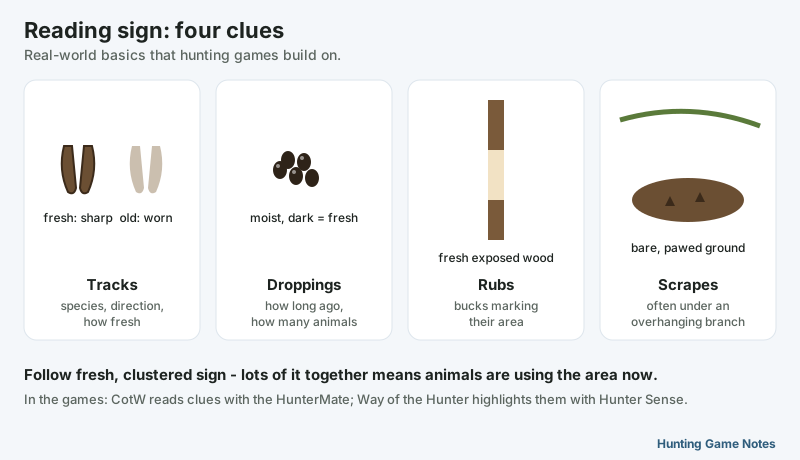
The games borrow from real tracking. A few basics, from state wildlife material and long hunting practice:
- Tracks: crisp, sharp edges mean fresh; worn, softened edges mean older.
- Droppings: Maryland's Department of Natural Resources points out that scat is a good way to tell whether white-tailed deer have been using an area; moist, dark pellets are fresh.
- Rubs: bucks rub small trees with their antlers, leaving freshly exposed wood.
- Scrapes: bare, pawed patches of ground, often under an overhanging branch.
- Look for clusters. One sign means an animal passed; lots of fresh sign together means they're using the area.
Tracking tips for any hunting game
- Move slowly - you'll miss clues and make noise if you run.
- Check freshness before you commit to a trail.
- Keep the wind in your face as you follow it.
- When fresh sign bunches up, slow right down - the animal may be close.
- If the trail leads toward a need zone, get there early and wait (need zones and routines).
Frequently asked questions
How do you track animals in theHunter: Call of the Wild?
Find clues like prints, droppings, blood or calls and inspect them with the HunterMate. Players say droppings show how fresh the trail is, and the game guides you along the line of travel.
What is Hunter Sense in Way of the Hunter?
A mode that highlights tracks, blood trails, how fresh droppings are and where noises came from, according to reviews. You use it while standing still.
Could you really tell an animal's weight from a track in theHunter Classic?
Its official store page says that with practice you could tell weight and gender from a simple animal track.
How do real hunters tell if deer sign is fresh?
Sharp-edged tracks, moist dark droppings, and freshly exposed wood on rubs are signs of recent activity.
Sources and further reading
- theHunter Classic on Steam - "tell weight and gender from a simple animal track"
- Way of the Hunter 2 official site - dog detects animal signs
- GameGrin: Way of the Hunter review - Hunter Sense
- Call of the Wild Steam discussion on tracking - community findings
- Maryland DNR: common white-tailed deer sign (PDF) - real-world deer sign
How this was written: Based on official game pages (theHunter Classic store page, Way of the Hunter 2 site), a published Way of the Hunter review, community findings and fan wikis, and a state wildlife agency's deer-sign handout. Community claims are labeled.