Applied Epic Workflow Automation Tools: What Is Built In, What Isn’t
Hello to everyone whose Epic reminder fired on time and the renewal PDF still sat unread.
Every Epic user I read says some version of the same thing: Epic has automation, and the work still lands on a person.
I spent an afternoon with Applied’s own pages, its press release and the user-group articles so you don’t have to.
Three dates matter. Applied’s Client Network published its work groups and further actions tips on January 8, 2025. Applied announced Epic Conductor on September 29, 2026. And as of today, I found no page that names a price or a rollout date for it.
Short answer: Applied Epic workflow automation tools come in three layers: rules inside Epic (activity codes, work groups, further actions, scheduled reports), Epic Conductor, Applied’s AI built into Epic, and your own server that uses Epic’s APIs to read carrier PDFs and scanned ACORD forms. Rules remind, Conductor reads inside Epic, a server fills the gaps.
- Rule layer
- Activities, work groups, further actions and reports (Applied Client Network, January 8, 2025)
- AI layer
- Epic Conductor, announced (Applied press release)
- Applied’s claim
- AI extraction is
immediately cutting data entry by more than 50%
, withlogging every action for E&O
- Our figure
- About 100 to 400 hours a year reading renewals by eye at 300 to 1,200 renewals, by our calculation below
What workflow automation does Applied Epic already have?
Applied Epic already has four rule tools that create work without anyone typing it: activity codes, work groups, further actions and scheduled reports.
The Applied Client Network article describes each one. Activity codes can be customized to trigger specific workflows and tasks
. Work groups organize activities and tasks by department or function
. Further actions enable the creation of automated workflows
, such as payment reminder emails or the next new-business step assigned to a named person.
Reports are the renewal workhorse. The same article says a scheduled expiration report can create renewal-verification activities, so nobody has to remember to look at 60 days out.
| Tool | What it does | What it cannot do |
|---|---|---|
| Activity codes | Trigger tasks and workflows consistently | Read a document |
| Work groups | Sort activities by department or function | Decide what is in a policy |
| Further actions | Chain reminders and next steps to people | Compare two carriers’ coverage |
| Scheduled reports | Create renewal activities from expiration dates | Tell you the lowered limit in the renewal offer |
Summary: Epic’s rules decide who does what and when. They don’t read what the carrier sent.
What is Epic Conductor and what does it automate?
Epic Conductor is Applied Systems’ AI platform built into Applied Epic, announced September 29, 2026, that reads carrier documents, checks policies and drafts work inside Epic using its existing permissions.
Applied’s Epic page lists what it does in Applied’s words: AI reads commercial policy documents and keeps the record accurate from issuance to renewal
, AI compares the issued policy with the quote, binder and prior term
and AI drafts certificates from current policy data for your team to approve
.
The press release groups it into three areas: operational automation, financial automation and connected trading. Chief product officer Lance Williams said Many of the AI solutions available today are features solving a narrow use case.
What I could not find: a price, a release date by agency, or a list of which carriers’ documents it reads. Insurance Business says the same: no availability dates or pricing. Ask your Applied rep before you plan around it.
What does Epic’s automation still leave for your team?
Epic’s automation still leaves the side-by-side judgment across several carriers to your team, because a rule can’t read a quote and a single-system AI can’t see what other carriers offered unless the documents are inside Epic.
A broker with three renewal offers still lines up three PDFs, hunts for the sublimit that changed, and types the winner into Epic. Conductor’s policy checking, as Applied describes it, compares an issued policy with its quote, binder and prior term. A comparison across carriers is a different job.
Then there is the front door. Scanned ACORD forms from a client’s old agency and carrier PDFs that arrive by email can be read by an outside server using AI vision, then written into Epic through its APIs. Applied says Epic offers APIs that let the other tools your agency relies on read and write client and policy data
.
How do the three layers fit around one renewal?
The three layers fit around one renewal in order: a rule opens the renewal task, AI reads what the carriers return, and a person approves the comparison before anything is written to the policy record.
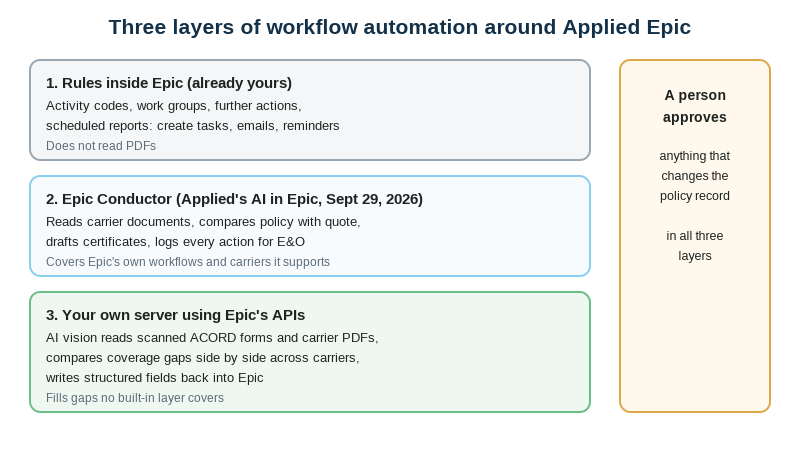
The diagram in text:
- Layer 1, rules inside Epic: activity codes, work groups, further actions, scheduled reports
- Layer 2, Epic Conductor: reads carrier documents, checks policy against quote, drafts certificates, logs every action for E&O
- Layer 3, your own server with Epic’s APIs: AI vision reads scanned ACORD forms and carrier PDFs, compares coverage gaps, writes structured fields back
- Side note: a person approves anything that changes the policy record
The renewal run, step by step:
- Trigger. A scheduled expiration report creates the renewal activity, as Applied’s user group describes.
- Collect. Renewal offers arrive from carriers as emailed PDFs and downloads.
- Read. AI vision pulls limits, deductibles, endorsements and exclusions, each with its page number.
- Compare. The server lines the carriers up and marks gaps against the expiring policy.
- Flag. Renewals with a lowered limit or a dropped endorsement go to the top of the producer’s list.
- Approve. A licensed person confirms the summary, then the fields are written to Epic.
For the renewal side in more depth, see insurance agency renewal automation software, and for the reading step see extracting data from ACORD forms automatically.
Do Zapier or Make connect to Applied Epic? Where sources disagree
Sources disagree on whether Zapier or Make connect cleanly to Applied Epic, so test with your own Epic before you build on either.
There is a calm in an Epic where the reminders, the reading and the comparing each have their own helper. Your team keeps the judgment; the retyping simply stops being theirs.
One automation consultancy, Delegated AI, describes workflows pulling renewal data through the Applied API and tools such as Zapier or Make. A rival vendor, US Tech Automations, argues there is no native Epic connector in Zapier and that workflows need retesting after Epic updates.
Both sell something, so treat both as claims. Applied’s own page confirms only that Epic offers APIs for tools to read and write client and policy data.
| Source | Says | Sells |
|---|---|---|
| Applied Systems | Epic offers APIs; Conductor is AI inside Epic | Epic |
| Delegated AI | Zapier or Make plus the Applied API can pull renewals | Automation services |
| US Tech Automations | No native Zapier connector for Epic; retesting needed | A rival platform |
One more conflict is trivial but real: Applied’s release and trade coverage place the September 29, 2026 announcement in different cities, so I leave the venue out.
How many hours does reading renewals by eye take in a year?
Reading renewals by eye takes about 100 hours a year at 300 renewals and 400 hours at 1,200, by our calculation at 20 minutes each, and about a quarter of that with a 5-minute review of a prepared summary.
| Commercial renewals a year | Hours at 20 minutes each | Hours at a 5-minute review |
|---|---|---|
| 300 | 100 | 25 |
| 600 | 200 | 50 |
| 1,200 | 400 | 100 |
Assumptions, our working count: 20 minutes to open the expiring policy and the renewal offer, find the changed limits and endorsements, and type notes into Epic. The 5-minute review assumes the document was already read and the differences listed. Flagged renewals take longer and are not in the last column.
Which Applied Epic automation should you switch on first?
Switch on the rule layer first, ask Applied about Conductor second, and add your own server third only for documents neither one reads.
- Rules first: free to use if you already have Epic, and fixes missed reminders.
- Conductor second: promising for in-Epic reading, but no price or rollout date is published.
- Your server third: fits scanned ACORD forms, multi-carrier comparison and anything arriving outside Epic.
Our automated insurance policy comparison tool guide shows the comparison output in detail.
What does a licensed person still check?
A licensed person still checks every coverage difference the AI flags, every field before it overwrites the policy record, and any advice to a client.
- Does each flagged limit, sublimit and endorsement match the page it points to?
- Was the right client and policy term matched in Epic?
- Did the summary leave out anything a carrier states only in a footnote?
- Is the note you send the client your own judgment, not the machine’s?
Epic Conductor’s own pitch of logging every action for E&O points the same way: an audit trail matters.
How we researched this
- Read Applied Systems’ Epic page, the Epic Conductor press release (September 29, 2026) and the Insurance Business launch article on November 28, 2026.
- Read the Applied Client Network article on work groups, reports and further actions (January 8, 2025).
- Read two vendor blogs on Epic and Zapier and flagged both as sellers.
- Built the time table from stated assumptions.
- What we did not do: we did not use Epic Conductor, did not test any connector, and found no Reddit thread that gave a reliable account, so we claim none.
Take your next five renewals, let an automated read sit beside your team, and see how many differences are listed before the first coffee.
Sources and further reading
- Applied Systems: Applied Launches Epic Conductor, Bringing Native AI to Applied Epic (September 29, 2026)
- Applied Systems: Applied Epic agency management system
- Insurance Business: Applied Systems builds AI directly into Epic
- Applied Client Network: Tips on Utilizing Work Groups, Reports and Further Actions in Applied Epic (January 8, 2025)
- Delegated AI: AI Automation Specialist for Insurance Agencies (vendor)
- US Tech Automations: Why Zapier Falls Short for Insurance Agencies (vendor)
Questions and answers
Can I use AI to automate Applied Epic workflows?
Yes, in two ways. Applied’s own Epic Conductor, announced September 29, 2026, puts AI inside Epic to read carrier documents and check policies against quotes. Or your own server can read carrier PDFs and scanned ACORD forms with AI vision and write fields back through Epic’s APIs. A licensed person approves what changes the record.
What workflow automation is built into Applied Epic?
Activity codes, work groups, further actions and scheduled reports. Per the Applied Client Network, they create tasks, reminders and renewal-verification activities. They route work but do not read documents.
What is Epic Conductor?
Epic Conductor is Applied Systems’ AI platform built into Applied Epic, announced September 29, 2026. Applied says it reads carrier documents, checks policies against quotes and logs every action for E&O. No price or rollout date is published.
Does Zapier work with Applied Epic?
Sources disagree. One consultancy describes Zapier or Make workflows using the Applied API, while a rival vendor says there is no native Epic connector. Applied confirms Epic offers APIs. Test with your own Epic.
How much time can workflow automation save in an Epic agency?
By our calculation, reading 600 renewals a year at 20 minutes each is about 200 hours, and a 5-minute review of a prepared summary is about 50. Your numbers depend on your agency’s real minutes per renewal.