Automated Certificate of Insurance Generator: Fast COIs, Checked First
Hello to everyone whose phone lit up with need a cert by 7 a.m.
while the coffee was still brewing.
If your inbox has three certificate requests marked urgent and it’s not even ten o’clock, this guide is for you.
One general contractor wants your client’s certificate before the crew can step on site tomorrow.
Another wants a waiver of subrogation that may not be on the policy, and someone has to look before anything is sent.
Short answer: An automated certificate of insurance generator reads each request, checks the holder and the wording asked for against the client’s policy and endorsements in your agency management system, and fills an ACORD 25 (2025/12) from the master certificate. Clean requests go out with a CSR’s approval; anything the policy doesn’t support is flagged for a licensed person.
- The form to print now
- ACORD 25 (2025/12), which replaced the 2016/03 edition (ACORD December 2025 bulletin)
- Old edition cut-off
- Issuing ACORD 25 (2016/03) after December 1, 2026 breaks ACORD’s license terms, according to Big “I” New York
- Built-in generators
- Applied Service Portal, Vertafore’s Certificates tool with InsurLink, EZLynx Client Center and HawkSoft Self-service Certificates (table below)
- Typing time
- About 42 to 84 CSR hours a month at 20 requests a weekday, by our calculation below
- AI reading cost
- About 2 to 5 cents a request with Claude Sonnet 5.5, by our calculation below
Why do certificate requests take so much of a CSR’s day?
Certificate requests take so much time because each one is urgent for the client, small enough to interrupt anything, and still needs a careful check of what the holder is asking for against what the policy really says.
The job is common enough to be a role of its own. A commercial lines service representative posting from Archer Risk Services lists the duty to Process and issue a high volume of Certificates of Insurance (COIs)
.
The same posting names the slow part: Review contractual insurance requirements and ensure certificates are issued accurately and in compliance with policy terms
. Filling the form is quick. Reading the general contractor’s insurance exhibit and checking each requirement is where the minutes go.
And the timing is never kind. The request arrives at 4:40 on a Friday, because the crew starts Monday at 7.
What is an automated certificate of insurance generator?
An automated certificate of insurance generator is software that turns a certificate request into a filled, current ACORD certificate using the coverage already stored in your agency management system (AMS), then sends it to the holder and logs it.
There are two kinds, and most agencies end up using both:
- Template generators: your AMS or client portal issues a certificate from a master certificate you built, for a holder someone types in. Every major AMS has one.
- Request readers: an AI step reads the incoming email and any contract exhibit, pulls out the holder and the requirements, checks them against the policy, and hands a ready certificate or a flag to your CSR.
The first kind removes the typing. The second removes the reading and the checking, which is the part that actually eats the afternoon.
Which agency management systems already generate certificates?
All four of the systems most independent P&C agencies use already generate ACORD certificates from a master certificate, and each lets clients issue their own through a portal.
| System | Where certificates come from | Client self-service | Worth knowing |
|---|---|---|---|
| Applied Epic with the Service Portal (formerly Applied CSR24) | Coverage and insured data pulled from Applied Epic, on current ACORD forms or agency templates | Clients request certificates on the web or the agency’s app; the agency controls who can reissue | Since January 2026, emailed certificates carry a validation link and QR code for the holder |
| Vertafore AMS360 with the Certificates tool in AgencyOne | Master certificates in eForms Manager, or the newer Certificates tool using real-time AMS data | Clients generate and access certificates 24/7 through InsurLink | The Certificates tool needs AgencyOne with AMS360 and InsurLink (April 16, 2026 release) |
| EZLynx with Client Center | Certificate masters in EZLynx | Agent enables Client Center Certificate Self-Generation on a master, so the insured can add holders | At renewal the new master must be reshared; inactive holders don’t carry forward |
| HawkSoft with Self-service Certificates | ACORD 25 masters built in HawkSoft’s certificate wizard | Insureds add holders, print or email from an online portal | A HawkSoft Marketplace add-on; attached documents are not included in the published certificate |
If your agency already pays for one of these, turn it on for your steadiest commercial clients first. A contractor who issues their own certificate for the same three general contractors every month never needs to email you at all.
What do built-in certificate generators leave to your CSR?
Built-in generators leave the reading to your CSR: someone still has to open the request, work out what the holder wants, and decide whether the policy supports it before any template is used.
A template only knows what was put into the master certificate. It can’t read a general contractor’s email asking for additional insured status, primary and non-contributory wording, a waiver of subrogation and 30-day notice, then tell you which of those four the policy really backs.
There’s a data trap, too. Vertafore’s AMS360 certificate help says edits made on the form are kept there: The data is not saved in the policy database and does not flow back to the Policy data entry form.
A hand-typed limit on a certificate can quietly drift away from the policy record.
And self-service only works for clients who log in. The rest still email the request, often with a 30-page subcontract attached and the insurance section on page 22.
Which ACORD 25 edition should a certificate generator print?
A certificate generator should print ACORD 25 (2025/12), the Certificate of Liability Insurance edition ACORD released in December 2025 to replace the 2016/03 edition that agencies used for almost ten years.
ACORD’s December 2025 bulletin says the form has been filed and approved by all applicable States
. The headline change is one new sentence in the certification paragraph:
LIMITS SHOWN ARE INCLUSIVE OF AMOUNTS REQUESTED BY THE CERTIFICATE HOLDER AND MAY NOT REFLECT POLICY LIMIT AMOUNTS IN EXCESS OF THOSE REQUESTED.
The bulletin also lists an updated logo and copyright line, a *Not Applicable in WY
footnote and a reformatted coverages grid with the same data fields.
The date that matters is December 1, 2026. Big “I” New York explains that ACORD’s license lets a replaced edition be used for no more than 12 months, and says Anyone issuing ACORD 25 (2016/03) after next December 1 will be in violation of the terms of the ACORD license.
The AMS makers have been updating. Vertafore’s May 20, 2026 AMS360 service pack notes list fix F34952: Updated ACORD 25 (2025/12) Certificate of Liability Insurance
.
How does an automated certificate generator work, step by step?
An automated certificate generator works by reading the request into structured items, checking each one against the policy in your AMS, and only then filling the certificate, so the coverage on the form always comes from the policy and never from the request.
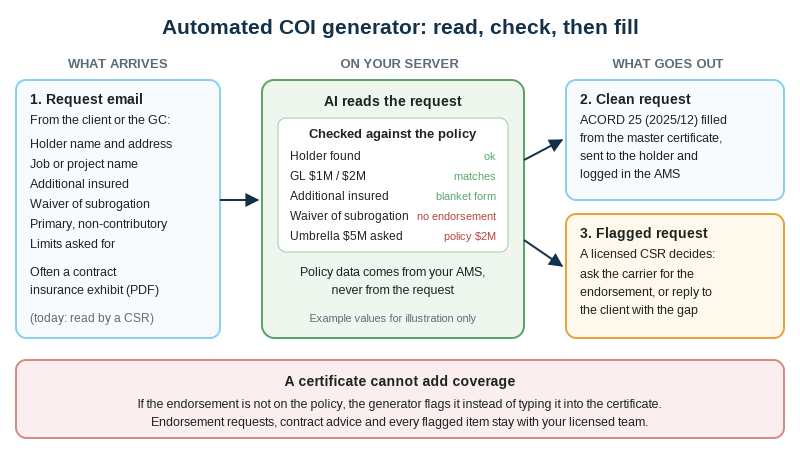
The diagram in text:
- What arrives: a request email from the client or general contractor with the holder’s name and address, the job, the wording asked for and often a contract insurance exhibit as a PDF
- On your server: AI reads the request and checks each item against the policy and endorsements in your AMS, in the example finding the holder, matching $1M / $2M general liability limits and a blanket additional insured form
- Flagged in the example: no waiver of subrogation endorsement, and $5M umbrella asked for against a $2M policy
- Clean request: ACORD 25 (2025/12) filled from the master certificate, sent to the holder and logged in the AMS
- Flagged request: a licensed CSR asks the carrier for the endorsement or replies to the client with the gap
The automated run, step by step:
- Trigger. A request lands in a shared certificates inbox, a web form, or a portal request.
- Read. AI pulls the named insured, holder name and address, project, policies and limits asked for, and wording such as additional insured, waiver of subrogation and primary and non-contributory.
- Match. The server finds the client and the current master certificate in your AMS.
- Check. Each requirement is compared with the policy’s limits, dates and endorsement list, and marked supported, not supported or unclear.
- Fill. For a fully supported request, the certificate is issued from the master on ACORD 25 (2025/12) with the holder added.
- Approve. A CSR sees the request beside the draft and clicks send, or edits.
- Send and log. The certificate goes to the holder, a copy is saved to the client in the AMS, and the holder is kept for next year’s renewal batch.
- Flag. Anything not supported goes to a licensed person with the reason, ready for an endorsement request to the carrier.
If the request is an application rather than a certificate, the same reading step is covered in our guide to extracting data from ACORD forms automatically.
What can a certificate of insurance never do, even when software fills it?
A certificate of insurance can never add, change or extend coverage, so an automated generator must refuse to type wording the policy doesn’t already support.
There is a calm in a certificate inbox where the routine requests are already drafted and only the tricky ones wait for you. Your team keeps the judgment about endorsements; the copying and the hunting simply stop being theirs.
The NCOIL Certificates of Insurance Model Act, first adopted in 2012 and readopted on July 16, 2022, puts it plainly in Section 3D:
A certificate of insurance is not a policy of insurance and does not affirmatively or negatively amend, extend, or alter the coverage afforded by the policy to which the certificate of insurance makes reference.
Section 4B adds that a certificate may not warrant that the policy meets a contract’s insurance requirements. Section 5 says a holder gets cancellation notice only if the policy or an endorsement grants it.
The model is widely law. Big I Tennessee says Tennessee’s version, in effect since July 1, 2020, is based on model legislation that has been adopted in over 30 other states.
Check your own state’s version before you set the rules.
For a generator, that law becomes three hard rules:
- Additional insured, waiver of subrogation and primary and non-contributory go on the certificate only when the matching endorsement is on the policy.
- Limits come from the policy record, never from the amount the holder asked for.
- No promised notice of cancellation beyond what the policy says.
How many CSR hours do certificates take each month?
Certificates take roughly 42 to 84 CSR hours a month at 20 requests a weekday, by our calculation, and about 14 hours if most requests only need a two-minute review.
| Requests per weekday | Hours at 6 minutes each | Hours at 12 minutes each | Hours at a 2-minute review |
|---|---|---|---|
| 5 | 10.5 | 21 | 3.5 |
| 10 | 21 | 42 | 7 |
| 20 | 42 | 84 | 14 |
| 30 | 63 | 126 | 21 |
Assumptions, our working count for one manual request: 1 minute to read the email, 1 minute to find the client and master certificate, 2 to 6 minutes to check the holder’s wording against the endorsements, 1 to 3 minutes to fill and send, and 1 minute to log it. That’s 6 to 12 minutes.
The two-minute review assumes the request was already read, matched and checked, so the CSR only compares the draft with the request and clicks send. Flagged requests take longer and are not in that column.
What does it cost to read a certificate request with AI?
Reading one certificate request costs about 2 cents with Claude Sonnet 5.5 when it’s a plain email, and about 4 to 5 cents when a three-page contract insurance exhibit is attached, by our calculation at Anthropic’s public prices.
Anthropic’s PDF support page says each page uses 1,500 to 3,000 text tokens, and each page’s image uses at most 1,568 visual tokens. The pricing page lists Claude Sonnet 5.5 at $2 per million input tokens and $10 per million output tokens, and Claude Haiku 5.5 at $0.10 and $0.50 for prompts up to 100,000 tokens.
| Request | Input tokens | Sonnet 5.5 per request | Haiku 5.5 per request | Sonnet 5.5, 420 a month |
|---|---|---|---|---|
| Email only | 3,000 | $0.021 | $0.001 | $8.82 |
| Email plus 3-page contract exhibit | 12,204 to 16,704 | $0.039 to $0.048 | $0.002 | $16.55 to $20.33 |
Assumptions: 1,000 tokens of email, 2,000 tokens of instructions and policy data from the AMS, 3,068 to 4,568 tokens per exhibit page, and 1,500 output tokens per request. Four hundred twenty requests is 20 a weekday for 21 weekdays. Hosting, setup and review time come on top.
Self-service portal, AMS tool or AI request reader: which should you start with?
Start with the portal or certificate tool your AMS already has, because it removes the typing for repeat holders at little extra effort, and add an AI request reader for the emailed requests with special wording.
- Repeat holders, steady clients: the AMS portal (Applied Service Portal, InsurLink, EZLynx Client Center or HawkSoft Self-service Certificates).
- High volume from your own team: master certificates and batch renewal issuing inside the AMS.
- Emails with contract exhibits and special wording: an AI request reader on your server that checks endorsements and drafts the certificate for approval.
A request reader also pays off twice. The endorsement list it keeps current is the same data your renewal flags use to spot a dropped waiver at renewal, and new holders captured at client intake are ready on day one.
Where do the sources on certificate automation disagree?
The sources disagree on how to fill the limits boxes on the new ACORD 25, which edition is current, and how much time automation saves, so check each claim against your own office.
- Limits on ACORD 25 (2025/12): ACORD’s new sentence allows limits that reflect what the holder asked for, while Big “I” New York advises agencies to
input the limits shown in the policy declarations in those fields
regardless. A generator should follow your agency’s written choice. - Is the old edition illegal? Big “I” New York says using ACORD 25 (2016/03) is legal but breaks ACORD’s license after December 1, 2026. Some explainer pages online still call 2016/03 the current edition.
- Speed: Vertafore’s April 16, 2026 release speaks of distributing
hundreds of certificates in seconds
, which describes sending, not checking contract wording. No independent measurement of checked certificates was public on November 28, 2026.
For many agencies, the back-and-forth of certificate requests is a persistent source of friction
What should a licensed person still check before a certificate is sent?
A licensed person should still check every flagged requirement, every new holder with special wording, and any certificate tied to a contract, because a wrong certificate can mislead a holder about coverage that isn’t there.
- The holder’s name and address match the contract or request exactly
- The policies, numbers and dates are the current term, not last year’s
- Additional insured, waiver and primary and non-contributory boxes are ticked only where the endorsement exists
- The description of operations names the job, without promising contract compliance
- The form is ACORD 25 (2025/12), and limits follow your agency’s written policy
- The certificate and request are saved to the client in your AMS
Start small: run next week’s certificate emails through an AI read beside your CSR and compare its flags with what your team caught by hand.
If the drafts match and the missing waiver gets caught before the crew shows up, you’ll know what an automated certificate of insurance generator can take off your desk.
How we researched this
- Read ACORD’s December 2025 forms bulletin (dated January 16, 2026) for the ACORD 25 (2025/12) changes, and Big “I” New York’s April 3, 2026 note on the edition change and license date.
- Read the full NCOIL Certificates of Insurance Model Act (readopted July 16, 2022) and Big I Tennessee’s page on Tennessee’s certificate law.
- Read the official certificate pages of Applied Systems (Service Portal and its release hub), Vertafore (AMS360 help, the April 16, 2026 Certificates release and May 20, 2026 service pack notes), EZLynx support and HawkSoft help, on November 28, 2026.
- Searched Reddit and agent forums for certificate request threads; the threads were not reachable to us, so the workload picture comes from a public CSR job posting and the makers’ own pages.
- Built the time and cost tables from stated assumptions and Anthropic’s published token and price figures.
- What we did not do: we did not test any of the four AMS certificate tools or time real requests in an agency.
Run one week of certificate emails through an automated read beside your team, and see how many drafts are waiting before the first request is even opened.
Sources and further reading
- ACORD: Forms Notification Service, December 2025 Bulletin (ACORD 25 2025/12)
- Big "I" New York: The Old ACORD Certificate Form Is Not Illegal. Stop Using It. (April 3, 2026)
- NCOIL: Certificates of Insurance Model Act (readopted July 16, 2022)
- Big I Tennessee: Certificates of Insurance
- Applied Systems: Service Portal (formerly Applied CSR24), certificates of insurance
- Applied Systems: Service Portal product release hub (instant certificate validation, January 2026)
- Vertafore: integrated Certificates solution press release (April 16, 2026)
- Vertafore: AMS360 help, Certificate of Liability Insurance
- Vertafore: AMS360 Service Pack Release Notes 05.20.2026 (ACORD 25 2025/12)
- EZLynx: ID Cards, Binders, Evidence of Insurance, and Certificate Masters
- EZLynx: Certificate Holder Management
- HawkSoft: Self-service Certificates help
- Archer Risk Services: Commercial Lines Service Representative job posting
- Anthropic: PDF support (page text plus page image)
- Anthropic: API pricing (Claude Sonnet 5.5, Claude Haiku 5.5)
Questions and answers
Can I use AI to generate certificates of insurance automatically?
Yes. AI can read each certificate request email and contract exhibit, check the holder and wording against the client’s policy and endorsements, and draft an ACORD 25 (2025/12) from the master certificate in your agency management system. A CSR approves it before sending, and anything the policy doesn’t support goes to a licensed person.
Can I still use the ACORD 25 (2016/03) certificate?
Not after December 1, 2026 under ACORD’s license terms. Big “I” New York explains that ACORD lets a replaced edition be used for no more than 12 months after the new one, and ACORD 25 (2025/12) was released in December 2025. Big “I” New York says using the old form is legal, but breaks the license after that date.
Can clients issue their own certificates of insurance?
Yes, if your agency turns it on. Applied’s Service Portal, Vertafore’s InsurLink with the AgencyOne Certificates tool, EZLynx Client Center and HawkSoft’s Self-service Certificates add-on all let insureds issue certificates or add holders from a master certificate the agency controls.
Can a certificate of insurance add an additional insured?
No. Under the NCOIL Certificates of Insurance Model Act and the state laws based on it, a certificate does not amend, extend or alter coverage. Additional insured status comes from an endorsement on the policy, so the certificate can only show it when the endorsement exists.
How much does an automated certificate generator cost to run?
The AI reading is cheap: by our calculation at Anthropic’s public prices, about 2 cents per plain email and 4 to 5 cents with a three-page contract exhibit on Claude Sonnet 5.5, or about $9 to $20 a month for 420 requests. AMS portal add-ons are priced by each vendor, and setup and review time come on top.