Insurance Agency Automation in Dallas-Fort Worth, Texas (2026)
Every hail season in North Texas, the same renewal question comes back: what changed in the fine print?
I wanted to know what the independent agencies around Dallas and Fort Worth really face, so on November 29, 2026 I read the Texas Department of Insurance’s public agency license file and counted it myself.
The same morning I read the Census Bureau’s metro numbers, a Cotality hail report from March and a Texas renewal guide from October.
Three facts stood out. The metro added 177,922 people in one year, the state licenses 9,414 active property and casualty agencies, and hail is the line item most DFW renewals now argue about.
Short answer: Dallas-Fort Worth agencies can automate three jobs first: comparing carrier policy PDFs side by side, pre-filling intake and ACORD forms, and flagging risky renewals. A server reads the PDFs with AI vision, lines up deductibles and endorsements, and syncs structured data into your AMS. A licensed broker still checks every flag.
Why do Dallas-Fort Worth agencies feel the paperwork first?
Because Dallas-Fort Worth is growing faster than almost any U.S. metro, and every new business and building brings its own policy, ACORD form and renewal date.
The Census Bureau’s Vintage 2024 estimates put the Dallas-Fort Worth-Arlington metro at 8,344,032 people on July 1, 2024, up 177,922 in a year. Only New York and Houston added more. See the Census Bureau’s county and metro release.
| Rank | Metro | Population, July 1, 2024 | Added in one year |
|---|---|---|---|
| 1 | New York-Newark-Jersey City | about 19.9 million | 213,403 |
| 2 | Houston-Pasadena-The Woodlands | 7,796,182 | 198,171 |
| 3 | Dallas-Fort Worth-Arlington | 8,344,032 | 177,922 |
More people means more small commercial accounts to write: restaurants, contractors, dental offices, trucking outfits and the strip centers that house them. Each one arrives as a pile of PDFs and an ACORD 125.
How many insurance agencies are there in Dallas-Fort Worth?
By our count of the Texas Department of Insurance open data, 2,548 active property and casualty general lines agency licenses sit in 60 Dallas-Fort Worth cities, about 27 percent of the 9,414 in the whole state.
The state publishes one row per agency license on data.texas.gov. We filtered to the General Lines Agency license with the Property and Casualty qualification and an expiration date after November 29, 2026.
| Place | Active licenses |
|---|---|
| Texas, all cities | 9,414 |
| Houston | 1,225 |
| Dallas | 521 |
| San Antonio | 449 |
| Austin | 408 |
| Fort Worth | 209 |
| Plano | 197 |
| Irving | 122 |
| Frisco | 118 |
| Arlington | 117 |
| 60 DFW cities together (our list) | 2,548 |
In short: Dallas alone has 521 agency licenses, and the 60-city DFW area has 2,548, so a client is never far from a competitor who can quote the same carriers.
The file also shows newcomers. In the DFW list, 1,018 of the active licenses were issued after November 29, 2021, which is 26 percent of the 3,911 new active licenses statewide in that period.
We count licenses by the city on the license record, not where an agency’s clients are, and our 60-city list is our own choice of DFW suburbs. Treat the numbers as a close count, not an official one.
What does hail do to a Dallas-Fort Worth commercial renewal?
Hail turns the renewal into a fine print reading job, because the wind and hail deductible and the roof terms often change even when the premium does not.
In 2025, more than 235,000 Texan homes experienced damaging hail, far exceeding any other state.
That release is about homes, and it places Dallas-Fort Worth in the Texas Triangle with Houston, Austin and San Antonio, which together hold more than $2.2 trillion in exposed replacement cost value. Commercial buildings share the same sky.
The Agent’s Office, a Texas renewal guide dated October 7, 2026, describes three terms an account manager has to find on every property renewal:
- Wind and hail deductible: often written as a percentage of the building’s insured value, not a flat dollar amount.
- Roof valuation: the ISO endorsement CP 10 36, Limitations on Coverage for Roof Surfacing, can change roof valuation and exclude cosmetic wind or hail damage.
- Carrier roof-age schedules: some carriers pay roofs on their own age-based schedules.
An example from the same guide’s math: a 2 percent deductible on a $500,000 building means the client pays the first $10,000 of a hail claim. Whether that number moved since last year is exactly what a comparison tool should show first.
Why are property rates falling when the fine print is not?
Because the headline price and the terms are two different things, and the sources we read do not even agree on the price.
| Measure | Reported change | Attributed to |
|---|---|---|
| Commercial property premiums, Q2 2026 | down an average of 6.3% | CIAB, August 18, 2026 |
| U.S. property rates | down 13% | Marsh Global Insurance Market Index, July 23, 2026 |
The two numbers measure different things, so both can be true. For a DFW client the useful question is the one a rate chart cannot answer: did the deductible, the roof terms or the form edition change?
The same guide cites Gallagher’s Fall 2025 market update saying some non-coastal Texas real estate accounts moved 5 percent wind and hail deductibles down to 2 or 3 percent. That is a reported trend, not a promise for your accounts. Check each offer.
Which three jobs can a Dallas-Fort Worth agency automate first?
Policy comparison summaries, pre-filled intake forms, and renewal risk flags, because they are the three places brokers lose the most hours to reading and retyping.
- Policy comparison summaries: a server reads each carrier’s PDF and lines up limits, deductibles, forms and endorsements in one grid. Our guide to an automated insurance policy comparison tool shows the grid.
- Pre-filled intake forms: the client’s answers are typed once, then fill the ACORD forms and carrier applications. See how to extract data from ACORD forms automatically.
- Renewal risk flags: the renewal offer is read against the expiring policy and a lowered limit or a new roof exclusion goes to a person. Details in insurance agency renewal automation software.
Re-keying is the loudest complaint. In Applied Systems’ 2026 survey of 702 independent agents, 74 percent named re-keying risk data into multiple carrier portals as their top pain point. See the Applied Systems press release.
How does a server read carrier PDFs and fill my agency management system?
It treats each page as an image plus text, extracts the fields you care about with page numbers, compares them, and writes the result into your AMS through its API or an import.
A renewal that arrives with its changes already listed is a calmer kind of storm season. Your account managers still make the call; they just stop spending the afternoon finding out what the call is about.
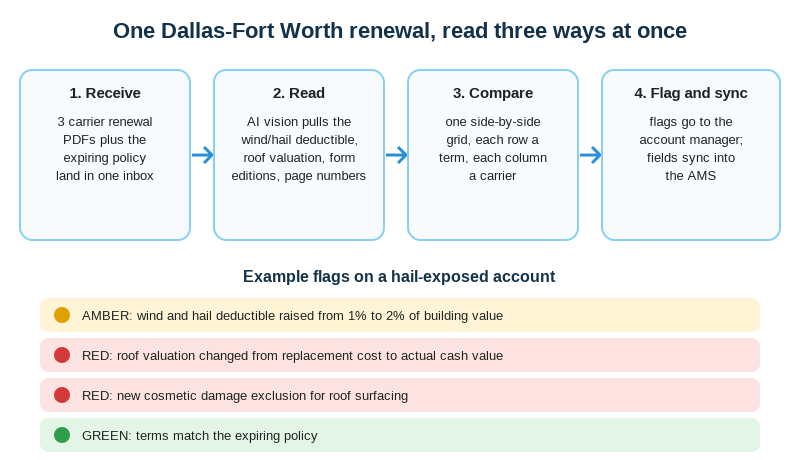
The four example flags in the picture, as text:
- Amber: wind and hail deductible raised from 1% to 2% of building value.
- Red: roof valuation changed from replacement cost to actual cash value.
- Red: new cosmetic damage exclusion for roof surfacing.
- Green: terms match the expiring policy.
Anthropic’s documentation describes how Claude reads PDFs as page images and text, which is what lets it handle scanned ACORD forms. See Anthropic’s PDF support page. Our earlier estimate for reading three 50-page quotes is roughly $1.04 to $1.49 in model fees.
Where the data lands depends on your system:
- Applied Epic: Applied says Epic offers APIs for outside tools.
- AMS360: Vertafore lists an open API and third-party integrations.
- HawkSoft: a Partner API for approved vendors.
- EZLynx: an Applied Systems product; ask your rep which route your plan includes.
How much do hand-compared renewals cost a Plano-size agency?
About $18,000 a year in staff time for 400 commercial renewals, on the stated assumptions below.
| Commercial renewals a year | Hours per account | Hours a year | Cost at $30 an hour |
|---|---|---|---|
| 150 | 1.5 | 225 | $6,750 |
| 400 | 1.5 | 600 | $18,000 |
| 800 | 1.5 | 1,200 | $36,000 |
Assumptions: 45 minutes to compare three carrier offers by eye, plus 45 minutes to re-key into three portals (a vendor, QuoteSweep, puts manual entry at 15 to 20 minutes per carrier), and $30 an hour as a rough loaded rate. These are our numbers, not a survey. Time your own team for one week.
Where does a licensed Texas broker still have to decide?
At every flag, every recommendation and every bind. The automation reads and lines things up; it does not advise.
- Open every red flag next to the carrier’s source page before the proposal goes out.
- Confirm form numbers and editions, not only the word “included”.
- Check client contracts, such as leases and loan documents, against the roof and deductible terms.
- Keep the original carrier PDFs attached to the client record in the AMS.
The tool compares only what you give it. It cannot tell you about a carrier you never approached.
What does a sensible first month look like for a DFW agency?
Run it in shadow mode on accounts you already compared by hand, then widen only after the grid matches your own spreadsheets.
- Week 1: pick ten commercial property accounts with hail exposure and run the same PDFs through the tool.
- Week 2: compare its grid with your own, line by line, and note every miss and every catch.
- Week 3: turn on renewal flags for the accounts renewing in the next 90 days.
- Week 4: count the hours saved and the gaps caught, then decide whether it stays.
If it does not save real time on your own policies in that month, it is not worth keeping.
How we researched this
- Counted the Texas Department of Insurance agency license file on data.texas.gov on November 29, 2026 (General Lines Agency, Property and Casualty, expiring after that date). The DFW figure uses a list of 60 cities we chose.
- Read the Census Bureau’s Vintage 2024 metro table, Cotality’s March 24, 2026 hail release, The Agent’s Office guide (October 7, 2026) and Applied Systems’ 2026 survey release, plus the AMS makers’ pages.
- Searched for Reddit and forum threads on re-keying and comparing quotes; the results were vendor blogs, so no forum quotes are used.
- The CIAB and Marsh figures come through The Agent’s Office; we did not open the originals. The time-cost table is our own arithmetic.
- We did not install or test any tool, and this is not legal or insurance advice.
Try one month of hail-exposed renewals read beside your team, and see which deductible changes surface before the client asks.
Sources and further reading
- U.S. Census Bureau: Growth in Metro Areas Outpaced Nation (Vintage 2024)
- Texas Department of Insurance via data.texas.gov: agency license file
- Cotality: Hail now a leading driver of insured losses (March 24, 2026)
- The Agent’s Office: Texas Commercial Property Insurance Renewal (agency guide)
- Applied Systems: 2026 agency-carrier connectivity survey
- Anthropic: PDF support
- Applied Systems: Applied Epic
- Vertafore: AMS360
- HawkSoft: API partners
- EZLynx: management system
Questions and answers
Can I use AI to automate an independent insurance agency in Dallas-Fort Worth?
Yes, for the reading and retyping. A server can read carrier PDFs and scanned ACORD forms with AI vision, compare coverage side by side, pre-fill intake forms and flag risky renewals, then sync fields into your AMS. A licensed broker still reviews flags, advises and binds.
How many property and casualty insurance agencies are in Dallas-Fort Worth?
By our November 29, 2026 count of Texas Department of Insurance open data, 2,548 active P&C general lines agency licenses have a mailing city in our 60-city DFW list, out of 9,414 in Texas. Dallas alone has 521.
Why do hail deductibles matter for DFW commercial renewals?
Many Texas commercial property policies carry a separate wind and hail deductible written as a percentage of building value, so a change from 1 to 2 percent on a $500,000 building moves the client’s share of a claim to $10,000. It must be found at every renewal.
Does this work with Applied Epic, AMS360, HawkSoft or EZLynx?
Usually. Each maker offers an API, an approved partner route or an import, and which applies depends on your version and contract. Ask your rep how an outside program can update a policy record and attach a PDF.
Do I need to replace my agency management system?
No. The automation sits next to the system you already use and writes into it. If your AMS only allows manual entry, the tool can still produce a finished summary your team pastes in once.