How to Stop Manual Rekeying Into Carrier Portals (Key It Once)
Hello to everyone typing the same address into a fourth carrier portal.
Every commercial desk I read about ends up in the same place: one client, one set of facts, typed again into every carrier’s screen.
On November 29, 2026 I read the Applied Systems and Ivans 2026 connectivity survey release, Applied’s Ivans Download page and EZLynx’s Rating Engine page, instead of the blogs that quote each other.
Three facts stood out. In that survey, 74 percent of agents named rekeying risk data into multiple carrier portals as a top pain point, 90 percent had cut business with a carrier over submission friction, and every flow Ivans Download describes runs from the carrier to the agency.
Short answer: To stop manual rekeying into carrier portals, key each client once into a master record, then let a server fill the rest. AI vision reads the signed ACORD scan and dec pages, the fields sync to your AMS, and each carrier’s form is drafted from the same record. A licensed person approves before anything is sent.
How can one entry fill every carrier’s form?
A server reads your source files once, stores every field with the page it came from, and maps those fields to each carrier’s own form layout.
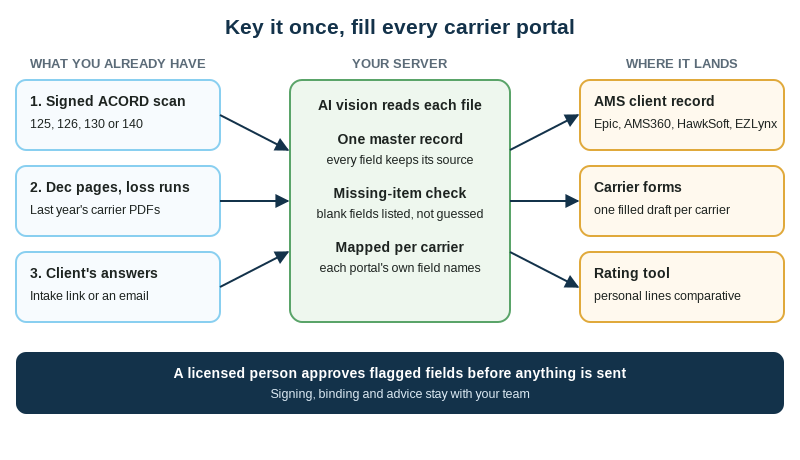
- Collect. The signed ACORD 125 scan, last year’s dec pages and the client’s answers arrive in one place.
- Read. AI vision turns each file into fields: names, addresses, payroll, vehicles, limits, loss history.
- Flag. Fields it cannot read or finds in conflict are listed, never guessed.
- Fill. The record syncs into the AMS and drafts each carrier’s submission.
- Approve. A CSR or producer checks the flags and sends.
The picture’s text, in short: three sources go in, one master record sits in the middle, and the AMS, the carrier forms and a rating tool come out.
How common is rekeying into carrier portals?
Very: in a 2026 survey of 702 independent agents, 74 percent named it the top pain point, and commercial agencies reported it more than personal lines agencies.
| Finding | Share of agents |
|---|---|
| Reduced business with a carrier because of submission friction | 90% |
| Rekey risk data into multiple carrier portals (top pain point) | 74% |
| Rekey, commercial lines-heavy agencies | 70% |
| Rekey, personal lines-focused agencies | 62% |
| Commercial agencies relying on email for submissions | 49% |
| Commercial agencies using dedicated submission capture software | 7% |
Source: the Ivans press release. The survey was voluntary and online, and Applied sells carrier connectivity, so read it as a sign of the pain, not a neutral census.
The gap between 49 percent email and 7 percent capture software is the part worth a second look. Most commercial desks still have no tool between the PDF and the portal.
Doesn’t carrier download already solve this?
Download solves the way back from the carrier to your AMS. It does not fill a carrier’s quote screen on the way out.
Applied describes Ivans Download as carriers sending policy, claims and billing updates to agencies, with 1.6 million transactions a day and more than 38,000 agencies connected. Every flow on that page runs carrier to agency; it does not describe agencies sending submissions the other way.
| Tool | Moves data | Does not do |
|---|---|---|
| Ivans Download | Carrier to AMS: policies, claims, eDocs, commissions | Fill a new submission |
| Comparative rater | One entry to many personal lines quotes | Cover most commercial forms |
| Our approach | Your files to a record to each carrier form and the AMS | Sign, bind or advise |
Download also does not read the commercial package PDFs carriers often send as attachments. For that read, see AMS360 data entry automation.
Can a comparative rater like EZLynx stop the rekeying?
For personal lines, largely yes. For commercial accounts, usually only in part.
EZLynx’s Rating Engine is built so an agent enters a risk once and gets quotes from several carriers, mainly auto, home and dwelling fire. That is exactly the “key it once” idea, applied to the lines a rater supports.
A restaurant with three locations, a fleet schedule and a payroll split by class code is a different shape. It is often a supplemental form or a portal screen per carrier, which is where the retyping returns.
How does a server read your ACORD and fill carrier forms?
It reads the scan with AI vision, writes structured fields, and maps them to each destination you have approved.
- Input: uploaded ACORD 125, 126, 130 or 140 scans, dec pages and loss runs. Our guide to extracting data from ACORD forms automatically covers the reading step.
- Record: one master client record with the source page beside each value. Automated client intake shows how the client’s own answers join it.
- Sync: the fields are written into the AMS through its import or API, such as Applied Epic, AMS360, HawkSoft or EZLynx.
- Drafts: each carrier’s form or portal values are prepared from the record. For a building, see commercial property quoting from one master record.
One rule keeps this honest: the server fills a draft, and a person presses send.
What if a carrier portal has no import or API?
Then the draft is a ready-to-paste sheet or a prepared submission email, not an automatic fill. Say so to yourself before you buy anything.
There is a calm in a submission that was read once and filled everywhere. Your team keeps the judgment about the account; the retyping simply stops being theirs.
- Ask each carrier or its agency rep whether it accepts a structured submission, an ACORD attachment or an API.
- Where it does, send the file the carrier already takes.
- Where it only has a web form, produce a one-page sheet in that form’s field order so the CSR copies instead of hunting.
- Do not script a login to a portal whose terms forbid it. Check the carrier’s agent agreement first.
We have not tested any carrier’s portal. The right split is your carriers’ own answers, not our guess.
What does a licensed person still check?
Three things: values that changed since last year, fields the reader flagged, and anything that affects coverage.
- Exposures: payroll, revenue, locations and vehicles, because a misread number changes the premium and the audit.
- Answers on the application: the client signs them, so a person reads them.
- The send: binding, advice and signatures are not delegated to software.
Treat the reader as a fast first typist whose work you proofread, not as a source of truth.
How much time does rekeying cost an agency?
About 53 hours a month for 40 commercial submissions to four carriers, on the assumptions below.
| Submissions a month | Carriers each | Minutes per portal | Hours a month | Cost at $30 an hour |
|---|---|---|---|---|
| 20 | 4 | 20 | 26.7 | $800 |
| 40 | 4 | 20 | 53.3 | $1,600 |
| 40 | 6 | 20 | 80 | $2,400 |
| 80 | 4 | 20 | 106.7 | $3,200 |
Assumptions: 20 minutes to key one small commercial account into one portal, and $30 an hour as a rough loaded CSR rate. These are our numbers, not a survey. Time your own team for a week.
How should an agency start?
Start with one line of business and one or two carriers, not the whole book.
- Week 1: list your top three carriers and ask each how it accepts submissions.
- Week 2: pick one account type, such as a contractor, and gather ten past ACORD scans.
- Week 3: run the reader on those ten and compare every field against the originals.
- Week 4: draft real submissions for one carrier, approve each by hand, and count the corrections.
If corrections stay high on one field, fix that mapping before adding a second carrier.
Put together, the survey’s 49 percent email figure, the one-way direction of download and the 20-minute portal entry say the same thing: the cheapest hours to win back sit between a signed ACORD and the first carrier screen, and a rule that your team keys nothing twice is a better first goal than any new portal.
How we researched this
- Read November 29, 2026: the Applied Systems and Ivans 2026 connectivity survey press release, Applied’s Ivans Download page and EZLynx’s Rating Engine page.
- Searched for agent discussions on Reddit; results were trade press and vendor pages, so no forum quotes are used.
- The time-cost table is our own arithmetic from stated assumptions.
- We did not install or test any tool or any carrier portal.
Try one commercial account keyed once and drafted for two carriers, and count the fields your team had to correct.
Sources and further reading
Questions and answers
Can I use AI to stop manual rekeying into carrier portals?
Yes, for the reading and filling. A server can read ACORD scans and dec pages with AI vision, store one master record, sync it to your AMS and draft each carrier’s submission. A person approves, and where a portal has no import, the output is a ready sheet to copy.
Why do agents rekey data into carrier portals at all?
Each carrier has its own screens and forms, and most commercial submissions travel as email and PDF. In a 2026 survey of 702 agents, 74 percent named rekeying a top pain point.
Does Ivans Download stop rekeying?
It sends policy, claims and billing data from carriers to your AMS. Applied’s page describes only carrier-to-agency flows, so it does not fill new submissions.
Will a comparative rater like EZLynx fix it?
For personal lines it lets you enter a risk once and get several quotes. Commercial accounts often still need a form or portal per carrier.
Is it safe to let software fill a carrier form?
It is safe as a draft that a licensed person reviews. The client’s signed answers, the exposures and the send stay with your team.