How to Automate Commercial Property Insurance Quoting
Hello to everyone typing the same warehouse into a fifth carrier portal.
Every commercial property renewal I read about ends the same way: the broker knows the risk by heart and still types it in again.
I spent a day with the public pages of Applied Systems, Vertafore, ACORD and the companies that build submission readers.
Three things stood out: re-keying is the pain agents name first, the values schedule rarely matches the form, and the quotes differ in terms, not just price.
Short answer: To automate commercial property insurance quoting, a service reads the ACORD 125, ACORD 140, values schedule and loss runs with AI vision into one master record, checks that the values add up, fills each carrier’s form or portal from it, reads the returned quote PDFs side by side, and syncs the approved choice to your AMS.
- Files it reads
- ACORD 125 and 140, statement of values, loss runs, scans and photos
- Record it builds
- One master submission, with the page each value came from
- Quotes it compares
- Valuation, coinsurance, causes of loss, deductibles, business income terms
- Who checks
- An account manager, on flagged values and before anything is bound
What does it mean to automate commercial property insurance quoting?
Automating commercial property quoting means software builds the submission once from the client’s documents and carries it to every carrier, instead of a person retyping it into each portal.
It covers three jobs: reading the documents, filling the carrier forms, and reading the quotes that come back. The pricing itself stays with the carrier. Your team keeps the advice and the binding.
Why does quoting one commercial property take so long?
Quoting one commercial property takes long because every carrier asks for the same facts in its own portal, and the agent types them again each time.
Applied Systems’ 2026 connectivity survey of 702 independent agents, completed in April and May 2026, found re-keying risk data into multiple carrier portals is the top pain point, cited by 74% of respondents. Commercial-lines agencies re-key at 70%, against 62% for personal lines.
The portal clock is the other half. QuoteSweep, a quoting vendor, estimates 18 to 35 minutes of manual entry per carrier for a small account. It calls these illustrations, not a measured study.
Which documents does a commercial property quote start from?
A commercial property quote starts from four documents: the ACORD 125 application, the ACORD 140 Property Section, a values schedule, and loss runs.
| Document | What it holds | Why the reader needs it |
|---|---|---|
| ACORD 125 | Named insured, locations, lines wanted | The name must match every other form |
| ACORD 140 | Building, business personal property, business income limits, causes of loss, valuation, coinsurance | The terms each carrier quotes against |
| Values schedule | One row per location with insured values | Totals must match the 140 |
| Loss runs | Prior claims by carrier and year | Carriers ask for them in every portal |
The Hedge Specialty ACORD 140 guide describes the form as the place for buildings, limits, valuation and causes of loss, and the ACORD Forms Index lists the current form numbers.
Our summary: four documents, one record. If a reader gets those four right, every carrier form after it is a copy.
How does the automated commercial property quote workflow run?
The workflow runs in four steps: read the documents, check the values, fill each carrier, then compare the quotes that come back.
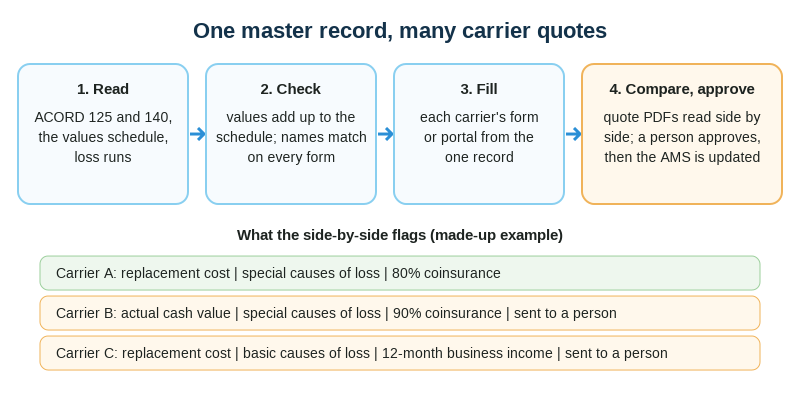
- Read. Your server watches an inbox or folder. Each PDF, scan or photo goes to an AI vision model that returns labelled fields with their page numbers. Anthropic’s documentation covers PDF support and structured outputs.
- Check. The location values must add up to the building and contents limits on the ACORD 140, and the insured’s name must match on every form. A mismatch goes to a person.
- Fill. The master record fills each carrier’s application. Where a carrier offers only a portal, a script keys it in. The agent reviews before it submits.
- Compare. Quote PDFs are read the same way and set side by side. Your account manager sees differences, not 50-page documents.
The same reading step is described in our guides to extracting data from ACORD forms and pulling limits off dec pages.
What does manual commercial property quoting cost an agency each month?
Manual quoting costs an agency 30 to 58 hours a month at 20 submissions to 5 carriers, using QuoteSweep’s per-carrier estimate.
This is our own arithmetic, compiled from the assumptions in the table, November 2026. Replace them with a week of your own timings.
| Item | Low | High |
|---|---|---|
| Minutes per carrier, by hand (QuoteSweep estimate) | 18 | 35 |
| Carriers per submission (our assumption) | 5 | 5 |
| Submissions per month (our assumption) | 20 | 20 |
| Hours per month, by hand | 30.0 | 58.3 |
| Hours per month, one review of 15 minutes per submission | 5.0 | 5.0 |
Math: 18 × 5 × 20 = 1,800 minutes, which is 30 hours; 35 × 5 × 20 = 3,500 minutes, which is 58.3 hours; 15 × 20 = 300 minutes, which is 5 hours. The review time is our assumption, not a measurement.
Which commercial property quote terms should the comparison flag?
The comparison should flag valuation, coinsurance, causes of loss, deductibles and business income terms, because two quotes with similar premiums can cover very different losses.
There is a calm in a property submission that was read once and filled everywhere. Your team keeps the judgment about values and terms; the retyping simply stops being theirs.
| Term | What to compare | Where it starts |
|---|---|---|
| Valuation | Replacement cost or actual cash value | ACORD 140 |
| Coinsurance | The percentage, such as 80 or 90 | ACORD 140 |
| Causes of loss | Basic, broad or special | ACORD 140 |
| Deductibles | Per-occurrence and any wind or hail deductible | Quote PDF |
| Business income | Limit, waiting period and period of restoration | ACORD 140 and quote |
Summary: a quote that matches on price but quotes actual cash value instead of replacement cost is a different product, and the reader should say so in one line.
Our guide to comparing commercial insurance quotes in PDF lists 40 terms to pull from each carrier’s file.
Doesn’t my comparative rater or Applied Epic already do this?
A comparative rater covers the carriers it is connected to; a reader covers the PDFs and portals it is not.
Applied announced Epic Quotes Commercial Lines in September 2024 for multi-carrier comparative rating inside Epic. Use it where your carriers are connected.
QuoteSweep notes that 131 of the 540+ carriers it tracks offer online quoting portals to agents (April 2026 data). The rest quote by email and PDF, which is where a document reader helps. Check your own panel before you build.
How does the chosen quote get into the AMS?
The approved quote is written to the AMS as structured fields: carrier, premium, limits, deductibles and the terms compared.
Vertafore’s help notes that ACORD application data does not flow back to the policy form in AMS360, so your server writes the fields through the import route your AMS vendor supports. Confirm that route first.
What does a licensed person still decide on a property quote?
A licensed person decides whether the limits and valuation suit the client, because the reader reports what the quote says, not what the building needs.
Values are often out of date. The reader can show that a schedule totals $4.2 million and the 140 says $3.9 million. Whether the building is insured to value is the account manager’s call. Nothing is bound without a person.
How we researched this
- Read in November 2026: the Applied Systems 2026 connectivity survey release, QuoteSweep’s carrier portal bottleneck article, the Hedge Specialty ACORD 140 guide, ACORD’s Forms Index, Vertafore’s AMS360 integrated ACORD applications help, and Anthropic’s PDF support and structured outputs documentation.
- Searched for agent discussions on Reddit; the results were vendor and educational pages, so no forum quotes are used. Several figures come from vendors, and we say so.
- The cost table is our own arithmetic from stated assumptions.
- We did not install or test any quoting tool, and we did not test extraction accuracy.
Run one property renewal through an automated read beside your team, and see how many carrier forms are filled before the second coffee.
Sources and further reading
- Applied Systems: 2026 Agency-Carrier Connectivity Trends survey
- QuoteSweep: How Carrier Portals Became the Bottleneck (vendor)
- Applied Systems: Epic Quotes Commercial Lines launch
- Hedge Specialty: ACORD 140 Property Guide
- ACORD Forms Index
- Vertafore: AMS360 help, Applications (Integrated)
- Anthropic: PDF support
- Anthropic: Structured outputs
Questions and answers
Can I use AI to automate commercial property insurance quoting?
Yes, for the reading and comparing. An AI vision model can read the ACORD 125 and 140, the values schedule and loss runs, and later read each carrier’s quote PDF into a side-by-side table. Your account manager should still check flagged values, advise on limits, and bind.
Does automation set the commercial property price?
No. The carrier’s underwriting sets the premium. Automation prepares and sends the same submission to each carrier, then reads what comes back.
What is the difference between an ACORD 140 and a statement of values?
The ACORD 140 is the Property Section attached to the ACORD 125, with limits, valuation and causes of loss. A statement of values lists each location and its insured values; the totals should match the 140.
Can it fill carrier portals that have no API?
Often, with a script that keys the approved record into the portal, and an agent reviews before submitting. Portal changes can break scripts, so plan for upkeep and check each carrier’s terms.
How much time can it save?
At our stated assumptions of 20 submissions and 5 carriers a month, hand entry is 30 to 58 hours and a 15-minute review per submission is 5. Measure your own week before you rely on it.