24/7 Law Firm Lead Qualification Phone Bot: Gates, Laws and Setup
A phone bot that qualifies law firm leads is only as good as the five questions you give it.
Every vendor page for a law firm phone bot promises the same thing: never miss a lead, answer 24/7.
On November 29, 2026 I read what sits under that promise instead of the blogs that quote each other: Clio’s Grow AI launch coverage, Smith.ai’s price page, the FCC’s February 8, 2024 ruling on AI voices, and Joseph Weizenbaum’s January 1966 paper in Communications of the ACM.
You probably won’t find this on Reddit, but Weizenbaum’s ELIZA already worked the way every intake bot does: a script of keywords and rules, kept apart from the program that follows it.
Short answer: A 24/7 law firm lead qualification phone bot answers your number at any hour, asks five gate questions (fit, date, other lawyer, names, urgency), books good fits, transfers urgent calls to an on-call attorney and writes the intake to your software. Clio Grow AI charges $25 per converted lead; Smith.ai’s AI Receptionist starts free.
What is a 24/7 law firm lead qualification phone bot?
A 24/7 law firm lead qualification phone bot is an AI voice agent that answers your firm’s calls around the clock, asks a new caller your screening questions and sorts the call into book, transfer, hold or decline.
It differs from a plain answering service in one way: it decides. A message taker writes down a name and a number. A qualification bot compares what the caller said with your firm’s rules.
- Answers every call at once, so a second caller never hears a busy signal.
- Asks your questions in a fixed order and stops before the full story.
- Scores the call against your criteria: case type, place, date, other lawyer, conflicts.
- Routes it: book, transfer, hold or decline.
- Records the call summary in Clio, Filevine or your intake sheet.
Our guide to an after hours legal intake answering service compares live receptionists and their prices. This guide stays on the part those pages skip: how the bot decides.
Why does the firm that answers first often win the case?
Because callers with a fresh injury, a notice or a death in the family keep dialing until a person picks up, and most firms do not pick up. The 2024 Clio Legal Trends Report measured it.
The Illinois Commission on Professionalism summarized the secret shopper study of 500 US law firms.
- Firms that answered the shopper’s call
- 40% in 2024, down from 56% in 2019
- Firms that neither answered nor called back
- 48%
- Shoppers likely to recommend the firm
- 12% overall; over three times higher when a person answered the phone
That is the whole market for a phone bot: a caller who would otherwise reach a beep. The bot does not need to beat a good receptionist. It needs to beat voicemail.
How does an AI phone bot qualify a legal lead?
An AI phone bot qualifies a legal lead by walking the caller through five gates in a fixed order: fit, date, other lawyer, names and urgency, then routing the call by your firm’s own rules.
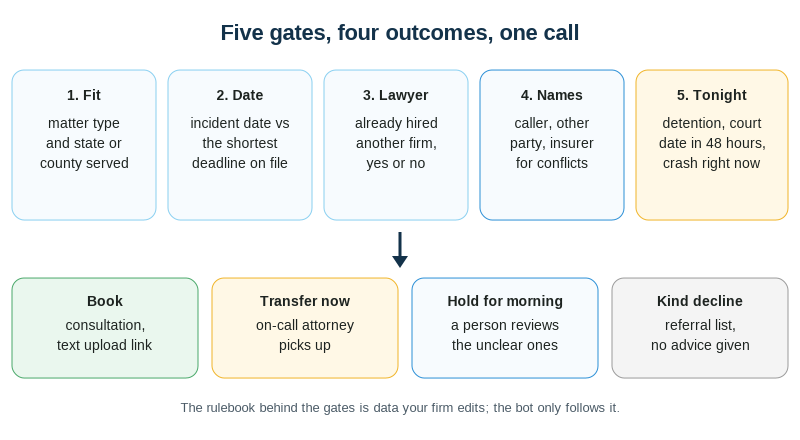
| Gate | What the bot asks | If the answer fits | If it does not |
|---|---|---|---|
| 1. Fit | What happened, and in which state or county? | Continue | Kind decline with a referral list |
| 2. Date | On what date did it happen, and was a city, county or agency involved? | Continue | Flag as a possible short deadline for a human |
| 3. Other lawyer | Has another lawyer or firm already been hired? | Continue | Stop, thank the caller, log it |
| 4. Names | Full names of the caller, the other person or company and the insurer | Run the conflict check | Hold for morning if a name matches a current client |
| 5. Tonight | Is anyone detained, hurt right now or facing a hearing in 48 hours? | Book a consultation | Transfer now to the on-call attorney |
In one line: five questions, in this order, and gate 5 can jump the queue at any moment. A caller who says a relative was detained tonight does not need to finish gate 2.
Clio describes the same logic for its own product. LawNext reports that Grow AI checks leads against the firm’s criteria, including case type, location and conflicts, and scores them using the firm’s history: Every hired matter, every declined case, and every past outcome becomes a signal.
Which law firm phone bots qualify leads, and what do they cost?
The phone bots that qualify legal leads include Clio Grow AI at $25 per converted lead and Smith.ai’s AI Receptionist from $0 for 25 calls, plus several newer vendors that publish less. We compare what each page says.
| Product | What it says it does | Public price |
|---|---|---|
| Clio Grow AI voice agent | Captures case information, checks it against firm criteria and conflicts, books fits; US only | $25 per converted lead; first three conversions free for current Grow customers |
| Smith.ai AI Receptionist | Lead qualification and call routing on every plan, call recording and transcripts, escalation to a live receptionist | Free for 25 calls; Pro $150 for 75 calls ($2.00 each), $270 for 150, $500 for 300 |
| LexCall | Asks accident date, treatment and insurance; escalates severe injuries to your phone | Page says from $99 a month |
| Answrr | Asks injury type, insurer and police report in the first minute; jurisdiction screening | See the vendor |
| Dapta | Qualifies on accident type, deadline, liability and damages; sends to Filevine, Litify, Clio or MyCase | See the vendor |
| Anyreach | Qualifies leads, takes intake and books consultations via call forwarding | See the vendor |
Three of the six pages are vendor marketing, and Dapta’s ranking article places Dapta first. Treat their claims as claims, and test each with your own call, as the last section explains.
Smith.ai’s page gives a number worth keeping. At 40 calls a month, the Pro plan is $150, or $3.75 a call, because you pay for the 75-call bundle. At 75 calls it is $2.00.
For a firm with fewer than three hires a month from the phone, Clio’s per-hire price can be lower, since you pay only when a client signs. Add Clio Grow’s own subscription to that.
Should a phone bot flag the statute of limitations?
A phone bot should flag a possible short deadline for a human but never tell the caller a deadline, because limitation periods differ by state, by defendant and by claim, and giving legal advice is not the bot’s job.
Three states show how far apart the numbers sit. The bot’s rulebook stores one line per state you serve, and a human keeps it current.
| State | General period | Shorter trap for the rulebook | Our flag line |
|---|---|---|---|
| Texas | 2 years, Civil Practice and Remedies Code 16.003, also for death | Local rules for government defendants; check each | Incident older than 700 days |
| Florida | 2 years for negligence accruing on or after March 24, 2023 (HB 837), 4 years before | Medical negligence has its own period | Incident older than 700 days |
| New York | 3 years, CPLR 214 | Notice of claim within 90 days when a city, county or agency is involved (General Municipal Law 50-e) | Government defendant and incident older than 60 days |
Our flag line is a simple rule we propose, not legal advice: wake a human when the incident is within about 30 days of the shortest deadline in the table. For 2 years that is day 700; for a 90-day notice it is day 60.
Where sources disagree, say so in the rulebook. Pages about Florida’s statute cite the negligence provision as 95.11(4)(a) in older write-ups and 95.11(5)(a) in newer ones after a renumbering. Link the current Florida Statutes section 95.11 in your own file, not a blog.
Do you have to tell callers they are talking to an AI, and can the bot record the call?
Your greeting should say who is answering and that the call may be recorded, because recording laws vary by state and California makes recording a confidential call without everyone’s consent a crime.
The kindest part of a qualifying call is what the caller does not have to do: repeat their worst day three times to three different people before anyone decides.
California Penal Code section 632 sets a fine of up to $2,500 per violation for recording a confidential communication without the consent of all parties, as Justia’s copy of the code and legal summaries show. A caller from California can reach a Texas firm’s number.
On disclosure, Smith.ai’s price page does not say how callers are told they reach an AI. Clio’s Grow AI settings let each firm choose whether the agent says so, as our earlier guide read in Clio’s Help Center.
The FCC’s February 8, 2024 ruling says calls with AI-generated voices are “artificial” under the Telephone Consumer Protection Act, and that telemarketers need prior express written consent. It speaks to calls the firm places, such as a callback or follow-up call made by a bot, not to answering an inbound call.
The practical rule: let the bot answer and text, but get the caller’s consent before any bot places a call to them.
What happens to what a caller tells the bot?
It is protected. A caller who describes a problem to a firm’s bot is a prospective client under ABA Model Rule 1.18, and the firm must supervise the bot as nonlawyer assistance under Model Rule 5.3.
The ABA’s Comment [4] to Rule 1.18 says a lawyer should limit the initial consultation to only such information as reasonably appears necessary for that purpose.
A bot’s script is where that limit lives.
So the five gates ask for dates, places and names, not the whole story. Let the caller say the story to the attorney, and let the bot say the attorney will go over that with you.
Rule 5.3 makes you responsible for reasonable efforts to keep the vendor’s handling in line with your duties.
Which calls should a phone bot hand to a person?
A phone bot should hand to a person any call with a detention, a hearing in the next 48 hours, a crash happening now, a caller in distress or a request to sign today.
- Detention or arrest tonight. Transfer to the on-call attorney before the next question.
- A court date within 48 hours. Clio’s own transfer example is the same trigger.
- An injury happening now. A caller at the roadside or the ER needs a voice, not a form.
- Distress. A grieving heir who starts crying should stop hearing questions.
- A fee agreement. The bot can send it; the attorney decides to accept.
Give the bot a primary and a backup transfer number, and rotate the on-call week between attorneys. Smith.ai’s page says calls can be escalated to a live North America-based receptionist at your discretion, which is a middle step before the attorney’s phone.
What happens to the file after the bot qualifies the call?
After the call, the intake summary lands in your software, the caller gets a text with a secure upload link, and a document pipeline sorts the photos and PDFs that arrive overnight into one indexed packet.
The first page of every injury, immigration or estate file is a call. The bot writes that page.
Then OCR and AI read the uploads, label each by type and date and attach them to the same record. Our Clio client intake automation guide shows the intake side, and the legal document indexing and summarization tool guide shows the sorting.
For injury files, that same record later feeds the medical chronology and the first draft of a demand letter. Paralegals upload scanned PDF packets to a secure web portal, and your server builds the timeline and drafts the summary.
How do you start a phone bot without risking a lost lead?
Start with weekends and one number, call it yourself as a fake new client, and read every intake for two weeks before you trust the routing.
- Write the rulebook. Five gates, your states, your flag lines, your transfer triggers.
- Write the greeting. Firm name, AI disclosure, recording notice, one sentence on what happens next.
- Forward weekends only. Read every intake Monday morning.
- Test calls. A pretend crash, a pretend detention at 11 p.m., a caller who already has a lawyer, and a Spanish speaker.
- Add weeknights in week two. Count calls booked that would have reached voicemail.
Weizenbaum wrote that Keywords and their associated transformation rules constitute the SCRIPT
and that the script is data, kept separate from the program.
For a firm that means the five gates and your three states’ flag lines are yours to edit on any Monday, so the bot you start with in December is the same bot your attorney can correct in January.
How we researched this
- Read on November 29, 2026: LawNext’s report on Clio Grow AI, Smith.ai’s AI Receptionist pricing page, the FCC’s February 8, 2024 release, the text of Weizenbaum’s 1966 ELIZA paper (a Stanford-hosted copy), and ABA Model Rule 1.18 and 5.3 pages. The Clio Help Center and the FCC pages blocked our reader in this session, so we rely on the earlier guide’s reading of Clio’s Help Center and on the FCC press text.
- State deadlines and California Penal Code 632 come from law-firm and legal-summary pages and Justia, not from the statutes read in full. Check the statute text for your own state.
- LexCall, Answrr, Dapta and Anyreach are described from their own marketing pages and a search summary; none of their performance claims were verified.
- Our Reddit and forum searches returned no usable practitioner threads, so we make no claim about what lawyers say there. We did not test any bot, and the flag lines are our own proposed rule, not legal advice.
Write the five gates, start with the weekends, and see how many good calls reach a person instead of a beep.
Sources and further reading
- LawNext: Clio launches Grow AI with 24/7 intake agents ($25 per converted lead)
- Smith.ai: AI Receptionist pricing
- Illinois Commission on Professionalism: 2024 Clio Legal Trends Report secret shopper results
- Weizenbaum, ELIZA: a computer program for the study of natural language communication between man and machine, Communications of the ACM 9(1), January 1966 (Stanford-hosted copy)
- FCC: February 8, 2024 release on AI-generated voices and the TCPA
- Justia: California Penal Code section 632
- Texas Civil Practice and Remedies Code section 16.003
- Graham Syfert: HB 837, Florida’s 2023 tort reform explained
- New York General Municipal Law section 50-e: notice of claim
- ABA Model Rule 1.18, Comment: duties to prospective client
- ABA Model Rule 5.3: responsibilities regarding nonlawyer assistance
- LexCall: AI voice agent for personal injury (vendor page)
- Dapta: AI voice agents for personal injury intake (vendor ranking)
Questions and answers
Can I use AI to run a 24/7 law firm lead qualification phone bot?
Yes. Clio’s Grow AI voice agent (US only) and Smith.ai’s AI Receptionist both answer calls around the clock, collect case details, apply your criteria and route the call. Keep the script to dates, places and names, transfer urgent calls to a person, and have your attorney review every intake, in line with ABA Model Rules 1.18 and 5.3.
What questions should a law firm phone bot ask to qualify a lead?
Five gates: what happened and in which state or county, the incident date and whether a government body was involved, whether another lawyer is already hired, the names of the caller and the other parties for the conflict check, and whether anything is urgent tonight. Stop there and leave the full story to the attorney.
How much does a law firm phone bot cost?
Smith.ai’s AI Receptionist page lists a free plan for 25 calls and Pro plans of $150 for 75 calls, $270 for 150 and $500 for 300. LawNext reports Clio Grow AI at $25 per converted lead, with no charge if the lead does not convert. Other vendors’ prices vary.
Does a law firm AI phone bot have to say it is an AI?
We found no single federal rule for answering an inbound call, but Clio lets each firm choose whether its agent discloses it, and the FCC ruled on February 8, 2024 that AI voices are artificial under the TCPA for calls placed to people. Tell callers plainly and ask your state bar about local rules.
Can a phone bot record a law firm intake call?
Many bots record and transcribe calls, but state law varies. California Penal Code 632 sets a fine of up to $2,500 per violation for recording a confidential call without everyone’s consent. Open every call with a recording notice, and have your attorney confirm the wording for each state you take calls from.