After Hours Legal Intake Answering Service: Costs, Options and Setup
Hello, and welcome to everyone who has opened the office voicemail on Monday morning and found six new-case calls from the weekend.
If your office phone forwards to voicemail at 5:30 p.m. and the injury calls keep coming at 9, this guide is for you.
In most boutique firms, the evening call lands in a mailbox, and someone listens to it the next morning between two other jobs.
By then the caller has often dialed the next firm on the list, and that firm picked up.
Short answer: An after hours legal intake answering service picks up your firm’s calls at night, on weekends and on holidays, screens each new caller with your own intake questions, transfers true emergencies to an on-call attorney and writes the lead into Clio Grow, Filevine or your intake software. Ruby, Smith.ai, Alert Communications and Clio’s Grow AI all offer it.
What is an after hours legal intake answering service?
An after hours legal intake answering service is a phone line staffed by trained receptionists, an AI voice agent or both, that answers a law firm’s calls when the office is closed and collects a new client’s first facts.
It is more than a message service. A plain answering service writes down a name and a number. A legal intake service follows your firm’s script.
- Answers every call live, 24 hours a day, including weekends and holidays.
- Screens the caller: matter type, incident date, location, the people involved and how urgent it is.
- Checks names against your conflict list, when your plan includes it.
- Escalates the few calls that cannot wait until morning to an on-call attorney.
- Records the intake in your software and, with some services, books the consultation or sends the fee agreement.
For a personal injury, immigration or estate firm, the job is simple to state: no new caller ever hears a voicemail beep, and the attorney starts the day with facts instead of a list of missed numbers.
Why do law firms lose new clients after hours?
Law firms lose new clients after hours because most calls are never answered by a person, and callers with a fresh injury or a frightening letter keep dialing until someone picks up.
The 2024 Clio Legal Trends Report measured it with a secret shopper study of 500 US law firms. The Illinois Commission on Professionalism summarized the results.
- Firms that answered the phone
- 40% in 2024, down from 56% in 2019
- Firms that answered neither the call nor called back
- 48%
- Firms that answered the shopper’s email
- 33% in 2024, down from 40% in 2019
- Shoppers likely to recommend the firm they contacted
- 12%
- Shoppers who reached a person by phone
- Over three times more likely than average to recommend the firm
Those numbers cover business hours too. After 5 p.m., a small firm with no coverage answers close to none of its calls.
Firm owners describe the same gap in public reviews of legal answering services. One reviewer of LEX Reception wrote of having a hard time finding anyone to take after hours calls with the professionalism they expected from their own people. That is the real worry: not just coverage, but coverage that sounds like the firm.
Should a law firm use live receptionists or an AI voice agent after hours?
A law firm can use live receptionists, an AI voice agent, or a hybrid where the AI answers and a person takes complex calls, and the right choice depends on call volume, language needs and how much screening you want.
| Service | Who answers | Legal intake features | Writes the lead to | Public price |
|---|---|---|---|---|
| Ruby | Live receptionists, English, Spanish and bilingual | Lead qualification and intake, custom questions | General integrations; check your system | From $250 a month for 50 minutes |
| Smith.ai live receptionists | Live agents, 24/7 | Intake questions, extended intake, conflict checks in your CRM | Clio among the listed CRMs | From $300 a month for 30 calls |
| Smith.ai AI Receptionist | AI first, transfer to a live receptionist day or night | Answers, screens and routes calls | Same CRM options | Free for 25 calls; Pro from $150 for 75 calls |
| Alert Communications | Live bilingual English and Spanish specialists | Your screening scripts, retainers sent and signed by e-signature | Filevine, Clio, Lead Docket and more | From $240 a month for 100 minutes |
| Clio Grow AI voice agent | AI voice agent, US only, transfer for high-priority calls | Gathers case details, screens for fit, books consultations | Clio Grow lead intake | $25 per converted lead, plus Clio Grow |
Live receptionists cost more per call and handle crying, confused or angry callers with more patience. Personal injury firms that get calls from the roadside or the ER often keep a person on the line for that reason.
AI voice agents cost far less per call and never put a caller on hold. Clio’s Grow AI launched on August 20, 2026, and LawNext reported that its voice agent is currently available only in the US.
A hybrid gives you both. The AI answers every call at once, and the conversations that need care go to a live receptionist or your on-call attorney.
How much does an after hours legal intake answering service cost?
An after hours legal intake answering service costs roughly $100 to $720 a month for a small firm taking 40 evening and weekend calls, depending on whether you pay per minute, per call or per new client.
We priced one realistic month at each service from its public list prices.
| Service and plan | How it bills | Month total | Per call |
|---|---|---|---|
| Ruby, 200 minute plan | Minutes; 160 used | $720 | $18.00 |
| Smith.ai live, Starter plus conflict checks | $300 for 30 calls, 10 extra at $11.50, conflict check $0.50 a call | $435 | $10.88 |
| Alert Communications, Alert Go | $2.50 a minute, no monthly minimum, before $100 per retainer | $400 | $10.00 |
| Smith.ai AI Receptionist, Pro 75 calls | Calls; 40 used | $150 | $3.75 |
| Clio Grow AI voice agent | $25 for each lead that becomes a client; 4 assumed | $100 | $2.50 |
Assumptions: 40 after hours calls a month, about two a weeknight plus a busy weekend, averaging 4 minutes each, so 160 minutes. For Clio Grow AI we assumed 4 of the 40 callers hire the firm, and the Clio Grow subscription itself is extra.
The prices leave out setup fees, overages beyond our scenario and add-ons, which every vendor says may apply. Ruby’s pricing page does not list a per-minute overage rate, so pick the plan that covers your busiest month.
Your own numbers matter more than ours. Pull last month’s call log, count the calls that came in after 5 p.m. and on weekends, and run them through the same table.
What happens to a law firm’s call after hours, step by step?
An after hours intake call moves through six steps: forward, greet, screen, escalate, record and hand over, and the caller never hears voicemail.
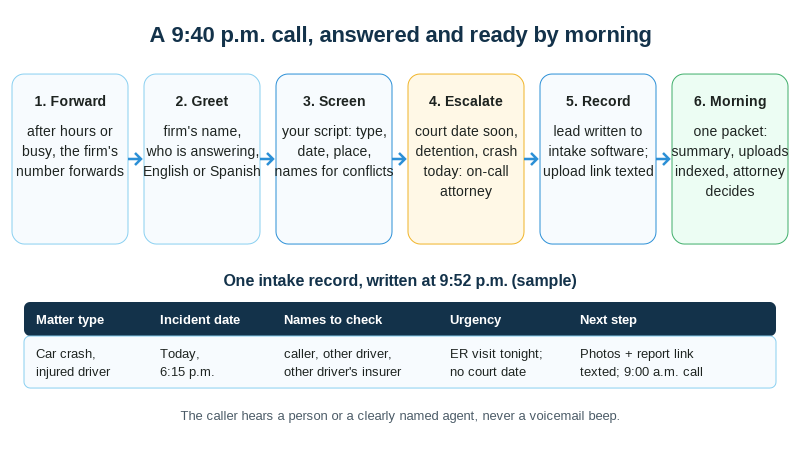
- Forward. Your phone system forwards calls after hours or when lines are busy. Clio’s Help Center says Grow AI calls are routed this way once you set up forwarding in your own phone system, such as RingCentral.
- Greet. The line answers with your firm’s name and says who is speaking. In Clio’s Grow AI settings, the firm chooses whether the agent discloses that it is AI.
- Screen. The receptionist or agent asks your script’s questions: what happened, when, where, who else was involved, and whether anyone is already representing the caller.
- Escalate. A short list of triggers transfers the call to your on-call attorney. Clio’s own example trigger is a caller with a court date in the next 48 hours.
- Record. The intake is written to your software, a consultation is booked, and the caller gets a text with a secure link for photos and papers.
- Hand over. In the morning, the attorney opens one intake packet: the call summary, the uploads already sorted, and what is still missing.
The diagram’s first three steps as text: 1 forward the firm’s number after hours or when busy, 2 greet with the firm’s name and who is answering, in English or Spanish, 3 screen with your script for type, date, place and names for conflicts.
The diagram’s last three steps as text: 4 escalate a court date soon, a detention or a crash today to the on-call attorney, 5 record the lead in intake software and text an upload link, 6 the morning packet with summary and indexed uploads, where the attorney decides.
The sample record in the diagram: a car crash with an injured driver, today at 6:15 p.m., with the caller, the other driver and the other driver’s insurer to check for conflicts. It notes an ER visit tonight and no court date.
The record’s next step: a photo and report upload link texted, and a 9:00 a.m. call booked. It is an illustration, not a real case.
What should an after hours legal intake script ask?
An after hours legal intake script should ask only what the attorney needs to decide whether to call back first thing: the matter type, the key date, the place, the other people involved and the urgency.
The kindest thing about a well-run intake line is what the caller hears at 10 p.m.: a calm voice that knows the firm’s name and has a plan for tomorrow.
- Personal injury. Date and place of the crash or fall, injuries and where they were treated, the other driver or property owner, any insurer that has called, whether a police report was made, and whether another lawyer is involved.
- Immigration. The kind of matter (family petition, removal, visa, citizenship), any hearing or deadline date on a notice, whether someone is detained right now, and the country and language of the people involved.
- Estate and probate. Who passed away and when, whether there is a will or trust, who the caller is to the person, the state and county, and any court date or deadline on a letter they received.
Every script should also capture the caller’s best callback time, whether texting is fine, and the preferred language. Ruby and Alert Communications both list Spanish and bilingual handling, which matters for many immigration and injury practices.
Short beats thorough at 10 p.m. A caller who just left the ER answers five clear questions well and twenty poorly.
What ethics rules apply when an answering service does legal intake?
When an answering service does legal intake, the caller becomes a prospective client under ABA Model Rule 1.18, and your firm must supervise the service as nonlawyer assistance under Model Rule 5.3.
Rule 1.18 protects what a prospective client says, even if the firm never takes the case. That is why the script should collect only enough to decide. The ABA’s Comment [4] to Rule 1.18 says a lawyer should limit the initial consultation to only such information as reasonably appears necessary for that purpose.
In plain terms: ask names, dates and places first, run the conflict check, and save the full story for the attorney. A caller who tells an answering service everything can create a conflict for the firm before anyone has checked one.
ABA Model Rule 5.3 makes the firm responsible for reasonable efforts to ensure that outside assistants act in line with the lawyer’s own duties. That covers a receptionist service and its confidentiality terms.
For AI voice agents, ABA Formal Opinion 512 (July 29, 2024) adds the duties of competence and confidentiality around generative AI. The NCBE’s Bar Examiner summary walks through it. Your state bar’s version of each rule is the one that binds you.
Which after hours legal calls still need a person?
After hours legal calls still need a person when the caller faces a deadline or a danger tonight, when they are too upset to follow a script, or when they want to sign up right now.
- Detention or arrest. A relative held by ICE or the police tonight goes straight to the on-call attorney.
- A hearing or deadline in the next 48 hours. Clio’s own transfer example, and a good rule for any practice.
- A crash or injury today where the caller is still at the scene or the hospital and asks what to do next.
- A caller in distress. A good receptionist or agent knows when to stop the script and transfer.
- A signed fee agreement. Alert Communications sends retainers for e-signature within minutes of qualification, on criteria the firm sets. The decision to accept the case still belongs to the attorney.
Write these triggers down, give the service one on-call number and a backup, and rotate the on-call week among the attorneys so nobody carries every night.
How do after hours intake calls turn into a ready case file?
After hours intake calls turn into a ready case file when the intake line texts the caller a secure upload link, and a document pipeline sorts whatever arrives overnight into one indexed packet.
New clients send phone photos of crash reports, insurance cards, hospital discharge papers, immigration notices and letters from the probate court, usually that same night. Without a system, those photos land in someone’s inbox as IMG_4471.jpg.
With a secure portal behind the upload link, OCR and AI read each upload, label it by type and date, and attach it to the intake record. Our guide to a legal document indexing and summarization tool explains how that sorting works.
For injury cases, the same records later feed the medical chronology and the first draft of the demand letter. The 9:40 p.m. call is simply the first page of that file.
How do you choose an after hours legal intake answering service?
Choose an after hours legal intake answering service by calling it yourself at night as a pretend new client, then checking exactly what landed in your intake software.
- Did the line answer within a few rings, with your firm’s name said correctly?
- Did it ask your script’s questions in order, and stop before taking the whole story?
- Did it run the conflict check, and transfer your test “court date tomorrow” call?
- Did a Spanish-speaking test caller get the same quality?
- Did the lead appear in Clio Grow, Filevine, Lead Docket or your system, with every field filled?
- Did the caller get the upload link and the consultation time by text?
- Does the contract cover confidentiality, recording and where call data is stored?
- Is the bill per minute, per call or per client, and what did your busiest month cost?
A calm first month starts with weekends only. In week one, forward Saturday and Sunday and read every intake. In week two, add weeknights. In week three, tune the script and the transfer triggers. In week four, count the consultations booked from calls that used to reach voicemail.
If the service doesn’t book real consultations from your own call log in that month, try another one. If it does, the 9:40 p.m. caller gets a calm voice and a plan, and your attorney gets a full morning instead of a list of missed numbers.
Let the line answer tonight, keep the judgment with your attorney, and see how different Monday morning feels.
Sources and further reading
- Illinois Commission on Professionalism: 2024 Clio Legal Trends Report secret shopper results
- Ruby: virtual receptionist pricing
- Smith.ai: live receptionist pricing and add-ons
- Smith.ai: AI Receptionist pricing
- Alert Communications: legal answering, intake and retainer services
- Clio Help Center: Grow AI’s Voice Agent
- Clio Help Center: Customize Grow AI (booking and call transfer)
- LawNext: Clio launches Grow AI with 24/7 intake agents ($25 per converted lead)
- ABA Model Rule 1.18, Comment: duties to prospective client
- ABA Model Rule 5.3: responsibilities regarding nonlawyer assistance
- NCBE Bar Examiner: ABA Formal Opinion 512 on generative AI tools
- Trustpilot: public reviews of LEX Reception
Questions and answers
Can I use AI to answer after hours legal intake calls?
Yes. AI voice agents such as Clio’s Grow AI and Smith.ai’s AI Receptionist can answer after hours calls, ask your intake questions, screen for fit and book consultations, with transfers to a live person or your on-call attorney for urgent calls. Keep the script short, review every intake, and follow ABA Formal Opinion 512 on confidentiality.
How much does an after hours legal answering service cost?
List prices read November 27, 2026 start at $250 a month for 50 minutes at Ruby, $300 for 30 calls at Smith.ai’s live receptionists, $240 for 100 minutes at Alert Communications, and $25 per converted lead for Clio Grow AI. For 40 four-minute calls a month, our calculation runs from about $100 to $720.
Does a legal answering service create conflict of interest risks?
It can, because a caller becomes a prospective client under ABA Model Rule 1.18, and what they say is protected even if you decline the case. Comment [4] tells lawyers to limit the first consultation to what is needed to decide, so the intake script should collect names and dates for a conflict check first.
Can an after hours answering service sign a new client?
Some can send your fee agreement. Alert Communications says it sends retainers for e-signature within minutes of qualification, on the criteria your firm sets, and charges per retainer. The firm still decides which cases to accept, and the attorney should confirm the engagement before work begins.
Should an AI receptionist tell callers it is an AI?
Clio’s Grow AI settings let each firm choose whether the voice agent discloses that the call is handled by AI. Telling callers plainly keeps trust high, especially with people in distress, and your state bar or state law may have its own rules on AI disclosure and call recording.