
How to Reduce the Machine Shop Estimating Bottleneck
Every shop owner seems to know that the quote waits on one person, and that person is also the one the shop floor needs.
Every shop owner I read about says the same thing: the slowest part of getting a job is the quote, and the quote waits on one person.
I spent an afternoon with the public pages of AMFG, Uptool and Machine Research to see how they describe that wait, and then built the numbers for a one-estimator shop myself.
Two details stood out. AMFG calls quoting a bottleneck that depends on the most experienced members on the shop floor, who are already maxed out
. And Uptool says to replace the spreadsheet when coordination work, not estimating judgment, consumes the quoting day.
Short answer: To reduce a machine shop estimating bottleneck, stop making the estimator read and retype every RFQ. An automated step watches the estimating inbox, uses AI vision to pull material, tolerances and quantity from PDFs and drawings, and drafts a baseline cost sheet within minutes. The estimator reviews and signs.
Why does one estimator become the bottleneck in a machine shop?
Because quoting needs shop knowledge, so it lands on the one or two people who have it, and RFQs arrive faster than they can read them.
AMFG puts it this way:
quoting is often a bottleneck that depends on the most experienced members on the shop floor, who are already maxed out.
AMFG, machine shop estimating and quoting software, read November 28, 2026
AMFG sells quoting software, so treat the framing as a vendor’s. It still matches what the other pages say, and it explains why hiring a second estimator is slow: the knowledge is hard to copy.
Where does an estimator’s day actually go?
A large share goes to gathering and retyping, not to judgment: finding the print, reading the callouts, and keying them into a sheet.
Uptool describes the typical workflow as drawing, BOM, customer email and estimator notes sitting in different places. Its rule of thumb is that coordination work, not estimating judgment, should be what you automate.
| Step | Needs a person’s judgment? | Can be drafted automatically? |
|---|---|---|
| Open the email, find the print, log the request | No | Yes |
| Read material, quantity, tolerances, finish | Only to check | Yes, with AI vision |
| Look up material and machine rates | No | Yes, from your price lists |
| Build the line items on a quote sheet | No | Yes |
| Decide risk, setups and whether to bid | Yes | No |
| Promise a delivery date | Yes | No |
Table compiled by Machine Shop Automation from the Uptool and AMFG pages, November 28, 2026. Four of six steps are reading and typing.
How many RFQs can one estimator handle before a backlog starts?
With 30 hours a week for quoting and 90 minutes per RFQ by hand, the limit is 20 RFQs; the 21st starts a backlog.
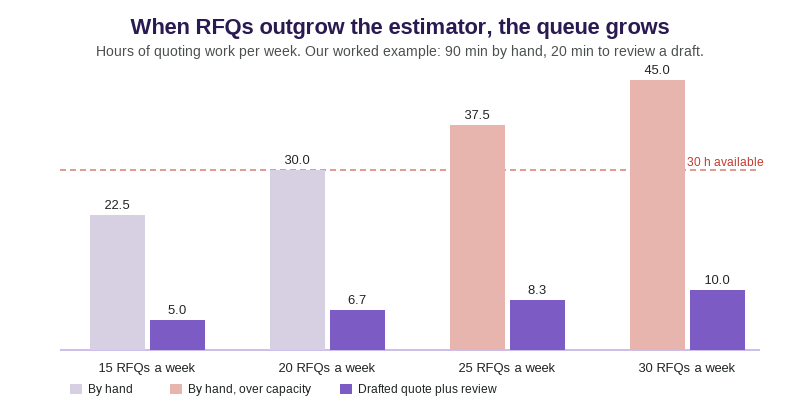
| RFQs a week | By hand (90 min each) | Backlog added a week | Draft plus review (20 min each) |
|---|---|---|---|
| 15 | 22.5 h | 0 h | 5.0 h |
| 20 | 30.0 h | 0 h | 6.7 h |
| 25 | 37.5 h | 7.5 h | 8.3 h |
| 30 | 45.0 h | 15.0 h | 10.0 h |
Assumptions: 30 of 40 hours go to quoting, the other 10 to calls, shop questions and customers. The 90 and 20 minute figures are examples, not measured results. Time your own estimator for a week and replace both.
The unfinished 7.5 hours in the 25-RFQ week carry into the next one, so the wait grows even when the average looks fine. Our guide to how to speed up manufacturing quote turnaround shows where those waiting days hide.
Does answering an RFQ faster really win more jobs?
Probably, but the numbers online are vendor figures, not independent data.
- Uptool says win probability is highest when an RFQ is answered in the first 4 hours and approaches baseline after 48 hours, citing Go Autonomous.
- Uptool also cites Optif AI: 38% to 42% win rates within 24 hours and 10% to 15% by five days.
- It cites ELL Advisory for UK top teams returning quotes in 48 minutes and closing 46%, against a 23% average.
Source: Uptool, quoting speed vs win rate, read November 28, 2026.
Why don’t the quote-speed statistics agree?
Because none of them is primary research, and they measure different things.
Reading Uptool’s page closely, each statistic points to a third-party benchmark, and one line (a 78% first-responder figure) has no clear source at all. Optif AI’s figure of 32% closed on sub-5-minute replies versus 7% after 24 hours is a different bucket from the 38% to 42% figure above.
A fair reading: a faster, accurate quote helps, and every writer here sells something that makes it faster. Measure your own win rate by response time from your last 50 quotes before trusting any of them.
How does automated RFQ parsing reduce the estimating bottleneck?
It does the reading and typing before the estimator opens the email, so the estimator starts from a draft, not a blank sheet.
The best fix for a bottleneck is a quiet one. It does the reading and typing before anyone opens the email, and leaves the bid-or-pass call to the estimator.
- Watch the inbox. Your web server monitors the estimating mailbox and picks up each new RFQ and its attachments.
- Read the print. AI vision reads the PDF or drawing for material, tolerances and quantities. Anthropic’s PDF support documentation says Claude reads both the text and the page images, which is why a scan can still be read, with more care.
- Price the draft. Your machine rates, setup times and material prices turn the facts into line items.
- Hand over. A pre-calculated quote sheet lands in the estimator’s queue, with the doubtful fields marked.
The full path is in our guide to automated CNC quoting software, and the inbox side is covered in machine shop RFQ automation.
What does the estimator still decide?
The estimator decides whether to bid, what risk to price in, and what delivery date to promise.
- Whether the part fits your machines, certifications and customer mix.
- Whether a tight tolerance or unfamiliar material needs a contingency line.
- Whether the lead time on the sheet matches the real schedule.
Machine Research says on its page that its tool is not meant to replace an experienced estimator, and that estimators review and adjust before sending. That is the design to look for.
What can I do about the estimating backlog before buying anything?
Triage the inbox and standardize your rates, because both shrink the queue for free.
- Sort RFQs on arrival: repeat parts, new standard parts, and odd work. Only the third needs your best estimator first.
- Write one hourly rate per machine and keep a current material price sheet, so nobody rebuilds them per quote.
- Reply to the buyer the same day with a date for the quote, even if the price is not ready.
- Ask for missing tolerances or material in the first reply, not on day three.
The same rate sheet is what a drafting tool uses, so this work is not wasted. Our guide to an instant quote generator for custom fabrication shows which parts can skip the queue entirely.
How do I test whether automation clears my estimating queue?
Run last month’s RFQs through a drafting tool and compare the drafts with the prices you sent.
- Pull 10 RFQs you quoted, with the final price you sent.
- Have the tool draft each one without seeing your price.
- Note the gap on each and which line caused it.
- Time the review against your estimator’s usual time on the same RFQs.
If you’d like help setting up that test on your own RFQs, the form at the top of this page reaches us.
How we researched this
- Read the public pages of AMFG, Uptool and Machine Research, plus Anthropic’s PDF support documentation, on November 28, 2026.
- Compared what each says about why quoting stalls and how response time affects win rates. All win-rate figures are vendor-cited and not verified by us.
- Calculated the queue table ourselves, with assumptions shown.
- We did not install or test any tool. Our searches returned no Reddit or forum threads on this exact phrase, so we do not report what machinists say there.
Time your estimator on five RFQs this week, and you will know exactly how big your queue is.
Sources and further reading
Questions and answers
Can I use AI to reduce my machine shop estimating bottleneck?
Yes, with a person signing off. An AI vision model can read PDF prints and RFQ emails for material, tolerances and quantity, and your rate sheet turns them into a draft quote in minutes. The estimator reviews the draft instead of building it, which is where the time is saved.
What causes an estimating bottleneck in a machine shop?
Quoting needs shop knowledge, so it falls to one or two experienced people who are also busy on the floor. AMFG describes them as already maxed out. Add RFQs that arrive as PDFs, emails and scans, and the reading and retyping fills the day.
How many RFQs can one estimator handle a week?
In our example, 20 at 90 minutes each, if 30 hours a week go to quoting. Your numbers will differ, so time a week of real RFQs. Past the limit, the backlog grows by the extra hours every week.
Does a faster quote win more jobs?
Vendors say yes, citing win rates of 38% to 42% within 24 hours against 10% to 15% by five days. Those figures are not independent research, so measure your own win rate by response time before relying on them.
Will automated quoting replace my estimator?
No. It removes the reading and typing and leaves the judgment. The estimator still decides whether to bid, what risk to price in and what delivery to promise, and signs every quote.