
PDRN for Menopausal Skin and Skin Over 50: What Changes and What Helps
Disclosure: this page contains Amazon affiliate links. As an Amazon Associate we earn from qualifying purchases, at no extra cost to you. PDRN topical products are cosmetics, not medical treatments, and nothing here is medical advice.
Hello, second-spring glow seeker, if your skin suddenly feels thirstier, thinner or just plain different since your fifties arrived, this one’s for you.
Picture your skin at 50 soaking up a rich cream at night and still feeling tight by lunchtime.
Menopause changes how skin holds water and how firm it feels.
PDRN can fit into that picture as a hydrating step that helps skin look smoother and plumper.
It works best as one part of a short routine with a rich moisturizer, daily sunscreen and, if your skin tolerates it, retinol or peptides.
If you’d like to browse while you read, here are PDRN creams for mature skin on Amazon.
Short answer: Yes, PDRN can suit mature and menopausal skin as a hydrating, plumping-looking step, but it’s a cosmetic, not a fix for falling estrogen. Pair it with what the American Academy of Dermatology suggests for menopause: a fragrance-free moisturizer, SPF 30+ sunscreen every day, and retinol or peptides. Two small studies show modest firmness gains.
- When it starts: the average age of menopause in the US is 52, and the transition usually happens between ages 45 and 55 (HHS Office on Women’s Health).
- What estrogen loss does: skin collagen can fall by as much as 30% in the first five years after menopause, and skin gets about 1.13% thinner each year after that (Thornton, 2013).
- The PDRN research: a 1% PDRN cream raised a skin elasticity score by 4.25% in 4 weeks in 10 adults aged 20 to 59. A 2026 trial in 31 women aged 35 to 55 found a PDRN eye cream beat a retinol eye cream over 28 days.
- The gap: a PubMed search on November 27, 2026 found no study of PDRN or polynucleotides in menopausal skin specifically.
- Our label check: of 5 popular PDRN creams, 4 list peptides, 1 lists five ceramides, 1 lists retinol and 1 lists “Fragrance”. The lists run from 48 to 67 ingredients.
What happens to skin during menopause?
As estrogen falls during menopause, skin holds less water, gets thinner, loses collagen and firmness, and can turn more sensitive. These changes build over years, which is why a routine that worked at 40 can feel thin and inadequate at 55.
Menopause itself is a single point in time. The HHS Office on Women’s Health explains that you reach it after 12 months in a row with no period, including no spotting
. It adds that In the United States, the average age of menopause is 52.
The same page notes that estrogen, progesterone and testosterone levels fall during perimenopause and after menopause, and lists skin among the many things that can change as a result.
The American Academy of Dermatology (AAD) page on skin care during menopause names the skin changes one by one. As estrogen levels fall, skin becomes thinner.
And: As collagen diminishes, our skin loses it firmness and begins to sag.
How fast does skin lose collagen after menopause?
Fastest in the first few years. A 2013 review in Dermato-Endocrinology by M. Julie Thornton of the University of Bradford pulls together the research on estrogen and skin:
Type I and III skin collagen is thought to decrease by as much as 30% in the first five years after menopause, which parallels the reduction in bone mass observed in post-menopausal women.
The review also reports that In estrogen deficient women skin thickness is reduced by 1.13% and collagen content by 2% per postmenopausal year.
Elasticity drops too: In early postmenopausal women, skin elasticity can decrease by 1.5% per year
.
To see what those yearly rates add up to, we ran the simple straight-line arithmetic. This is a way to picture the published rates, not a measurement or a prediction for anyone’s skin.
| Years after menopause | Skin thickness lost (1.13% a year) | Collagen lost (2% a year) |
|---|---|---|
| 1 year | about 1.1% | about 2% |
| 5 years | about 5.7% | about 10% (other studies: up to 30%) |
| 10 years | about 11.3% | about 20% |
| 15 years | about 17.0% | about 30% |
Here’s the catch in that table: the up to 30% in five years
figure and the “2% a year” figure come from different studies. Put together, they suggest collagen drops fastest early on and then keeps sliding more slowly.
The review links these changes to the years without estrogen rather than to birthdays alone. That’s why skin can seem to change quickly in the early fifties, even when your routine hasn’t.
Why does menopausal skin feel so dry?
Because menopausal skin loses some of its ability to hold water. The AAD puts it plainly: In menopause, skin loses some ability to hold water, so skin can get quite dry.
The AAD’s fix is simple and frequent: Apply moisturizer after bathing and throughout the day when your skin feels dry.
It also suggests a mild cleanser instead of soap.
Menopausal skin can also turn touchier. The AAD notes that skin’s pH changes around age 50, which makes skin more sensitive, and advises: Use a fragrance-free moisturizer.
Winter makes all of this harder. From November to February, cold air outside and dry indoor heat pull even more water from skin that already struggles to hold it.
Is PDRN good for mature skin?
PDRN can be a good fit for mature skin as a gentle, hydrating step that helps skin look smoother and a little firmer. The research on topical PDRN is small but encouraging, and it hasn’t been studied in menopausal skin specifically.
PDRN (polydeoxyribonucleotide) is a mix of DNA fragments, traditionally from salmon or trout and now also from plants like ginseng, rice and peony. On an ingredient list it usually appears as “Sodium DNA”.
For skin over 50, PDRN has two things going for it. It isn’t an acid, an exfoliant or a retinoid, so it’s unlikely to sting thin, dry skin on its own. And it usually comes in formulas packed with humectants like hyaluronic acid and glycerin, which is exactly what thirsty menopausal skin wants.
The honest limit: when we searched PubMed on November 27, 2026 for PDRN or polynucleotide studies in menopausal or postmenopausal skin, we found none. The studies below include people in their forties and fifties, but none of them is a menopause study.
What does the research on topical PDRN show?
Two small studies found modest gains in skin firmness from PDRN creams over 4 weeks. Both are short, both are small, and both have links to the skincare industry, so read them as early signals.
In the first, published in the International Journal of Molecular Sciences (Bak and colleagues, 2025), 10 Korean adults aged 20 to 59 (average age 41.6) used a cream with 1% peony-derived PDRN around the eyes twice a day for 4 weeks. Another 10 used the same cream without PDRN.
| Cream | Start | 2 weeks | 4 weeks |
|---|---|---|---|
| Plain cream (no PDRN) | 69.36 | 69.57 | 69.59 |
| Cream with 1% peony PDRN | 69.22 | 69.71 | 72.16 |
The PDRN group’s score rose 4.25% by week 4 (p < 0.001), while the plain cream barely moved. The change at 2 weeks wasn’t significant. The authors name the small sample size, comprising only 10 participants
as the main limitation, and all six authors work for one company, NewLife BST.
The second study, in PLoS One (Ye and colleagues, 2026), is closer to the age group this guide is for. It tested a PDRN eye cream on 31 Chinese women aged 35 to 55 (average 47.5) with fine lines, eye bags and self-reported sensitive skin.
PDRN vs retinol for wrinkles: which is better after 50?
Retinol has decades of research behind it and is what the AAD names for menopausal wrinkles, alongside peptides. PDRN is much newer. One 2026 trial found a PDRN eye cream outperformed a retinol eye cream over 28 days, but one short study can’t crown a winner.
I’ll admit it: a head-to-head study between a buzzy new ingredient and good old retinol makes me sit up like it’s the final round of a baking show.
That trial is the Ye study above. Each woman used a 0.1% PDRN eye cream on one side of her face and an identically formulated 0.1% retinol eye cream on the other, for 28 days, with daytime sunscreen required.
The PDRN side showed about two-fold greater gains in dermal thickness and density on ultrasound, and about 1.8-fold greater gains in elasticity and firmness, than the retinol side. The paper reports that Both treatments were well tolerated, with no reported adverse reactions.
Two cautions keep this in proportion. The authors themselves write that early ultrasound changes may partly reflect transient hydration or plumping effects
, so part of the gain may be water, not new collagen. And three of the five authors list affiliations with Shanghai skincare-research companies, though the paper declares no conflicts of interest.
Retinol’s track record is much longer. For sagging and wrinkles at menopause, the AAD suggests: Consider using a skin care product that contains retinol or peptides.
For thinning skin it adds, For some people, a retinoid cream can help.
Can you use PDRN and retinol together?
Yes, PDRN and retinol can share a routine, since PDRN isn’t an acid or another retinoid. Many people put retinol on in the evening and keep PDRN for the morning or for the nights in between, so dry, mature skin isn’t overloaded.
Start retinol slowly. Medicube’s own page for its PDRN Pink Peptide Eye Cream, which contains retinol, says to start gradually if you are new to retinol or have sensitive skin
. It also warns to use caution when layering it with other retinol products around the same area.
That’s the trap to avoid: two retinoid products at once. If your PDRN eye cream already lists retinol, it counts as your retinoid for that area.
Retinol also makes skin more sensitive to the sun, which is one more reason the AAD’s daily SPF 30+ sunscreen matters. And if you’re still pregnant or breastfeeding, retinoids are out; our guide to PDRN during pregnancy and breastfeeding explains why.
Which PDRN creams suit dry, mature skin best on paper?
Of the five popular PDRN products we checked, VT Cosmetics’ PDRN Capsule Cream looks richest on paper, with shea butter, squalane, two plant oils and nine peptides. Medicube’s PDRN Pink Hyaluronic Moisturizing Cream has five ceramides but also lists “Fragrance”. Medicube’s eye cream is the only one with retinol.
| Product | PDRN source (per the maker) | Ingredients listed | Sodium DNA’s place | Butters and oils | Ceramides | Peptides | Retinoid? | Fragrance listed? |
|---|---|---|---|---|---|---|---|---|
| VT Cosmetics PDRN Capsule Cream | Plant (ginseng) | 67 | 45th | 4 (shea, squalane, jojoba, moringa) | 1 | 9 | No | No |
| Medicube PDRN Pink Collagen Capsule Cream | Salmon | 59 | 25th | 2 (squalane, sunflower) | 1 | 4 | No | No |
| Medicube PDRN Pink Hyaluronic Moisturizing Cream | Salmon | 58 | 29th | 1 (meadowfoam) | 5, plus cholesterol | 5 | No | Yes: “Fragrance” |
| Anua PDRN Hyaluronic Acid 100 Moisturizing Cream | Salmon | 48 | 10th | 1 (squalane, 2nd ingredient) | 0 | 0 | No | No |
| Medicube PDRN Pink Peptide Eye Cream | Salmon | 52 | 22nd | 0 | 0 | 5 | Yes: retinol | No |
What the table shows, product by product:
- VT Cosmetics PDRN Capsule Cream (VT Cosmetics): vegan PDRN from ginseng in a gel cream VT calls
Lightweight yet rich
, with niacinamide high on the list and the most butters, oils and peptides here. Look for the VT PDRN Capsule Cream on Amazon. - Medicube PDRN Pink Collagen Capsule Cream (Medicube): salmon PDRN with hydrolyzed collagen, squalane and four peptides. Medicube’s own FAQ points to it for
richer hydration
than its lighter cream. Look for the Medicube PDRN Collagen Capsule Cream on Amazon. - Medicube PDRN Pink Hyaluronic Moisturizing Cream (Medicube): the only one with five ceramides plus cholesterol and phytosphingosine, the classic barrier trio. It also lists “Fragrance”, and Medicube describes a
lightweight, watery cream texture
. - Anua PDRN Hyaluronic Acid 100 Moisturizing Cream (Anua): the shortest list, with squalane second and Sodium DNA higher up than in any other product here. No peptides or ceramides, so it’s more of a simple hydrator.
- Medicube PDRN Pink Peptide Eye Cream (Medicube): salmon PDRN with retinol, five peptides and caffeine. It’s a retinoid product, so treat it as one.
Our tally: 4 of 5 list peptides, 1 of 5 lists five ceramides, 1 of 5 lists retinol and 1 of 5 names fragrance. Every one lists niacinamide and adenosine. We have not tested these products on anyone; this is a check of what the makers print.
Does it matter where Sodium DNA sits on the label?
Only a little. The FDA’s Cosmetics Labeling Guide says The ingredients must be declared in descending order of predominance.
So a cream’s first ingredients are its biggest ones.
The fine print changes that for small amounts: Ingredients present at a concentration not exceeding 1% may be listed in any order after the listing of the ingredients present at more than 1% in descending order of predominance.
Sodium DNA sits between 10th and 45th in these five lists, likely in that 1%-or-less zone where the order can be shuffled. VT’s page advertises “100,000 ppm PDRN” without saying what that number measures, while its list puts Sodium DNA 45th of 67.
In other words, a label can’t tell you exactly how much PDRN you’re getting. Choose by the whole formula and how your skin likes it.
Is a PDRN cream or serum better for mature skin?
For dry, menopausal skin, a PDRN cream usually makes more sense, because a cream adds the oils and butters that slow water loss. A PDRN serum works too, as long as a good moisturizer goes on top.
A serum is mostly water and humectants, which pull moisture into the skin. A cream adds emollients and occlusives like shea butter and squalane, which help hold it there. Skin that the AAD says loses some ability to hold water
usually needs both.
If you already love a moisturizer, a PDRN serum underneath is the easy swap. If you’d rather keep your routine to as few steps as possible, one rich PDRN cream can do both jobs.
What’s a simple PDRN routine for menopausal skin?
A mild cleanser, a PDRN serum or cream, a fragrance-free moisturizer and SPF 30+ sunscreen in the morning, with retinol or a peptide product at night, cover everything the AAD suggests. Add one new product at a time, so you can tell what your skin likes.
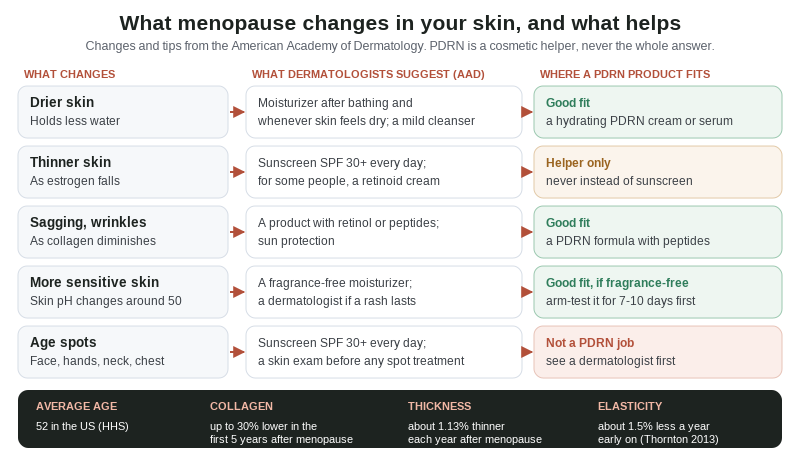
The diagram, row by row:
- Drier skin, because skin holds less water: moisturizer after bathing and whenever skin feels dry, plus a mild cleanser (AAD). A hydrating PDRN cream or serum is a good fit.
- Thinner skin, as estrogen falls: sunscreen with SPF 30+ every day, and for some people a retinoid cream (AAD). PDRN is a helper only, never instead of sunscreen.
- Sagging and wrinkles, as collagen diminishes: a product with retinol or peptides, plus sun protection (AAD). A PDRN formula with peptides is a good fit.
- More sensitive skin, as skin pH changes around 50: a fragrance-free moisturizer, and a dermatologist if a rash lasts (AAD). A fragrance-free PDRN product fits, after a 7-10 day arm test.
- Age spots on the face, hands, neck, arms or chest: daily SPF 30+ sunscreen and a skin exam before any spot treatment (AAD). This isn’t a PDRN job.
The numbers strip: average age of menopause 52 in the US (HHS Office on Women’s Health); collagen up to 30% lower in the first 5 years after menopause, skin about 1.13% thinner each year, and elasticity about 1.5% lower a year early on (Thornton 2013).
Put together, a day looks like this:
- Morning: a mild cleanser or just lukewarm water, a PDRN serum or cream, a fragrance-free moisturizer for dry, mature skin if your PDRN step is a serum, then a broad-spectrum SPF 30+ sunscreen.
- Evening: a mild cleanser, then retinol on 2-3 nights a week to start, building up slowly. On the other nights, your PDRN product and a rich moisturizer.
- During the day: more moisturizer whenever your skin feels dry, as the AAD suggests. A small tube in your bag helps.
For sunscreen, thin and sensitive skin often gets along better with mineral filters. Look at fragrance-free zinc oxide sunscreens, and arm-test those too.
When should you see a dermatologist instead?
See a dermatologist for any new or changing dark spot, adult acne that won’t settle, a rash that lasts, unwanted facial hair or thinning hair, or a cut that’s slow to heal. These are medical questions, not jobs for a cream.
The AAD is especially clear about spots. Age spots and skin cancer can look alike, so get a skin exam before trying any age-spot treatment.
The AAD also notes that when hormone levels fall, skin takes longer to heal, which raises the risk of infection. And some women get teenage-like acne before and during menopause, which a dermatologist can help control.
Five numbers worth remembering:
- 52
- the average age of menopause in the US (HHS Office on Women’s Health)
- Up to 30%
- the drop in skin collagen in the first five years after menopause (Thornton, 2013)
- 1.13% a year
- how much thinner skin gets each year after menopause (Thornton, 2013)
- 4.25%
- the elasticity gain from a 1% PDRN cream after 4 weeks, in 10 adults (Bak and colleagues, 2025)
- SPF 30+
- the daily sunscreen the AAD recommends for thinning skin and age spots
If hot flashes leave your cheeks red, our guide to PDRN for rosacea and redness-prone skin covers the AAD’s rosacea avoid list. And if your skin has started stinging at products it used to love, see how to try PDRN on sensitive and reactive skin.
Menopause is a normal stage of life, and skin changes with it. A short, rich, fragrance-free routine with sunscreen and a retinoid or peptides does the heavy lifting; a PDRN step adds hydration and a smoother look on top.
Be patient with your skin, keep the routine short and rich, and give each new product a few calm weeks. Skin at this stage deserves care and kindness, not a fight.
Sources and further reading
- American Academy of Dermatology: Skin care during menopause — last updated 11/24/25; dryness, thinning, sagging, age spots, pH change around 50, slower healing; moisturizer, SPF 30+, retinoid, retinol or peptides, fragrance-free moisturizer
- HHS Office on Women’s Health: Menopause basics — last updated October 19, 2026; 12 months in a row with no period; transition usually between 45 and 55; average age 52 in the US
- Thornton MJ. Estrogens and aging skin. Dermato-Endocrinology 2013;5(2):264-270 — collagen down as much as 30% in the first five years after menopause; thickness 1.13% and collagen 2% per postmenopausal year; elasticity 1.5% per year early on
- Bak S-U, et al. Anti-Aging Efficacy of Low-Molecular-Weight Polydeoxyribonucleotide Derived from Paeonia lactiflora. Int J Mol Sci 2025;27(1):220 — 10 adults per group aged 20-59; 1% peony PDRN cream twice daily for 4 weeks; elasticity R2 69.22 to 72.16 (+4.25%, p < 0.001); authors employed by NewLife BST Co.
- Ye R, et al. Topical medium-length PDRN enhances dermal extracellular matrix repair in photodamaged skin via PI3K-Akt/TGF-beta-regulated pathways. PLoS One 2026;21(7):e0350905 — randomized, double-blind split-face trial, 31 women aged 35-55 with sensitive skin; 0.1% PDRN vs 0.1% retinol eye cream for 28 days; about 2-fold greater dermal thickness and density gains; no adverse reactions
- FDA: Cosmetics Labeling Guide — ingredients in descending order of predominance; ingredients at 1% or less may be listed in any order (21 CFR 701.3)
- VT Cosmetics: PDRN Capsule Cream — maker’s page with full ingredient list (67 ingredients, Sodium DNA 45th, shea butter, squalane, 9 peptides, no fragrance)
- Medicube: PDRN Pink Collagen Capsule Cream — maker’s page with full ingredient list (59 ingredients, Sodium DNA 25th, squalane, 4 peptides, no fragrance)
- Medicube: PDRN Pink Hyaluronic Moisturizing Cream — maker’s page with full ingredient list (58 ingredients, Sodium DNA 29th, five ceramides, cholesterol, 5 peptides, ‘Fragrance’)
- Anua: PDRN Hyaluronic Acid 100 Moisturizing Cream — maker’s page with full ingredient list (48 ingredients, squalane 2nd, Sodium DNA 10th, salmon-derived)
- Medicube: PDRN Pink Peptide Eye Cream — maker’s page; key ingredients Salmon DNA PDRN, retinol, peptide, niacinamide; 52 ingredients, Sodium DNA 22nd; start gradually if new to retinol
Questions and answers
Is PDRN good for mature skin?
PDRN can be a good fit for mature skin as a gentle, hydrating step that helps skin look smoother and a little firmer. It isn’t an acid or a retinoid, so it’s unlikely to sting on its own. It hasn’t been studied in menopausal skin specifically, so pair it with the basics: moisturizer, daily SPF 30+ sunscreen, and retinol or peptides.
Does PDRN help with wrinkles?
Early research is encouraging but small. In a 2026 trial of 31 women aged 35 to 55, a 0.1% PDRN eye cream improved under-eye firmness and skin density more than a 0.1% retinol eye cream over 28 days. The authors note part of the effect may be temporary hydration, and PDRN creams are cosmetics, not wrinkle treatments.
Can you use PDRN and retinol together?
Yes. PDRN isn’t an acid or a retinoid, so it can share a routine with retinol. Many people use retinol in the evening, starting 2-3 nights a week, and keep PDRN for the morning or the nights in between. Don’t stack two retinol products, and wear SPF 30+ sunscreen every day.
What is the best skincare for menopausal skin?
The American Academy of Dermatology suggests a mild cleanser, moisturizer after bathing and whenever skin feels dry, a fragrance-free moisturizer if skin turns sensitive, broad-spectrum SPF 30+ sunscreen every day, and a product with retinol or peptides for sagging and wrinkles. See a dermatologist for new spots, lasting rashes or acne.
Why is my skin so dry during menopause?
As estrogen falls, skin loses some of its ability to hold water. The American Academy of Dermatology notes that skin can get quite dry in menopause and suggests applying moisturizer after bathing and throughout the day, plus a mild cleanser instead of soap. Cold, dry winter air can make it worse.