How to Reduce Property Management Maintenance Calls at the Source
Hello, and welcome to everyone whose maintenance line rang again while they were still answering the last when is the plumber coming?
Picture a Monday where the maintenance line rings half as often, and every call that does come in is a real repair.
Today the phone rarely rings for new problems alone, because it also rings for “is anyone coming?”, can they do Thursday?
and the same leak for the third time.
Those calls feel like one flood, but they come from five different places, and each place has its own fix.
Short answer: To reduce property management maintenance calls, sort them by type and remove each cause. Send automatic status texts so tenants stop asking for updates, take requests by photo text with safe fixes first, let tenants book repair windows, flag repeat repairs, and prevent common ones with filter delivery and a turnover checklist.
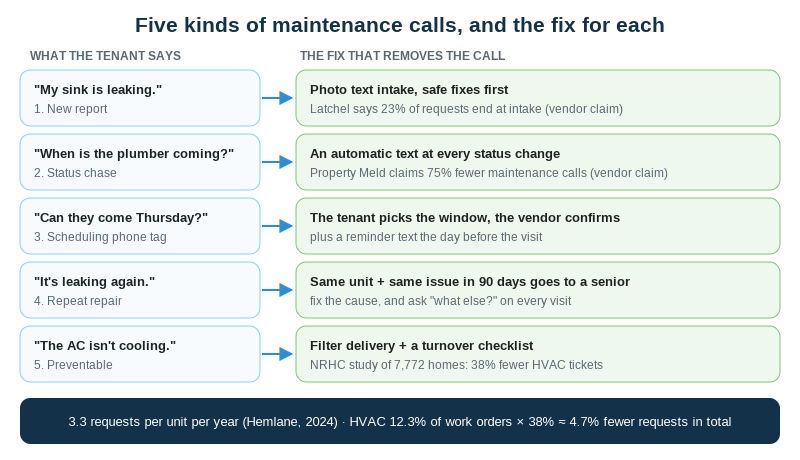
| Call type | What the tenant says | The fix | Best number we found |
|---|---|---|---|
| New report | My sink is leaking. | Photo text intake with safe fixes first | Latchel says 23% of requests end at intake (vendor claim) |
| Status chase | When is the plumber coming? | An automatic text at every status change | Property Meld claims 75% fewer maintenance calls (vendor claim) |
| Scheduling tag | Can they come Thursday instead? | The tenant picks the window, a reminder goes out the day before | No public number; measure your own |
| Repeat repair | ”It’s leaking again.” | Same unit and issue within 90 days goes to a senior person | No public number; measure your own |
| Preventable | The AC isn’t cooling. | Filter delivery and a turnover checklist | 38% fewer HVAC tickets in an NRHC study of 7,772 homes |
Why does a property management office get so many maintenance calls?
A property management office gets so many maintenance calls because one repair rarely makes just one call. The report is the first call, and the wait that follows produces the rest.
That wait is long. Hemlane’s analysis of 193,000+ work orders (June 2026) puts the median time to resolve a request at 13.1 days. Every one of those days is a chance for the tenant to call and ask what is happening.
Here’s the catch: every public benchmark counts work orders, not phone calls. We found no published figure for calls per work order, so the honest way to size your problem is to count your own for two weeks, by the five types above.
The good news hides in that same gap. Most of the calls on a busy maintenance line are not new problems at all, so they can be removed without saying no to a single repair.
How many maintenance calls should a property manager expect per unit?
A property manager should expect about 3.3 maintenance requests per unit per year, the 2024 figure in Hemlane’s work-order data, and several calls or texts for each request.
Hemlane reports 2.93 requests per unit in 2020 rising to 3.30 in 2024, with single-family homes at 3.40 and multifamily units at 3.23. Plumbing, HVAC, appliances and electrical make up roughly 70% of all requests.
| Category | Share of work orders | Median days to resolve |
|---|---|---|
| Plumbing | 25.4% | 9.9 |
| Heating / HVAC | 12.3% | 9.6 |
| Appliance repair | 12.2% | 15.8 |
| Electrical | 8.4% | 13.1 |
| Handywork | 5.8% | 19.7 |
| Pest control | 4.9% | 16.0 |
To turn requests into phone time, we ran a simple calculation. The table below is ours, built on Hemlane’s 3.3 and three working assumptions we state openly, so you can swap in your own numbers in the calculator underneath.
| Units | Requests a month | Calls and texts today | Staff hours today | Calls after the fixes | Staff hours after |
|---|---|---|---|---|---|
| 100 | 27.5 | 82.5 | 5.5 | 30.3 | 2.0 |
| 300 | 82.5 | 247.5 | 16.5 | 90.8 | 6.1 |
| 600 | 165 | 495 | 33.0 | 181.7 | 12.1 |
| 1,000 | 275 | 825 | 55.0 | 302.8 | 20.2 |
Assumptions: today each request brings 1 report plus 2 follow-up calls, at 4 minutes each. After the fixes, follow-ups drop to 0.5 per request, 23% of requests end at intake (Latchel’s claimed rate), and filter delivery removes 4.7% of requests (explained in the filter section). That is 63% fewer calls at every size.
The biggest lever in that math is not the fixed-at-intake share. It is the follow-up calls, because they multiply every single request, which is why status texts come first below.
How do you stop tenants calling to ask when the repair is happening?
You stop status calls by telling tenants what is happening before they think to ask, with an automatic text at every change in the work order’s status.
A portal helps, but only for tenants who open it. AppFolio’s tenant communication guide (October 20, 2026) says residents can track their progress from their phone, so they don’t need to call the office for a status update.
Buildium’s Resident Center help page works the same way: tenants tap an open request to view its status and updates from the property manager. A text that arrives on its own reaches the tenant who never logs in.
- Received:
We got your request for the kitchen sink in Unit 4B. Ticket 1182.
- Vendor assigned:
A licensed plumber has the job. You’ll get a time to choose shortly.
- Window booked:
Your repair is set for Thursday, 9 to 11 a.m.
- Day-before reminder:
Reminder: the plumber comes tomorrow, 9 to 11 a.m. Reply MOVE to pick another time.
- Done:
The plumber marked the job finished. Reply NO if the sink still leaks.
Those five texts are cheap. On Twilio’s US price page (read November 28, 2026), one outbound SMS costs $0.0083 plus a carrier fee of up to $0.005 (Verizon), about 1.3 cents. Five texts come to about 6.7 cents per repair.
At 300 units and 82.5 requests a month, that is about $5.49 a month in texting. Number rental and A2P 10DLC registration fees come on top, but the texts themselves cost less than one coordinator’s coffee run.
Property Meld’s FAQ claims Property Meld helps teams cut maintenance calls by 75%
, and says residents are kept informed of their work order status. That is a vendor claim with no published method, so treat it as a ceiling to test, not a promise.
How do you cut calls for problems a tenant could fix in a minute?
You cut those calls by taking every request as a photo text and offering one safe, tool-free fix before a work order or vendor is involved.
The cost of skipping that step is old news among landlords. In a BiggerPockets thread titled How do I reduce the number of maintenance calls from Tenants?
(November 2015), a Jacksonville landlord said $75 to $100 plumber and A/C visits were eating into cash flow.
The replies in that thread did not say answer fewer calls.
They said: define emergencies in the lease, take routine requests in writing, and ask what else?
on every visit so one trip covers several small items.
A photo text does all of that at once. It is in writing, it shows whether water is on the floor, and it lets a simple reset, such as a tripped GFCI outlet or a garbage disposal’s red button, be offered first.
Latchel’s maintenance page says 23% of resident requests are resolved at intake and never become a work order
. Like every number in this section, it is the vendor’s own, but it shows the size of the prize.
The step-by-step version is in our guide to a tenant troubleshooting text bot, and the sorting rules around it are in our guide to automated tenant maintenance triage software.
Does HVAC filter delivery really reduce maintenance calls?
Yes, filter delivery reduced HVAC maintenance tickets by 38% in an 18-month study of 7,772 single-family rentals by the National Rental Home Council (NRHC) with Second Nature, though the numbers quoted for it vary.
Second Nature’s study write-up (posted June 12, 2023) says the drop ranged from 31%, 37%, 42%, and 50%
across four operators. Here is where the same company’s pages disagree with each other.
| Where it appears | Number quoted |
|---|---|
| Study write-up, heading | 38% reduction in HVAC ticket requests |
| Study write-up, findings | ”nearly 40%” |
| Study write-up, by operator | 31%, 37%, 42% and 50% |
| Study write-up, conclusion | ”up to 50%” |
| Filter delivery product page | 42% in the banner, 38% in the body and FAQ |
Our reading: 38% is the pooled result, 42% is one operator’s result promoted to a headline, and “up to 50%” is the best of the four. Plan with 38%, or with 31% if you want the worst operator’s figure.
Now the gap none of those pages fill: what 38% of HVAC tickets means for your whole maintenance line. Hemlane puts heating and HVAC at 12.3% of all work orders, and 12.3% × 38% is about 4.7% fewer requests in total.
That 4.7% is our arithmetic, combining two sources that were not designed together. The NRHC sample was single-family, Second Nature sells the filters, and Hemlane’s HVAC category includes heating. Your share will swing with climate and building type.
The calls it removes are the worst ones, though. A “no cooling” call in a July heat wave is urgent, expensive and hard to book, so even a 4.7% cut lands on your busiest weeks.
Which turnover fixes prevent maintenance calls later?
The turnover fixes that prevent the most calls are cheap parts in the top request categories: toilets, drains, HVAC, thermostats and smoke alarms, done while the unit is empty.
The quiet win is not fewer repairs; it is fewer calls about the repairs you already have in hand.
A landlord in the same BiggerPockets thread put it simply: It’s a whooole lot easier to do these things when the units are empty.
Plumbing is 25.4% of Hemlane’s work orders, so the toilet and the sink come first.
- [ ] Replace the toilet flapper and check the toilet bolts and supply line.
- [ ] Run every drain and clear slow ones before move-in.
- [ ] Service the HVAC system and fit a fresh filter, with the size written on the return grille.
- [ ] Put new batteries in every thermostat.
- [ ] Test each smoke alarm, replace batteries, and check the date on the back.
- [ ] Press TEST and RESET on every GFCI outlet, and show the tenant where they are.
- [ ] Photograph the water shut-off valves and breaker panel for the move-in packet.
The smoke alarm line has a federal rule of thumb behind it. The US Fire Administration says to Replace the entire smoke alarm every 10 years.
An alarm past its date is a chirping 2 a.m. call waiting to happen.
The move-in packet matters as much as the parts. A tenant who knows where the GFCI outlet, the shut-off valve and the breaker panel are can fix or stop a problem before calling anyone.
How do you stop phone tag between the vendor and the tenant?
You stop scheduling phone tag by letting the tenant pick a repair window from times the vendor already offered, so the office never relays “Thursday?” and “Friday?” by hand.
Property Meld’s FAQ describes this setup: Vendors and technicians are able to communicate directly with residents to schedule maintenance.
AppFolio, Buildium and the dispatch services do the same with their own tools.
The reminder text the day before does half the work. It catches the tenant who forgot, the dog that needs to be put away and the can we move it?
while there is still time to rebook, instead of after a missed visit.
The full booking flow, from the approved vendor list to the closed work order, is in our guide on how to automate vendor dispatch for rentals.
How do you stop the same repair from coming back as a new call?
You stop repeat calls by flagging any request for the same unit and the same issue within 90 days, and sending it to a senior person who looks for the cause.
The 90 days is our suggested window, not an industry standard; choose your own and keep it fixed. A software rule can match unit and category automatically, so nobody has to remember that 4B’s sink leaked in September.
Landlords in a second BiggerPockets thread on frequent repair requests (January 2023) gave the same advice from experience. Replace worn items instead of patching them again, inspect periodically, and write down in the lease and move-in packet who handles what.
- Emergency
- Danger to people or the building: gas, fire, flooding, no heat in freezing weather. Handled at once, any hour.
- Urgent
- Costs money or comfort fast: an active leak, no hot water, a dead fridge. Handled within a day or two.
- Routine
- Small items such as a sticky drawer or a loose towel bar. Batched into one planned visit.
Writing those three levels into the move-in packet turns many urgent-sounding calls into routine texts. A tenant who knows the loose towel bar goes on the next visit list has no reason to call twice.
Which parts of cutting maintenance calls can be automated?
Most of the call-cutting steps can be automated, while emergencies, repeat-repair reviews and charge-back decisions should stay with a person.
| Step | What the automation does | What a person checks |
|---|---|---|
| Intake | Reads the text and photo, writes the work order into AppFolio, Buildium, Yardi Breeze or Rent Manager | Unclear photos and upset tenants |
| Safe fixes | Offers one tool-free step and asks YES or NO | The list of allowed fixes, written once |
| Status texts | Sends a text at each status change | The wording of the five templates |
| Scheduling | Offers vendor windows and sends the reminder | Vendors who decline or go quiet |
| Repeat flag | Matches unit and category within 90 days | The cause and the fix |
| Emergencies | Recognizes the words and calls the on-call line | Everything after that call |
Nights and weekends add one more layer. If tenants still call rather than text after hours, our guide to choosing an after hours property management call center covers who answers and what is allowed to wake you.
How do you know maintenance calls are really going down?
You know maintenance calls are going down when calls per request fall month over month while requests closed stay steady or rise.
- Calls and texts per request: the number the whole plan aims at. Count it for two weeks before you change anything.
- Status calls per request: calls that ask
when?
or “any update?”. This should fall first, within weeks of turning on status texts. - Fixed-at-intake rate: requests closed by a safe fix, compared with Latchel’s claimed 23%, and how many of them reopen within 7 days.
- Repeat rate: requests flagged by the 90-day rule, out of all requests.
- HVAC tickets per 100 units in your peak month, compared with the same month last year.
Pick one property, change one thing at a time, and give each change a month. A quieter phone you can explain number by number is worth more than any vendor’s percentage.
How we researched this
- Read Hemlane’s 193,000+ work-order analysis (published June 3, 2026) for requests per unit, category shares and days to resolve.
- Read Second Nature’s NRHC filter study write-up and its filter delivery product page, and listed every percentage each page quotes.
- Read the tenant-facing status features on AppFolio’s communication guide, Buildium’s Resident Center help page, Property Meld’s FAQ and Latchel’s maintenance page.
- Read two BiggerPockets landlord threads (2015 and 2023) on cutting maintenance calls and frequent requests.
- Checked Twilio’s US SMS prices and the US Fire Administration’s smoke alarm page.
- Searched for a public benchmark of calls per work order and found none, so our call table uses stated assumptions and a calculator.
- All pages read November 28, 2026. We did not install or test any of these tools; vendor percentages are labelled as vendor claims.
Count your calls by type for two weeks, fix the biggest type first, and let the phone get quieter one month at a time.
Sources and further reading
- Hemlane: Rental property maintenance, by the numbers (193,000+ work orders, June 2026)
- Second Nature: NRHC study on HVAC filter delivery and HVAC ticket requests
- Second Nature: Air filter delivery service for property managers
- AppFolio: The best tenant communication software for 2026
- Resident Center, powered by Buildium: mobile help center
- Property Meld: Frequently asked questions (75% fewer maintenance calls claim)
- Latchel: maintenance features (23% resolved at intake claim)
- Twilio: SMS pricing in the United States
- U.S. Fire Administration: Smoke alarms
- BiggerPockets forum: How do I reduce the number of maintenance calls from tenants? (2015)
- BiggerPockets forum: Overwhelmed by frequent tenant repair requests (2023)
Questions and answers
Can I use AI to reduce property management maintenance calls?
Yes. AI can take repair requests by photo text, offer one safe fix first, send status texts at every change and book the vendor’s window, which removes most follow-up calls. Keep emergencies, repeat repairs and unclear photos with a person, and measure calls per request before and after.
How many maintenance requests per unit per year is normal?
About 3.3 requests per unit per year, according to Hemlane’s analysis of 193,000+ work orders (2024 figure, up from 2.93 in 2020). Single-family homes averaged 3.40 and multifamily units 3.23. Each request usually brings several calls or texts on top.
Should I charge tenants for unnecessary maintenance calls?
It depends on your lease and local landlord-tenant law. Landlords on BiggerPockets often bill for proven tenant damage and no-problem-found visits written into the lease. Offering a safe fix by text first makes those disputed trips rarer, so there is less to charge.
Do tenant portals really reduce maintenance calls?
A portal reduces calls only from tenants who open it. AppFolio and Buildium let residents track request status in their portals, but an automatic text at each status change reaches the tenants who never log in, and that is where most status calls come from.
How much does it cost to text tenants maintenance updates?
About 6.7 cents per repair for five status texts, using Twilio’s US price of $0.0083 per SMS plus a carrier fee of up to $0.005. At 300 units and 82.5 requests a month, that is about $5.49 a month, before number and registration fees.