
Convert Emailed Rate Cons to McLeod TMS: Three Routes Compared
Every broker on McLeod knows the moment when the rate con is in the inbox and the same twelve fields get typed again.
Every broker on McLeod knows the moment: the rate con is in the inbox, the order screen is open, and the same twelve fields get typed again.
I spent an afternoon reading what McLeod itself publishes about getting email into LoadMaster and PowerBroker, and what the vendors who plug into it claim.
McLeod released its AI order creation interface on November 21, 2024. Truck News reported on September 18, 2026 that about 30 companies had licensed McLeod’s Respond AI.
That means a McLeod shop now has three real routes, and they differ in who builds it, who is certified and who answers the phone.
Short answer: To convert emailed rate cons to McLeod TMS, a cloud server watches the dispatch inbox, uses AI Vision to read each PDF into JSON, checks the fields, and sends an order to the McLeod API with the PDF attached. You can license McLeod’s Respond AI, use a McLeod Certified AI partner, or build it yourself.
What does it mean to convert an emailed rate con into a McLeod order?
It means the order appears in LoadMaster or PowerBroker without anyone typing it: the customer, stops, dates, rate and reference numbers are read from the PDF and written into the order.
- What triggers it
- A new email in a watched inbox, such as loads@yourbrokerage.com.
- What is read
- The attached PDF or scan, by an AI vision model that returns JSON.
- Where it is written
- The McLeod API, as an order, with the original PDF attached.
- Who is told
- A dispatcher, only when a check fails or a field is missing.
What are the three ways to get an emailed rate con into McLeod?
The three routes are McLeod’s own Respond AI, a McLeod Certified AI partner, or your own server on the REST API, and they trade control for effort.
| Route | Who builds it | What the maker says | Best for |
|---|---|---|---|
| McLeod Respond AI | McLeod | Handles unstructured email; about 30 companies licensed (Truck News, Sept 18, 2026) | Shops that want one vendor |
| Certified AI partner (Vooma, Everest, Drumkit, Debales) | The partner | Uses McLeod’s Order Creation Interface; partners must be McLeod Certified | Shops that want a ready product |
| Your own server on the McLeod API | You or a developer | REST API with the same validation as the desktop software | Odd layouts, custom checks |
In one line: license it from McLeod, rent it from a certified partner, or build the thin layer yourself.
What does McLeod’s own Respond AI do with emailed load tenders?
Respond AI is built largely for unstructured email: it helps write rate quote replies, suggests a rate or range, and records sent quotes so a carrier can track wins and losses.
Truck News also says load tenders in emails, attachments or spreadsheets can be brought into the system automatically. About 47 percent of incoming emails in an informal McLeod review involved a request Respond AI could potentially handle.
McLeod’s page on Respond AI refused our automated reader, so for features and pricing, ask your McLeod rep.
Can a certified AI partner create McLeod orders from email?
Yes. McLeod’s November 21, 2024 release says its Order Creation Interface lets customers convert unstructured email data and attachments into order entries
in LoadMaster and PowerBroker.
It is a set of API endpoints that let AI providers create order requests, update orders and confirm created orders. The release names Vooma, Everest and Drumkit and says more partners are expected.
It states no price or licensing terms, and says providers must become McLeod Certified to onboard.
Debales, a vendor that describes its own McLeod integration, claims 30-plus fields read from a rate con, a sandbox connection in 2 to 3 days and 5 to 6 weeks to full production. Those are the vendor’s claims, not ours.
Can I build it myself on the McLeod API?
Yes, if your McLeod license includes API access. McLeod’s API page says it uses a REST model and enforces authentication, auditing, permissions and validation just like the desktop software does.
You choose the format with the Accept header: Use application/xml for XML and application/json for JSON,
and XML is the default if the header is unset. A third-party guide describes OAuth 2.0 bearer tokens and a POST to an orders endpoint.
Which services you can call depends on your license and version, so ask McLeod for your own documentation and a sandbox before writing code. The AI part is the smaller half; Claude’s PDF support reads each page as text plus an image, so stamps and checkboxes are visible to the model.
How does the email become an order, step by step?
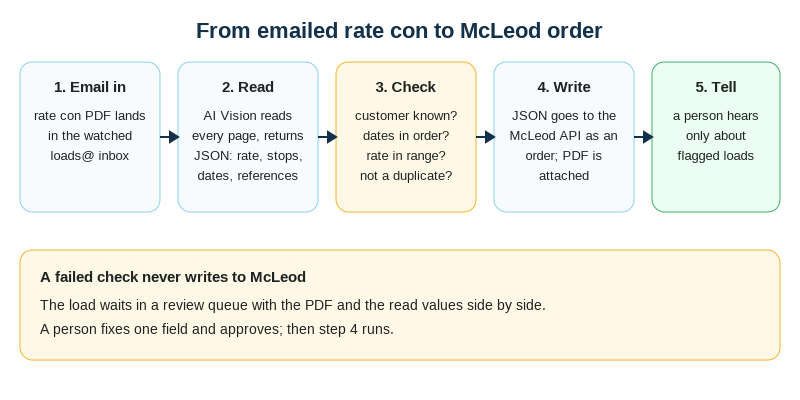
- Watch. A cloud server monitors the dispatch inbox and picks up each new email with a PDF.
- Read. AI Vision reads every page, including scans, and returns JSON: customer, rate, pickup and delivery stops, dates, reference numbers.
- Check. Rules confirm the customer exists in McLeod, delivery is after pickup, the rate is in range and the load is not a duplicate.
- Write. The JSON goes to the McLeod API as an order and the original PDF is attached to it.
- Tell. A person hears about flagged loads only, with the PDF and read values side by side.
How much time does retyping emailed rate cons cost a month?
By our arithmetic, a desk keying 15 rate cons a day at 7 minutes each spends about 37 hours a month, and review-only handling cuts that to about 8.
Here’s the quiet win: once the order builds itself, the McLeod screen your team opens is already filled, and their time goes to the loads that look wrong.
| Way of handling | Minutes per rate con | Hours a month (15 a day, 21 days) | Cost at $25 an hour |
|---|---|---|---|
| Typed by hand | 7 | 36.8 | $919 |
| Review only | 1.5 | 7.9 | $197 |
| Difference | 5.5 | 28.9 | $722 |
Assumptions: 7 and 1.5 minutes are our own guesses, 21 working days, and $25 an hour as a rough loaded cost. Time ten of your own rate cons before trusting any figure, ours included.
What should be checked before anything is written to McLeod?
Six checks should pass first, and a failed check holds the load for a person instead of writing a wrong order.
- The sender and customer match a customer already in McLeod.
- Pickup comes before delivery, and both dates are real.
- The rate is within the range you expect for that lane.
- Every page of the PDF was read, including accessorial terms.
- The same rate con is never written twice.
- The PDF is saved on the order before any field is trusted.
What should I ask McLeod and the vendor first?
Ask five plain questions before any contract is signed.
- Does my license include the API, and which services?
- Is the vendor McLeod Certified, and for my version?
- Can I have a sandbox, and how long does it take?
- Who owns the extracted data, and is it used for training?
- What does the vendor do when a layout is unknown?
What does a sensible first week look like?
Pick one customer and run the server in shadow mode, so it drafts orders while your team keeps typing.
- Day 1: collect 20 of that customer’s rate cons and time your own entry.
- Day 2: get API access and a sandbox from McLeod.
- Day 3: compare the server’s JSON with what your team keyed.
- Day 4: fix the fields it misses, then write only to the sandbox.
- Day 5: switch on live writes for that customer with the flag step on.
How we researched this
- Read on November 28, 2026: McLeod’s Order Creation Interface release (November 21, 2024, via PRWeb), McLeod’s API documentation page, Truck News on Respond AI (September 18, 2026), Debales’ McLeod integration page and Anthropic’s PDF support documentation.
- Searched for Reddit and forum threads on McLeod rate con entry; our tools returned none, so we quote no community posts.
- McLeod’s own product pages returned an access error to our reader, so we rely on its release and on press coverage for Respond AI.
- The time table is our own arithmetic, not a measurement. Vendor timelines are labeled as vendor claims.
- We did not run any of these tools and could not read pricing, which none of the sources publish.
Pick one customer, ask McLeod for a sandbox, and let one week of drafted orders show what your team can stop typing.
Sources and further reading
- McLeod Software: AI-powered Order Creation Interface for LoadMaster and PowerBroker (Nov 21, 2024)
- McLeod API documentation: home
- Truck News: McLeod leverages AI to reduce manual work (Sept 18, 2026)
- Debales: McLeod integration guide (vendor claims)
- Zuplo on DEV: Unlocking the potential of the McLeod API
- Anthropic: Claude PDF support
Questions and answers
Can I use AI to convert emailed rate cons to McLeod TMS?
Yes. AI Vision can read a rate con PDF into structured data, and a cloud server can send it to McLeod through the API or a certified partner’s order interface. Keep a person on flagged or unfamiliar documents and on rates.
Does McLeod have an API for creating orders?
Yes. McLeod’s API page says it uses a REST model, returns XML or JSON, and enforces the same validation as the desktop software. Which services you can use depends on your license, so ask McLeod.
Which AI companies work with McLeod for email order creation?
McLeod’s November 21, 2024 release names Vooma, Everest and Drumkit, and says more partners are expected. Providers must be McLeod Certified to onboard.
Does McLeod have its own AI for emailed load tenders?
Yes, Respond AI. Truck News reported on September 18, 2026 that about 30 companies had licensed it and that it can bring in load tenders from emails, attachments or spreadsheets.
How long does a McLeod rate con integration take?
No maker publishes a neutral figure. Debales claims a sandbox in 2 to 3 days and full production in 5 to 6 weeks, which is a vendor claim. Ask each vendor for a sandbox date in writing.