
What Are AI Agents, and How Are They Different From Chatbots?
Disclosure: this page contains Amazon affiliate links. As an Amazon Associate we earn from qualifying purchases, at no extra cost to you.
Ever asked a chatbot to book a table and got a lovely paragraph about restaurants instead, task delegator?
That’s the gap AI agents are built to close, so I read every maker’s own page to see what they can really do for you today.
On November 27, 2026, at least seven AI agents from Anthropic, OpenAI, Google, Meta and Microsoft can book, buy, write and file things for you, and four earlier ones have already been switched off.
If you’d like the long view on how these systems are designed, there are books about AI agents on Amazon, but the dated table below is the part that changes every month.
Short answer: An AI agent is an AI that does a task for you instead of just answering. You give it a goal; it plans steps, uses tools like a browser, your email or files, checks the result and keeps going until done. A chatbot answers and stops; an agent acts, and should ask before anything risky.
The five facts that sum up AI agents right now:
- An agent is an AI in a loop: Anthropic calls agents
typically just LLMs using tools based on environmental feedback in a loop
. - Seven agents you can use today: ChatGPT Work and dots (OpenAI), Claude Cowork and Claude Duet (Anthropic), Tasks in Gemini (Google), Muse (Meta) and Copilot Autopilot (Microsoft).
- Four were switched off: Operator, ChatGPT agent, ChatGPT Atlas and Google’s Project Mariner, none of which reached its second birthday.
- Only two name a hard line: Claude Duet won’t trade securities or move money between accounts, and in dots a password change always stays with you (our count of seven).
- Hijacking is rarer, not gone: Anthropic says its browser agent’s attack success rate is now below 0.08%, down from 23.6% in August 2025, and that
The risk is not zero.
What is an AI agent, in plain words?
An AI agent is a large language model (the engine behind a chatbot) that is allowed to use tools and keep working on its own until a goal is met. It plans, acts, looks at what happened and tries again.
The clearest definition comes from Anthropic’s engineering post Building effective agents (December 19, 2024). It describes agents as systems where LLMs dynamically direct their own processes and tool usage
.
The same post separates agents from workflows. A workflow follows predefined code paths
that a person wrote in advance; an agent chooses its own next step. Anthropic’s advice to builders is blunt: start with the simplest solution possible, and only increasing complexity when needed
.
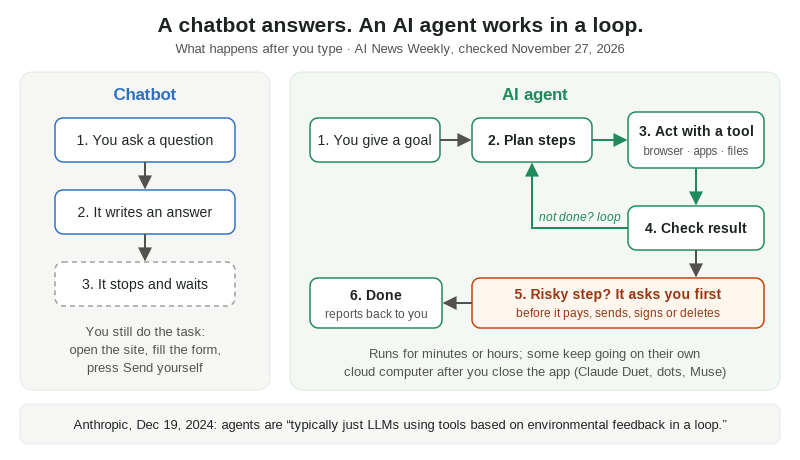
The diagram as text:
- Chatbot: you ask a question, it writes an answer, it stops; you still open the site and press Send yourself.
- AI agent: you give a goal; it plans steps, acts with a tool (browser, apps, files), checks the result and loops back until the job is done.
- The approval gate: before it pays, sends, signs or deletes, a well-built agent asks you first, then reports back.
- Running time: minutes or hours; Claude Duet, dots and Muse keep going on their own cloud computer after you close the app.
How is an AI agent different from a chatbot?
A chatbot gives you words; an AI agent gives you a finished task. The difference shows up in four places: who starts, what it can touch, how long it runs and what it needs from you.
| Question | Chatbot | AI agent |
|---|---|---|
| Who starts the work? | You, every time | You, or the agent itself: Claude Duet sends you a morning brief from your connected apps without being asked |
| What can it touch? | The text you paste in | A browser, connected apps (email, calendar, Slack, Google Drive), your files, sometimes your whole screen |
| How long does it run? | One answer | Minutes to hours; OpenAI says ChatGPT Work can keep working on a project for hours |
| What does it need from you? | A good question | A clear goal, the right permissions, and your approval at risky steps |
So is ChatGPT an agent? The ChatGPT app is both now. Plain chat is a chatbot; ChatGPT Work and dots, inside the same app, are agents.
What is the difference between AI agents and agentic AI?
There is no single agreed difference between AI agents and agentic AI: the companies and writers who use the words split into three camps, and we found all three among the pages ranking for this question in November 2026.
- Agentic AI is the umbrella. Anthropic’s post calls every variation
agentic systems
, covering both fixed workflows and true agents. - Agentic AI is a team of agents. Some vendors, such as Moveworks in its explainer, use “agentic AI” for the layer that plans and coordinates several agents toward one goal.
- Agentic is a degree. Other explainers treat “agentic” as an adjective: the more an AI decides its own steps, the more agentic it is. You can count agents; you can’t count agentic AI.
Our plain reading: an AI agent is a thing you can name (Claude Duet, dots). “Agentic AI” describes how much freedom an AI has. When a product page says agentic
, ask the one question that matters: what can it do without asking me?
Which AI agents can you actually use in November 2026?
Seven AI agents from five big companies are live on November 27, 2026: ChatGPT Work and dots from OpenAI, Claude Cowork and Claude Duet from Anthropic, Tasks in Gemini from Google, Muse from Meta and Copilot Autopilot from Microsoft.
The table lists what each one can reach and what it asks before acting, from the maker’s own page. Nobody else had lined up the access rules side by side, and they differ more than the marketing does.
| Agent (maker, launch) | What it can reach | What it asks before acting | Who can get it |
|---|---|---|---|
| ChatGPT Work (OpenAI, July 9, 2026) | Connected apps such as Slack, Microsoft Teams, Google Drive, SharePoint, email, calendars and CRMs; on desktop, local files and apps, a built-in browser and Computer Use | You decide what it can access, when it should check in, and when it needs your approval before taking action.Admins can restrict sensitive actions | Web and mobile: Pro, Enterprise and Edu first, then Plus and Business; desktop app: every plan, including Free |
| dots (OpenAI, September 29, 2026) | Its own cloud computer and browser, the apps you connect, and your laptop if you allow it | Built-in rules for when to act and when to ask; background research uses read-only tools; Certain sensitive tasks, such as changing a password, always stay with you. | Pro and Business Premium in eligible markets; Enterprise beta when an admin turns it on |
| Claude Cowork (Anthropic) | Folders you connect (only while the desktop app is open), connectors, a built-in browser or your Chrome, and computer use on Pro, Max and Ultra | Computer use asks before each app; in Chrome you choose “Manually approve” or the default “Automatically approve”; it asks before financial sites | Desktop: all paid plans; web and mobile: Pro, Max, Ultra and Team (beta), Enterprise if enabled |
| Claude Duet (Anthropic, October 21, 2026) | Its own cloud computer and browser; your Claude connectors such as Gmail, Google Calendar, Google Drive, Slack, QuickBooks, HubSpot, Docusign and Calendly; Link and Shop Pay | Asks before it sends a message, makes a payment, signs a document or deletes anything; trading securities and moving money between accounts are off-limits even with approval | Waitlist research preview for Pro, Max and Ultra; not on Enterprise yet |
| Tasks in Gemini (Google, free rollout November 17, 2026) | More than 60 apps, phone calls to businesses, Google Pay checkout, Instacart orders | Asks before clicking “Buy” by default; you can turn Purchase confirmation off, mark routine actions “Always allow” and set a spending cap | Free in the U.S., Japan, Korea, Canada, Australia and India; purchases: 18+, U.S., English |
| Muse (Meta, U.S. September 8, 2026; UK November 23, 2026) | Its own cloud computer (a secure virtual machine), email, calendar and checkout tools you connect | Asks before sending an email or making a purchase; can’t see your passwords or payment details | Anyone 18+ in the UK on iOS, Android, muse.ai and WhatsApp; free for most uses |
| Copilot Autopilot (Microsoft, November 17, 2026) | Lives in your company’s Microsoft 365 tenant with its own identity, memory and tools | Can check with you before key actions; its own Entra Agent ID and a named manager; IT can block it anytime and every action is logged | Work accounts in Microsoft’s Frontier early-access program |
What the seven have in common, by our count:
- 3 of 7 run on their own cloud computer and keep working after you close the app: dots, Claude Duet and Muse.
- 3 of 7 name purchases or payments as something they ask about first: Claude Duet, Tasks in Gemini and Muse.
- 3 of 7 let you switch approvals to automatic: Gemini (Purchase confirmation off, “Always allow”), Claude in Chrome (“Automatically approve”) and ChatGPT Work (you decide when it needs approval).
- 2 of 7 say they never see your passwords: Claude Duet and Muse.
- 2 of 7 name a hard line that stays with you even if you approve: Claude Duet and dots.
Which AI agents were shut down or renamed?
Four AI agents from OpenAI and Google were retired or folded into newer products between July 2025 and November 2026: Operator, ChatGPT agent, ChatGPT Atlas and Project Mariner.
| Agent | Launched | What happened | Days live |
|---|---|---|---|
| Operator (OpenAI) | January 23, 2025 | Folded into ChatGPT agent on July 17, 2025; OpenAI’s Help Center says its website is no longer accessible | 175 |
| ChatGPT agent (OpenAI) | July 17, 2025 | The Help Center now says ChatGPT agent is no longer availableand points to ChatGPT Work | No end date published |
| ChatGPT Atlas browser (OpenAI) | October 21, 2025 | OpenAI’s Help Center: ChatGPT Atlas has been retired and no longer receives updates.Notebookcheck reported the stop date as August 9, 2026 | 292 |
| Project Mariner (Google) | December 11, 2024 | Digital Trends and Wired reported that Mariner’s page said it was shut down on May 4, 2026, its technology moving into Gemini | 509 |
Here’s the gap nobody covers: what happens to your stuff. Atlas users had about 30 days to export bookmarks and history before the stop date, Notebookcheck reported. Before you build a routine around any agent, know where its exports live.
What can AI agents do well, and where do they still slip?
AI agents do well at errand-shaped work with a clear finish line: sorting an inbox, comparing products, booking appointments, filling forms, drafting replies, building a spreadsheet from scattered files. They slip on judgment, and the makers say so on their own pages.
- Claude Duet: the help page warns it
can also make mistakes, such as misreading a thread or misjudging what’s urgent
. It doesn’t make phone calls or text other people, and you can’t watch or take over its browser. - Tasks in Gemini: calling businesses isn’t available in Indiana, Louisiana, Minnesota, Montana or Nebraska, according to Google’s November 17 post.
- Claude Cowork: cloud tasks keep running after you close your laptop, so Anthropic tells you to review them when you come back.
That’s the honest shape of agents in late 2026: good assistants for chores, still in need of a person who reads the summary before anything goes out the door.
What is “agent washing”?
“Agent washing” is Gartner’s name for rebranding an ordinary chatbot, assistant or automation tool as an “AI agent” without real agent abilities.
In its June 25, 2025 release, Gartner estimated that only about 130 of the thousands of companies selling “agentic AI” are real. It also predicted that over 40% of agentic AI projects will be canceled by the end of 2027, over costs, unclear value or weak risk controls.
Gartner analyst Anushree Verma put it plainly: Many use cases positioned as agentic today don’t require agentic implementations.
The test for any product is simple: does it take actions in other apps, or does it only talk?
What should you let an AI agent do with your accounts?
Let an AI agent read and draft freely, but keep money, messages and deletions behind your approval. That rule matches what the makers’ own defaults do, and it’s the one rung most worth keeping even when an app offers to skip it.
Here’s what made me grin: Claude Duet will happily draft your invoice, but it won’t move money between your own accounts even if you approve it. It’s like a helper who carries every grocery bag into the house and still won’t touch the wallet on the counter. Honestly? That’s exactly the helper I’d want.
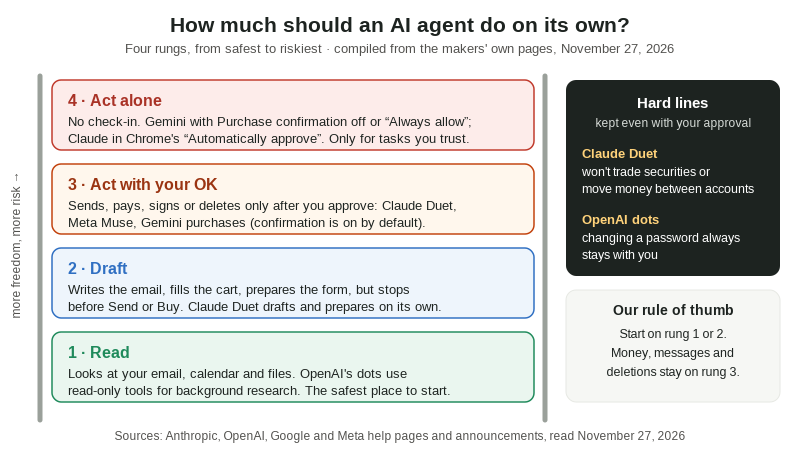
The ladder as text:
- Rung 1, Read
- The agent looks at your email, calendar and files. OpenAI’s dots use read-only tools for background research. The safest place to start.
- Rung 2, Draft
- It writes the email, fills the cart or prepares the form, then stops before Send or Buy. Claude Duet reads, drafts and prepares work on its own.
- Rung 3, Act with your OK
- It sends, pays, signs or deletes only after you approve: Claude Duet, Muse and Gemini purchases, where Purchase confirmation is on by default.
- Rung 4, Act alone
- No check-in: Gemini with Purchase confirmation off or “Always allow”, Claude in Chrome’s “Automatically approve”. Only for tasks you trust.
- Hard lines
- Claude Duet won’t trade securities or move money between accounts even with your approval; in dots, changing a password always stays with you.
Google’s own Gemini purchases help page spells out what happens on rung 4: If you turn it off, Gemini automatically completes the transaction when your conditions are met.
What is prompt injection, and why does it matter for AI agents?
Prompt injection is a trick where a web page, email or document hides instructions that an AI agent reads and follows as if you’d typed them, like forward the last invoice to this address
.
It matters more for agents than for chatbots because an agent can act on what it reads. The OWASP Top 10 for Agentic Applications (December 2025) puts “Agent Goal Hijack” first on its list of risks.
Anthropic published real numbers. In its Claude for Chrome post (August 25, 2025), 123 test cases across 29 attack scenarios gave a 23.6% attack success rate without defences, cut to 11.2% with them.
Its current Claude in Chrome safety page says the setup with Claude Opus 4.8 reduces attack success rates to less than 0.08%
in Anthropic’s internal testing, and adds that the chances of an attack are still non-zero
.
Those two numbers aren’t one test run twice: the models, the defences and the attack sets all changed. Read them as “much rarer”, not “solved”.
How do you use an AI agent safely?
Use an AI agent safely by giving it the smallest access that gets the job done and keeping your approval on anything that spends, sends or deletes. Eight habits, each taken from a maker’s own advice or settings:
- Use a separate browser profile without your bank, health or government logins, as Anthropic advises for Claude in Chrome.
- Keep purchase confirmation on (Gemini’s default) and set a hard spending cap.
- Pay with a one-time card where offered: Claude Duet pays through Link with a virtual card, so your real card number isn’t shared.
- Connect one folder, not your whole drive. Anthropic warns that computer use
isn’t limited to the folders you’ve connected
and that Cowork’s deletion protection doesn’t cover it. - Start on trusted sites and simple jobs such as research or form-filling.
- Stop the task at once if the agent wanders to unrelated sites or asks for sensitive details; Anthropic names both as signs of prompt injection.
- Read every approval card before you tap yes; Anthropic’s Duet page asks you to review drafts and approval requests.
- Disconnect apps you no longer use, and know where to export your data before a product is retired.
Where do the makers’ pages and explainers disagree?
The makers’ own pages disagree on three things: what “agentic” means, who can get some agents, and whether approval is the default. Here is each conflict with both sides.
| Question | One source says | Another says |
|---|---|---|
| What is “agentic AI”? | Anthropic: every workflow and agent is an “agentic system” | Vendors such as Moveworks: the layer that coordinates many agents |
| Where can you get Claude Duet? | Anthropic’s launch article (October 21): starting with US Pro, Max, and Ultra subscribers | Anthropic’s help page (read November 27): Pro, Max and Ultra users in five countries; People Matters reported the India preview on November 25 |
| Is approval on by default? | Gemini: Purchase confirmation is on by default | Claude in Chrome’s Cowork side panel: “Automatically approve” is the default, pausing only when it decides approval is needed |
| How often does prompt injection work? | Anthropic, August 2025: 11.2% with defences | Anthropic, November 2026: below 0.08%, on a newer model and test set |
None of these is a mistake: pages were written months apart, for different products. That’s why every row on this page carries the date we read it.
What happened with AI agents in November 2026?
November 2026 was the month the big companies pushed agents to the mainstream: Microsoft and Google launched on the same day, November 17, and Meta and Anthropic followed on November 23.
- : OpenAI updated its dots post for the GPT-6.1 Terra model. (Our 2026 AI model release timeline lists every model behind these agents.)
- : Microsoft began rolling out Copilot Autopilot to Frontier customers, calling it
a trusted autonomous agent that is personal to you, always on, and working for you
. - : Google made Tasks in Gemini free for hundreds of millions of people in six countries, running on Gemini 4 Hydrogen and paying through the Agent Payments Protocol (AP2).
- : Meta brought Muse to the UK for anyone 18 and over.
- : TechCrunch reported Anthropic’s Claude Ship, agents that review, fix and approve routine code changes for Team and Enterprise customers on GitHub.
- : People Matters reported that Anthropic opened the Claude Duet research preview in India.
What are the key numbers on AI agents?
The key numbers on AI agents on November 27, 2026, from the makers’ and analysts’ own pages:
| Finding | Number | Source |
|---|---|---|
| AI agents live from the five big makers | 7 | Our count |
| Agents retired or folded in | 4 (175, 292 and 509 days live where dated) | OpenAI Help Center, Digital Trends; our arithmetic |
| Agents that run on their own cloud computer | 3 of 7 | OpenAI, Anthropic, Meta; our count |
| Agents that name a hard line even with approval | 2 of 7 | Anthropic, OpenAI; our count |
| Browser-agent attack success, August 2025 | 23.6% without defences, 11.2% with | Anthropic, 123 test cases |
| Browser-agent attack success, now | Below 0.08% | Anthropic, Claude Opus 4.8 |
| Apps Gemini Tasks connects to | More than 60 | Google, Nov 17, 2026 |
| “Real” agentic AI vendors | About 130 of thousands | Gartner, Jun 25, 2025 |
| Agentic AI projects Gartner expects canceled by end of 2027 | Over 40% | Gartner, Jun 25, 2025 |
The short version: an agent is a chatbot with hands. Give it small jobs first, keep your thumb on the approve button for money and messages, and check the date on any “best agent” claim.
We’ll refresh the agent table every month, and sooner when one launches or shuts down. For more help setting up new tech at your own pace, see how to use AI as free tech support, and for how the models behind agents are scored, our guide to AI leaderboards.
So here’s the plan, task delegator: pick one boring chore, hand it to an agent on the read or draft rung, and keep your thumb on the approve button for anything that costs money. I’ll re-check every agent on this page next month, and sooner if another one launches or quietly disappears.
Sources and further reading
- Building effective agents (Anthropic) — Dec 19, 2024; agent and workflow definitions
- Introducing Claude Duet (Anthropic) — Oct 21, 2026; approvals, off-limits actions, virtual card
- Get started with Claude Duet (Claude Help Center) — connectors, limits, mistakes warning; read Nov 27, 2026
- Use Claude Cowork on web, desktop, and mobile (Claude Help Center) — folders, browser, plans; read Nov 27, 2026
- Let Claude use your computer in Cowork (Claude Help Center) — per-app permission; not limited to connected folders
- Use Claude in Chrome safely (Claude Help Center) — below 0.08% attack success; approval modes; safety advice
- Piloting Claude for Chrome (Anthropic) — Aug 25, 2025; 123 test cases, 23.6% to 11.2%
- ChatGPT is now a partner for your most ambitious work (OpenAI) — Jul 9, 2026; ChatGPT Work
- Introducing dots (OpenAI) — Sep 29, 2026, updated Nov 3, 2026
- ChatGPT agent (OpenAI Help Center) — "no longer available"; read Nov 27, 2026
- ChatGPT Atlas retirement (OpenAI Help Center) — retired, no longer receives updates
- How to use Tasks in Gemini for personal assistance (Google) — Nov 17, 2026; Josh Woodward
- Make purchases & payments with Gemini Apps (Gemini Apps Help) — Purchase confirmation default; read Nov 27, 2026
- Introducing Muse in the UK (Meta) — Nov 23, 2026
- Copilot at Microsoft Ignite (Microsoft) — Nov 17, 2026; Jared Spataro; Copilot Autopilot
- Gartner Predicts Over 40% of Agentic AI Projects Will Be Canceled by End of 2027 (Gartner) — Jun 25, 2025; agent washing, about 130 real vendors
- OWASP Top 10 for Agentic Applications for 2026 (OWASP GenAI Security Project) — Dec 9, 2025; ASI01 Agent Goal Hijack
- Anthropic launches Claude Ship (TechCrunch) — Nov 23, 2026; Sarah Perez
- Anthropic brings Claude Duet to India (People Matters) — Nov 25, 2026
- ChatGPT Atlas ends on August 9 (Notebookcheck) — Atlas stop date
- Google pulls the plug on Project Mariner (Digital Trends) — shut down May 4, 2026
Questions and answers
What is an example of an AI agent?
Claude Duet from Anthropic is an example of an AI agent: it sends a morning brief from your connected apps, drafts replies and prepares tasks, and asks before it sends, pays, signs or deletes anything. Other examples in November 2026 are OpenAI’s ChatGPT Work and dots, Tasks in Gemini, Meta’s Muse and Microsoft’s Copilot Autopilot.
Is ChatGPT an AI agent?
Plain ChatGPT chat is a chatbot, but the ChatGPT app now includes agents: ChatGPT Work (launched July 9, 2026) and dots (September 29, 2026). The older ChatGPT agent mode is no longer available, according to OpenAI’s Help Center.
Are AI agents safe to use?
AI agents are reasonably safe for low-risk chores if you keep your approval on payments, messages and deletions. Hijacking by prompt injection is much rarer than in 2025 (Anthropic reports below 0.08% for Claude in Chrome), but Anthropic says the risk is not zero, so use a separate browser profile and start with small tasks.
What is the difference between AI agents and agentic AI?
An AI agent is a specific product that takes actions for you, such as Claude Duet or dots. “Agentic AI” has no single meaning: Anthropic uses it as an umbrella for all agent-like systems, some vendors use it for several agents working together, and others mean how much freedom an AI has.
Can an AI agent buy things for me?
Yes. Tasks in Gemini, Claude Duet and Meta’s Muse can all check out online, and each asks before paying by default. Gemini lets you turn that confirmation off and set a spending cap; Claude Duet pays with a virtual card through Link so your real card number isn’t shared.