
AI Trip Planning Doubled Among Older Travelers: How to Use It Without Getting Burned
Disclosure: this page contains Amazon affiliate links. As an Amazon Associate we earn from qualifying purchases, at no extra cost to you.
Pack your curiosity, itinerary dreamer — twice as many travelers over 50 now ask AI to help plan their trips, and I’ve gone through the newest numbers, every big assistant’s travel tools and the oops-moments, so your next trip gets the good parts and none of the surprises! Yes — AI can plan a lovely trip for an older traveler, as long as the AI does the legwork and you do the checking. For the paper side of the trip — boarding passes, hotel confirmations, the printed day-by-day plan — travel document organizers keep everything in one place.
Short answer: Yes, AI is a useful trip planner for older travelers, and twice as many now use it: 16% of travelers 50+, up from 8% a year earlier (AARP, March 2026). Use ChatGPT, Gemini, Copilot or Claude for ideas, deals and a day-by-day plan, then check every place, time and price on the official site and book there yourself.
The six facts that sum up AI trip planning for older travelers in November 2026:
- 16% of U.S. travelers 50 and older who know about AI used it to plan leisure travel, double the 8% of a year earlier (AARP Research, 2026 Travel Trends, March 10, 2026).
- 28% vs 4%: travelers 50-59 use AI for trip planning seven times as often as travelers 70 and older (same AARP survey; the ratio is our arithmetic).
- 44% of older travelers who used AI used it to find the best travel deals — the top use, tied with finding unique experiences (AARP).
- 6% of travelers 50+ say AI recommendations have the greatest influence on where they go; 66% say their own research (AARP).
- Booking arrived in 2026: Google’s AI Mode in Search began booking hotels in the U.S. on August 27, 2026, and Claude added Booking.com, Tripadvisor and Viator connectors on April 23, 2026.
- $274 million was reported lost to travel, vacation and timeshare fraud in 2024, with a median loss of $922 (FTC Consumer Sentinel Network Data Book 2024).
How many older travelers use AI to plan trips?
About one in six older travelers uses AI to plan trips: 16% of U.S. travelers 50 and older who are aware of AI said they had used it to plan leisure travel, up from 8% a year earlier, according to AARP Research’s 2026 Travel Trends survey. The jump came almost entirely from travelers in their 50s and 60s.
AARP Research’s 2026 Travel Trends: A Survey of U.S. Adults Age 50-Plus
(Lona Choi-Allum, published March 10, 2026; an online survey of 2,051 U.S. travelers, including 1,189 aged 50 and older, fielded November 11 to December 15, 2025) broke the AI numbers down by age. Travelers 50-59 went from 14% to 28%, travelers 60-69 from 8% to 19%, and travelers 70 and older from 3% to 4%.
By our arithmetic, that’s 2.0 times as many AI trip planners among travelers in their 50s, 2.4 times as many among travelers in their 60s, and only one percentage point more among travelers 70 and older. AARP’s own summary of the slide: travelers 70-plus express significantly less interest than those ages 50-69
. In the same survey, 69% of travelers 70 and older said they were not likely to use AI to plan trips in the near future, against 38% of travelers 50-59.
That fits the wider picture: Pew Research Center’s How Americans’ opinions and use of AI differ by age
(June 17, 2026) found that 23% of adults 65 and older use AI chatbots, against 49% of all U.S. adults. Carey Kyler, Senior Director of Consumer Insights at AARP Services, put the travel side of it this way in AARP’s March 10, 2026 press release:
Even with cost pressures, adults 50-plus are finding creative ways to keep exploring, whether that’s using rewards, shopping for deals, or turning to AI for smarter trip planning.
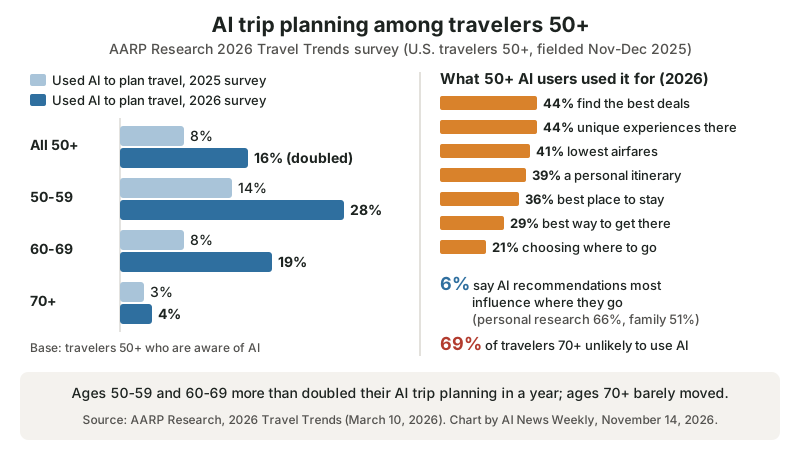
The chart as text — used AI to plan leisure travel, among travelers 50+ aware of AI (AARP Research, 2025 survey then 2026 survey): all 50+, 8% then 16%; ages 50-59, 14% then 28%; ages 60-69, 8% then 19%; ages 70+, 3% then 4%. What 50+ AI users used it for (2026): find the best travel deals 44%; identify unique experiences at the destination 44%; find the lowest airfares 41%; curate a personalized itinerary 39%; identify the best accommodations 36%; choose the best way to get there 29%; choose a destination 21%. Greatest influence on where to go, all travelers 50+: personal research 66%, friends and family 51%, AI recommendations 6%. Not likely to use AI to plan trips: ages 70+, 69%; ages 50-59, 38%.
What do older travelers use AI for when planning a trip?
Older travelers mostly use AI for the money and the details, not for picking the destination. Among travelers 50+ who had used AI, AARP Research found the top uses were finding the best travel deals (44%), identifying unique experiences at the destination (44%), finding the lowest airfares (41%) and building a personalized itinerary (39%); only 21% used AI to choose where to go.
The deal-hunting makes sense: the same AARP report found that 89% of travelers 50+ bargain shop at least sometimes, and that 45% say the high cost of air travel gives them pause. Where to go is still a human decision — 66% of travelers 50+ say their own research has the greatest influence, 51% say friends and family, and just 6% say AI recommendations. AARP sums it up: older travelers are using AI to help find deals, identify unique experiences or curate personalized itineraries, though few use it to choose a destination
.
What changed in AI trip planning in 2025 and 2026?
AI assistants went from suggesting trips to helping book them between April 2025 and August 2026: Microsoft, OpenAI, Anthropic and Google all connected their assistants to travel sites such as Booking.com, Expedia and Tripadvisor, and Google’s AI Mode began booking hotels itself. At the same time, reports of AI-invented places and wrong opening hours made checking the plan more important.
- — Copilot Actions. Microsoft’s “Your AI Companion” said
Copilot can now partner with you to complete tasks behind the scenes
, with launch partners including Booking.com, Expedia, Kayak, Priceline, Tripadvisor, Skyscanner, Viator and Vrbo. - — AI-invented trips make the news. The BBC reported travelers sent by AI chatbots to a
Sacred Canyon of Humantay
in Peru that doesn’t exist; the OECD’s AI Incidents Monitor logged it on September 29, 2025 (details below). - — Booking.com and Expedia inside ChatGPT. TechCrunch (Maxwell Zeff, October 6, 2025) reported that ChatGPT users
will be able to access interactive applications from companies like Booking.com, Expedia
and others. - — Alexa+ and Expedia announced. Amazon said Alexa+ will
find, suggest, compare, book, and manage hotel bookings globally
with Expedia,all coming to Alexa+ in 2026
. - — AI trip planning doubles. AARP Research reports 16% of travelers 50+ used AI to plan travel, up from 8%.
- — Claude’s travel connectors. Anthropic’s
New connectors in Claude for everyday life
added Booking.com, Tripadvisor and Viator, among others, on all plans. - — The FTC’s summer travel-scam alert. The FTC warned that
Scammers sometimes use paid ads and put their number alongside a well-known company’s name
. - — Gemini explains its trip planning. Google wrote that
Gemini gets real-time information — think locations, reviews, prices, and more — from Google Maps, Flights, and Hotels
. - — Hotel booking in Google’s AI Mode. Google’s
3 new ways to plan and book travel in Search
(James Byers) added hotel booking in AI Mode in the U.S., flight price tracking and points-and-miles prices.
Which AI assistants can plan or book a trip in 2026?
All six big AI assistants can plan a trip in 2026, and most now connect to real travel sites: Google’s AI Mode can book a hotel in the U.S., while ChatGPT, Copilot and Claude search partners such as Booking.com and Expedia and hand you to the partner’s own pages, and Alexa+’s Expedia booking was announced for 2026. In every case, you choose and confirm.
| Assistant | Travel partners or data named | What it does for a trip | Where you finish |
|---|---|---|---|
| Google AI Mode in Search | Booking.com, Choice Hotels, Expedia, Hilton, Hotels.com, IHG, Marriott, Priceline, Trip.com, Wyndham; flight prices from 300+ airlines and travel sites | Plans the trip, tracks flight prices, shows points-and-miles prices, books hotels | Hotels: “Continue on Google” and Google Pay, U.S., English (the hotel or platform handles customer service). Flights: the airline’s site or a booking platform |
| Gemini app | Google Maps, Flights and Hotels; Viator for tours | Day-by-day itineraries with real-time places, reviews and prices; can read trip confirmations in Gmail if you turn that on | You press “book” yourself, per Google |
| ChatGPT | Booking.com and Expedia apps | Hotel and travel options inside the chat | The partner’s own pages (as reported; OpenAI’s page refused our fetch) |
| Microsoft Copilot | Booking.com, Expedia, Kayak, Priceline, Tripadvisor, Skyscanner, Viator, Vrbo | Copilot Actions completes tasks on partner sites “behind the scenes” | On the partner’s site, through Copilot |
| Claude | Booking.com, Tripadvisor, Viator connectors (all plans) | Searches stays, compares hotels and finds tours in the chat | Anthropic says Claude is designed to check with you firstbefore it books or buys |
| Amazon Alexa+ | Expedia (announced for 2026) | Find, compare, book and manage hotels by voice | Through Alexa, once it launches; we found no launch announcement by November 14, 2026 |
Which one should an older traveler use? The one you already have and like. If you search on Google every day, AI Mode is right there; if your family set you up with ChatGPT, Claude or Copilot, each can now pull real hotel listings. The planning skill matters more than the app — and so does the checking, which is where the next section comes in.
What can go wrong when AI plans your trip?
AI trip plans go wrong in three main ways: the AI invents a place that doesn’t exist, it gets opening hours or last departures wrong, and it repeats prices or rules that have changed. All three are caught the same way — by checking each place, time and price on the official website before you go.
Okay, can we talk about the canyon? Somewhere in Peru, two travelers set off for a ‘Sacred Canyon’ an AI chatbot had described in loving detail — and it doesn’t exist. I love a chatbot’s enthusiasm, but I like my canyons real, my ropeway times checked and my sunsets with a way back down.
- A place that doesn’t exist
- The BBC reported in September 2025 that two tourists in Peru set off to hike alone to a
Sacred Canyon of Humantay
described by an AI chatbot; a local trekking guide said no such canyon exists. The OECD AI Incidents Monitor records the risks as financial loss and physical danger at high altitude. - The wrong closing time
- A couple used ChatGPT to plan a sunset hike on Mount Misen in Japan; the AI Incident Database (incident 1635) records that the chatbot allegedly gave the last ropeway down as 5:30 PM, and the ropeway had already closed when they reached the top.
- Old facts
- Fees, schedules, entry rules and cancellation policies change. Google’s own hotel-booking post tells travelers to review details
like the cancellation policy
before booking.
That last check matters more this year: in AARP’s 2026 survey, 36% of travelers 50+ said reports of airline cancellations give them pause about flying, up from 24% a year earlier. A plan with a written cancellation policy and a backup train or flight is worth more than a perfect-looking one.
Can AI help with wheelchair, mobility or medical needs on a trip?
Yes — AI is good at the paperwork side of accessible travel, such as drafting a request to the airline or hotel and listing the questions to ask, but the help itself has to be booked with the people who provide it. At U.S. airport security, that’s TSA Cares; for a wheelchair from the curb to the plane, it’s your airline.
TSA’s TSA Cares request form says to call TSA Cares at 855-787-2227 if your flight is within 72 hours, that TSA Cares helps only through the screening checkpoint
, and that for in-flight help or wheelchair assistance from the curb to the aircraft
you should contact your airline. In AARP’s 2026 survey, 14% of travelers 50+ named getting through airport security as a worry about flying, and 3% named wheelchair damage. AARP’s report draws the conclusion plainly:
Accessibility shapes how people travel, not whether they do.
A good AI prompt here: Write a short, polite email to [airline] asking for wheelchair assistance from check-in to the gate for my flight on [date], and list what else I should ask them.
Then send it — or read it out on the phone — yourself.
How do travel scams catch people, and how does AI change them?
Travel scams catch people with fake listings, fake booking sites and fake customer-service numbers, and AI makes the fakes more convincing: in 2024 Americans reported 58,347 travel, vacation and timeshare fraud cases to the FTC, with $274 million lost and a median loss of $922. The fix is the same as ever — book through the real site, by credit card.
Those numbers come from the FTC’s Consumer Sentinel Network Data Book 2024 (March 2025), the newest full data book we found, where travel, vacations and timeshare plans ranks ninth among fraud categories by money lost. 67% of those reports included a money loss — by our arithmetic, about 39,000 reports (58,347 times 0.67).
AI’s part is in the polish. Booking.com’s chief information security officer, Marnie Wilking, told the BBC (Tom Gerken, June 21, 2024, republished by RNZ) that phishing scams had risen anywhere from a 500 to a 900 percent
in 18 months, and that The attackers are definitely using AI to launch attacks that mimic emails far better than anything that they’ve done to date
. She called two-factor authentication the best way to combat phishing and credential stealing
.
How do you spot a fake travel site, listing or phone number?
Spot a fake travel offer by how it wants to be paid and where its contact details came from. The FTC’s How to avoid a travel scam this summer
(June 17, 2026) says Only scammers say the only way to pay is by
wire transfer, gift card, payment app or cryptocurrency, and that scammers buy search ads that put their own phone number next to a real airline’s or hotel’s name.
- Type the address yourself. Go to the airline’s or hotel’s website by typing it in, or scroll past the paid ads, before you call any number.
- Check the listing elsewhere. The FTC’s Rental Listing Scams page says to search the address with the owner’s or rental company’s name, and to check the rental company’s own website.
- Search for complaints. Search the company’s name with “scam”, “review” or “complaint” before you commit (FTC).
- Get it in writing. Ask for the full details and the contract before you send a deposit; walk away from an organizer who won’t give specifics (FTC).
- Messages “from” your booking site. If an email or chat message asks you to re-enter card details, open the app or website yourself and look there instead.
How do you plan a trip with AI without getting burned?
Plan a trip with AI in three steps: ask the AI for ideas that fit your pace and needs, check every place, time and price on the official website, then book it yourself on the real site with a credit card. The AI saves you hours of searching; the official sites and your own booking keep you safe.
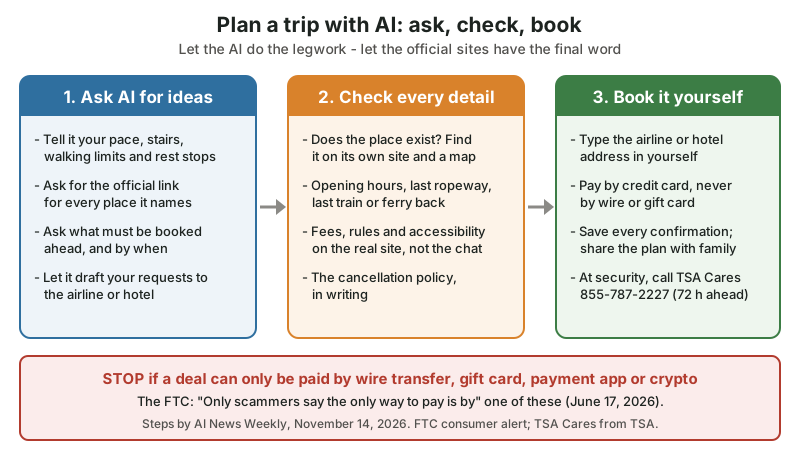
The diagram as text — 1. Ask AI for ideas: tell it your pace, stairs, walking limits and rest stops; ask for the official link for every place it names; ask what must be booked ahead and by when; let it draft your requests to the airline or hotel. 2. Check every detail: does the place exist on its own site and a map; opening hours and the last ropeway, train or ferry back; fees, rules and accessibility on the real site, not the chat; the cancellation policy in writing. 3. Book it yourself: type the airline or hotel address in yourself; pay by credit card, never by wire or gift card; save every confirmation and share the plan with family; at security, call TSA Cares, 855-787-2227, 72 hours ahead. Stop if a deal can only be paid by wire transfer, gift card, payment app or crypto (FTC, June 17, 2026).
One more habit for the road: keep your phone charged, because the plan, the tickets and the help lines all live on it — a portable phone charger in the day bag is cheap peace of mind.
What should you type into ChatGPT, Gemini, Copilot or Claude to plan a trip?
Type your real needs first — dates, pace, walking limits, who’s coming — and ask the AI to give an official link for every place and to say what it isn’t sure about. Our own prompt for a first plan:
Plan a 4-day trip to [city] in [month] for
two travelers in their 70s.
- We walk about 1 mile at a time, with rests.
- Avoid steep stairs; one main outing a day.
- Back at the hotel by 6 pm.
For each day, list the places with:
- a link to each place's official website
- opening hours, and say if you aren't sure
- what must be booked ahead, and by when
Don't invent places. Use simple words.
And our prompt for checking a plan you already have:
Here is my trip plan: [paste it].
1. Is every place real? Give the official link.
2. Which times, prices or rules should I
   check on the official site before I go?
3. What is the last bus, train or ferry back
   each day?
4. Where could a cancellation leave me stuck,
   and what's my backup?
Then do what the AI can’t: open those links and read the official pages yourself. For a step-by-step version with one assistant, our sister site How To With Claude AI is publishing a matching seniors series with screens and prompts for Claude. For a trip abroad, part 8 of this series covers AI translation in 2026, from Google Translate to AirPods.
What are the key numbers on AI trip planning for older travelers?
The key numbers on older travelers, AI trip planning and travel scams, gathered from AARP Research, Pew Research Center, Google and the FTC:
| Finding | Number | Source |
|---|---|---|
| Travelers 50+ (aware of AI) who used AI to plan travel | 16% (8% a year earlier; doubled) | AARP, Mar 2026 |
| Used AI to plan travel, ages 50-59 / 60-69 / 70+ | 28% / 19% / 4% (2.0x / 2.4x / +1 point in a year) | AARP, Mar 2026 |
| Travelers 70+ not likely to use AI for trips | 69% (ages 50-59: 38%) | AARP, Mar 2026 |
| Top use among older AI users | Best deals and unique experiences, 44% each | AARP, Mar 2026 |
| AI recommendations as the top influence on where to go | 6% (own research 66%) | AARP, Mar 2026 |
| Worried by airline cancellation reports | 36% (24% a year earlier) | AARP, Mar 2026 |
| Adults 65+ / all adults who use AI chatbots | 23% / 49% | Pew, Jun 2026 |
| Airlines and travel sites in AI Mode flight prices | 300+ | Google, Aug 2026 |
| Travel, vacation and timeshare fraud reports | 58,347 (67% with a loss, about 39,000) | FTC, 2024 data |
| Reported losses / median loss | $274 million / $922 | FTC, 2024 data |
| TSA Cares lead time | 72 hours before the flight (855-787-2227) | TSA |
The surveys measure different things — AARP asked travelers 50+ about their habits, Pew asked all U.S. adults about AI, and the FTC counts the reports people chose to file — so read each row on its own.
The short version for older travelers and the families who help them: let AI dream up the trip and hunt the deals, then let the official websites have the final word. Ask, check, book — and you get the best of both, a trip that fits you and no surprises at the end of the road.
So here’s your boarding pass, itinerary dreamer: let the AI dream big and hunt the deals, check every place on its own website, book it yourself with a credit card — and call TSA Cares three days before you fly if you’d like a hand at security. Somewhere a window seat has your name on it, and that’s a lovely thing.
Sources and further reading
- 2026 Travel Trends: A Survey of U.S. Adults Age 50-Plus (AARP Research, Lona Choi-Allum) — Mar 10, 2026 (updated Nov 10, 2026); 1,189 travelers 50+, Nov 11-Dec 15, 2025; AI use 8% to 16%, by age 14/28, 8/19, 3/4; uses 44/44/41/39/36/29/21%; doi 10.26419/res.01061.001
- 2026 Travel Trends, full report (AARP Research, PDF) — slides 25-26 (air-travel worries: cancellations 36% vs 24%, security 14%, wheelchair damage 3%), 32-34 (AI), 42 (implications)
- New AARP Report: Older Americans Plan More Travel in 2026 as They Embrace AI and Deal Hunting (AARP) — Mar 10, 2026; Carey Kyler quote; 89% bargain shop
- How Americans’ opinions and use of AI differ by age (Pew Research Center) — Jun 17, 2026; 23% of 65+ vs 49% of all adults use AI chatbots
- 3 new ways to plan and book travel in Search (Google, James Byers) — Aug 27, 2026; AI Mode hotel booking (U.S., English), flight price tracking, 300+ partners, points and miles
- How Gemini plans such detailed vacation itineraries for you (Google, Sarah Armstrong) — Aug 6, 2026; real-time data from Google Maps, Flights and Hotels
- Your AI Companion (Microsoft) — Apr 4, 2025; Copilot Actions and its travel launch partners
- OpenAI launches apps inside of ChatGPT (TechCrunch, Maxwell Zeff) — Oct 6, 2025; Booking.com and Expedia apps
- New connectors in Claude for everyday life (Anthropic) — Apr 23, 2026; Booking.com, Tripadvisor, Viator; all plans; checks with you before it books
- Expedia, Yelp, Angi, and Square to build new agentic experiences for Alexa+ (Amazon) — Dec 23, 2025; hotel booking by voice, coming in 2026
- AI-Generated Travel Advice Sends Tourists to Non-Existent and Dangerous Destinations in Peru (OECD AI Incidents Monitor) — Sep 29, 2025; the "Sacred Canyon of Humantay", from BBC reporting
- Incident 1635: ChatGPT reportedly gave incorrect Mount Misen ropeway hours (AI Incident Database) — logged 2025; couple stranded at the summit
- Consumer Sentinel Network Data Book 2024 (FTC) — Mar 2025; travel, vacations and timeshare plans 58,347 reports, 67% with a loss, $274M, median $922
- How to avoid a travel scam this summer (FTC consumer alert) — Jun 17, 2026; fake ads and numbers; payment red flags
- Rental Listing Scams (FTC Consumer Advice) — search the address and owner; check the rental company’s site; get the contract first
- Booking.com warns of up to 900 percent increase in travel scams (BBC, Tom Gerken, via RNZ) — Jun 21, 2024; Marnie Wilking on AI phishing and two-factor authentication
- Request for TSA Cares Assistance (TSA) — 855-787-2227 within 72 hours; checkpoint only; airline for curb-to-aircraft wheelchair help
Questions and answers
Is it safe to use ChatGPT to plan a trip?
Yes, for ideas and a first draft, as long as you check it. AI chatbots can invent places or give wrong opening hours — a couple using ChatGPT on Mount Misen in Japan reportedly found the ropeway already closed — so confirm every place, time and price on the official website before you book or go.
Can AI book flights and hotels for you?
Partly. Since August 27, 2026, Google’s AI Mode can book hotels in the U.S. with Google Pay, while flights are still bought on the airline’s or a booking platform’s site. ChatGPT, Copilot and Claude connect to partners such as Booking.com and Expedia, and you confirm before anything is booked.
What is the best AI trip planner for seniors?
The best one is the assistant you already use and trust: Google’s AI Mode and Gemini draw on Google Maps, Flights and Hotels, while ChatGPT, Copilot and Claude connect to Booking.com, Expedia or Tripadvisor. Tell it your pace and walking limits, ask for official links, and check them yourself.
How do I avoid vacation rental scams?
Book through the official site, pay by credit card, and never pay by wire transfer, gift card, payment app or cryptocurrency, which the FTC says only scammers insist on. Search the address with the owner’s name, check the rental company’s own site, and get the contract before you send a deposit.
How do older travelers get help at airport security?
Call TSA Cares at 855-787-2227 at least 72 hours before your flight to ask for help through the security checkpoint. For a wheelchair from the curb to the plane or help on board, contact your airline directly.