Convert Mechanic Inspection Notes to a Customer Summary
LF CV boot torn
is a complete sentence to a technician and a mystery to everyone else.
Every service advisor I read about has had the same moment: the tech writes a note in six words, and the customer needs two paragraphs.
I spent an afternoon with the vendor announcements and guides that now sell this exact conversion, to see what is real.
AutoVitals launched Otto Notes on February 10, 2026, and Tekmetric opened DVI Quick Capture in early access on November 3, 2026. Both exist because the translation step costs shops time on every vehicle.
Short answer: You can convert mechanic inspection notes to a customer summary automatically. A server reads each note and photo from your shop system, drafts a plain-English summary covering what was found, why it matters, how soon and the price, and your advisor checks it before a text link goes to the owner.
What is a customer summary of an inspection note?
A customer summary is the technician’s finding rewritten so a car owner can decide without a mechanic’s vocabulary.
- The tech’s note: short, exact, written for colleagues (
TPMS light on, LR sensor no comm
). - The customer summary: what was found, why it matters, how soon, and what it costs.
- Who writes it today: the service advisor, usually at the counter or on the phone.
- What stays the same: the facts. Only the wording changes.
The tech’s note stays on the repair order as the record. The summary is what the owner sees.
Why do customers say no to work written in shorthand?
Because a customer can’t act on a finding they don’t understand, and a soft paraphrase can make an urgent one sound optional.
Bolton Technology gives a brake example: a tech finds 2 mm of pad left, pulsation and rotor rust, and the advisor says your brakes are getting low.
The article says a customer hearing “getting low” may read slow wear and put the repair off.
Service advisor job listings ask for the same skill, such as the ability to explain technical information in easy-to-understand language. It is a core part of the job, and it eats the day.
Here’s the catch: Bolton gives no statistic for this effect, so treat it as a well-known pattern, not a measured rate.
What does a good rewrite of a technician note look like?
It names the part, says what is wrong in everyday words, states the risk, and gives a timeframe.
| Technician note | Customer summary | Urgency |
|---|---|---|
| LF CV boot torn, grease on knuckle | The rubber cover on the left front axle joint is torn and grease has leaked out. Dirt can get in and wear the joint out quickly. | Soon |
| Pads 2 mm, rotors scored, pulsation | Your front brake pads are almost gone and the discs are grooved. This can make stopping take longer. We recommend replacing both now. | Now, safety |
| TPMS light on, LR sensor no comm | The tire pressure sensor on the rear left wheel has failed, so the car can’t warn you if that tire loses air. (Repair Shop Solutions example) | Soon |
| Battery fails load test, 320 A at 8.9 V | The battery’s voltage drops too low under load, so it may not start the car on a cold morning. We recommend replacing it. (Repair Shop Solutions example) | Soon |
The table in one line: each summary keeps the tech’s facts, adds the “so what”, and carries a clear urgency.
How much time does rewriting inspection notes cost an advisor?
About 11 to 43 hours a month for a shop that inspects 100 to 400 vehicles, if each inspection has four findings to explain by hand.
| Inspected vehicles a month | By hand (hours) | Draft + check (hours) | Hours back | Value at $25 an hour |
|---|---|---|---|---|
| 100 | 13.3 | 2.5 | 10.8 | $271 |
| 200 | 26.7 | 5.0 | 21.7 | $542 |
| 400 | 53.3 | 10.0 | 43.3 | $1,083 |
Assumptions: four findings per inspection; 2 minutes to rewrite each by hand; with a draft, 1.5 minutes per vehicle to read, fix and send. These are our round numbers, not a survey. Time your advisor for one day and swap yours in.
The table in one line: a 200-vehicle shop gets back roughly 22 hours a month, close to three working days.
How does a server turn inspection notes into a customer text?
It reads the note and photos from your shop system, drafts the summary, waits for the advisor, then texts the owner a link.
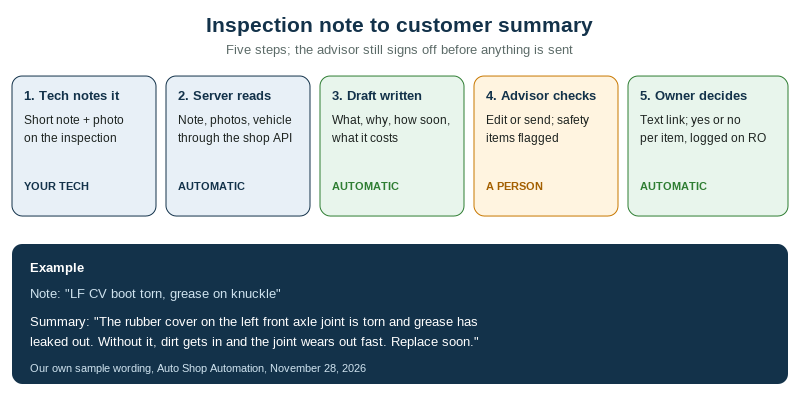
The diagram, as text:
- Trigger. The tech marks the inspection done, or saves a finding.
- Read. The server pulls the note, photos, mileage and vehicle through your shop management API.
- Draft. It writes what was found, why it matters, how soon, and the price from the estimate line.
- Check. Safety items are flagged. The advisor edits or sends.
- Send. The owner gets a text link and approves or declines each item.
- Log. The answer is saved on the repair order, and any no goes to your follow-up list.
Approval links and the 2-hour nudge are covered in our guide to how to increase your repair estimate approval rate by SMS. This page is about the writing step before it.
Can my shop software already rewrite technician notes?
Some can. Two shop platforms now sell exactly this, and a server fills in the rest.
A clear sentence is a kindness to the customer, who gets to decide with confidence. And your advisor gets to start from a good draft instead of a blank box.
| Product | What it does | Who checks it |
|---|---|---|
| AutoVitals Otto Notes (February 10, 2026) | Rewrites short technician notes into customer explanations; an advisor or manager clicks the AI icon | Advisor can restore the original, edit the rewrite, or generate a new one |
| Tekmetric DVI Quick Capture (November 3, 2026) | Turns a tech’s photos, video and audio into findings written in customer-friendly language | The technician reviews every finding and accepts or edits it; early access for Tekmetric’s Scale plan, free through 2026 |
| Tekmetric inspections | Shares findings by text or email, with photos and videos | Advisor shares the link |
If you already use one of these, switch it on first. A server helps where your software has no rewrite step, or where you want the draft to come from the photos, the vehicle history and the estimate together. The route in is each system’s API; Tekmetric, for one, grants API access by request.
For the texts Tekmetric already sends on its own, see our map of Tekmetric automated customer messaging.
How do you keep an automated summary accurate about safety and price?
Give the draft strict rules: no new facts, a stated urgency, and the price copied from the estimate.
- No invented findings. The summary may only restate what the note and photos show.
- Say the urgency out loud. Use words like “now, safety” or “can wait”, not “getting low”.
- Keep the price from the estimate. The draft never calculates or rounds it.
- Keep the original note. The tech’s wording stays on the repair order.
- No pressure words. Otto Notes is described as avoiding pushy wording, and that is a good rule for any draft.
Authorization matters too. California’s Bureau of Automotive Repair says a shop must give a written estimate and get the customer’s authorization before work starts, and Business and Professions Code section 9884.9 requires authorization for additional repairs. Your state may differ, so check yours.
Which inspection findings should an advisor always read first?
Anything about safety, anything unusual, and any line over an amount you choose.
- Brakes, steering, tires, suspension and anything marked “do not drive”.
- A finding where the photo and the note don’t seem to match.
- A note the draft couldn’t understand, such as shorthand only your tech uses.
- A repair above your review amount, say $1,000.
- A customer who has declined the same item twice.
The advisor keeps the judgment, and the server keeps the typing. Two sources, Repair Shop Solutions and AutoVitals, both describe the human edit step for that reason.
How do you start converting inspection notes this week?
Collect your ten most common notes first, then draft the summary for each once.
- Day 1: list the ten notes your techs write most, from the last month of inspections.
- Day 2: write one plain-English summary for each, with its urgency.
- Day 3: switch on drafting for those ten only, with advisor approval on every send.
- Day 4: add the photo to each text.
- End of week: compare approvals on those items with last month, and keep what wins.
The aim isn’t to remove your advisor from the explanation. It is to let them start from a good draft, not a blank box.
How we researched this
- Read November 28, 2026: AutoVitals’ Otto Notes announcement, Tekmetric’s DVI Quick Capture release and DVI feature page, Repair Shop Solutions’ guide, Bolton Technology’s inspection article, the California Bureau of Automotive Repair page and Business and Professions Code section 9884.9.
- Compared: what each product says about who checks the rewrite (they differ: advisor, technician, or not stated).
- Our own work: the hours table, and the sample before-and-after wording, with assumptions stated.
- Searched for r/AutoMechanics and service advisor forum threads on this task; the search returned none we could use, so we quote none.
- Not done: no hands-on testing of Otto Notes, Quick Capture or any drafting tool, and nothing installed in a shop.
Collect the ten notes your techs write most this week, and the first summaries will write themselves.
Sources and further reading
- AutoVitals: Launches Otto Notes (February 10, 2026)
- Tekmetric: New tools help shops finish inspections faster (November 3, 2026)
- Tekmetric: Digital vehicle inspection software and mobile app
- Tekmetric API portal
- Repair Shop Solutions: Using AI to help customers understand digital vehicle inspection recommendations
- Bolton Technology: Why digital inspections drive customer approval confidence
- California Bureau of Automotive Repair: Maintenance and repairs
- California Business and Professions Code section 9884.9
Questions and answers
Can I use AI to convert mechanic inspection notes to a customer summary?
Yes. A server can read each technician note and photo from your shop system, draft a plain-English summary with what was found, why it matters, how soon and the price, and hold it for your advisor to check before it is texted to the owner.
Does AutoVitals or Tekmetric already do this?
Both sell a version. AutoVitals launched Otto Notes on February 10, 2026 to rewrite technician notes for customers. Tekmetric opened DVI Quick Capture in early access on November 3, 2026, for its Scale plan.
Will an AI summary make a repair sound more or less urgent than it is?
It can if it isn’t told how. Give it strict rules: no new facts, a stated urgency such as now, safety, and a human check on safety items.
Should the customer ever see the technician’s original note?
Keep it on the repair order as the record, and show the customer the plain-English summary beside the photo. If the customer asks, your advisor can share the original.
How many hours would this save an advisor?
By our estimate, about 22 hours a month for a shop inspecting 200 vehicles, assuming four findings at 2 minutes each by hand against 1.5 minutes per vehicle to check a draft. Time your own advisor to get your number.