How to Increase Repair Estimate Approval Rates by SMS (With Photos)
Hello, and here’s to every estimate text that comes back with a yes before lunch.
If your advisor sends repair estimates by text and then watches them sit unanswered all afternoon, this guide is for you.
The customer isn’t saying no.
They are in a meeting, the text came from a number they don’t know, and the link opened eleven lines of parts codes they couldn’t judge.
Short answer: To increase repair estimate approval rates by SMS, send the technician’s photo or video with every recommended line, rewrite each line in plain English, put the most urgent item and its price first, use one link from a number the customer has saved, and follow up automatically at 2 hours. J.D. Power found photo or video roughly doubles approvals.
- With photo/video, 2024
- 51% of customers who got an inspection had the recommended work done, versus 24% without (J.D. Power 2024 ASI, 10,264 owners)
- Full-service repair, 2025
- 41% with photo/video, 17% without (J.D. Power 2025 ASI, 10,348 owners)
- Text preference, 2026
- More than half of aftermarket customers in every segment prefer texts for service updates (J.D. Power 2026 ASI, 10,572 owners)
- Photo/video sent, 2024
- Fewer than one in four customers (23%) got any photo or video with their inspection (J.D. Power 2024 ASI)
What actually raises repair estimate approval rates by text?
Four things raise approval rates on estimate texts: proof the customer can see, words the customer understands, a short message with one decision, and a reply that comes fast.
| Lever | What it means in the text | Evidence |
|---|---|---|
| Proof | The tech’s photo or short video of the worn part, on the line it belongs to | J.D. Power: approvals 51% vs 24% (2024), 41% vs 17% (2025, full-service repair) |
| Plain words | Front brake pads at 2 mminstead of FR pads 2mm rtr scored | Tekmetric says customers approve more work when they can see exactly what their vehicle needs |
| One decision first | The red, safety item first with its price; yellow items below it | Our recommendation; no published study we found measures this lever on its own |
| Speed | A second text at 2 hours, a call the next morning | J.D. Power 2026: more than half of customers prefer texts for service updates |
Proof matters most, and it is also the lever shops skip most. In J.D. Power’s 2024 Aftermarket Service Index, fewer than one customer in four received any photo or video with the inspection.
J.D. Power’s 2026 release put the link to texting plainly: texting lets advisors share photo and video inspection results, more than doubling the likelihood that customers will approve recommended work
, as reprinted by Aftermarket Matters (May 5, 2026).
Why do customers ignore repair estimate texts?
Customers ignore estimate texts when the text looks like spam, reads like a parts catalog, arrives at the wrong moment or asks for a big decision with no context.
- The number is a stranger. AutoTechIQ notes a shop text can arrive
from a number they don’t recognize, asking them to tap a link
, and many people report and delete those (AutoTechIQ). - The carrier filtered it. Twilio’s A2P 10DLC documentation lists lower message filtering as a benefit of registering, so an unregistered sender risks never landing at all.
- The words are shop words.
Rtr scored, cv boot torn, recommend R&R
means nothing to most drivers, and nobody approves what they can’t picture. - Everything looks urgent. Eleven lines with the same weight make the customer put the whole estimate off until they can call.
- The price lands alone. A total of $1,140 with no photo and no reason reads as an upsell, even when the brakes really are at 2 mm.
Here’s the catch: none of those reasons is about the customer’s trust in the repair itself. Each one is about how the estimate text was built, which means each one can be fixed in the text.
The first fix costs nothing. Ask every customer at drop-off to save the shop’s texting number, and put that number on the counter sign and the appointment confirmation.
How does an automated SMS estimate approval workflow work?
A small service reads the finished inspection from the shop management system, turns the technician’s notes into plain English, sends one approval text, watches for the decision and follows up on a schedule.
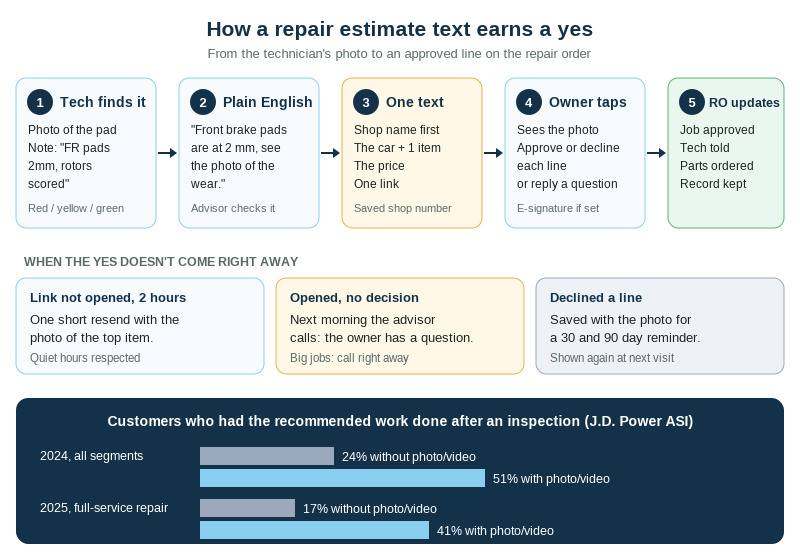
The diagram, as text:
- Tech finds it: a photo of the worn part, a note like
FR pads 2mm, rotors scored
and a red, yellow or green rating. - Plain English: the note becomes
Front brake pads are at 2 mm, see the photo of the wear.
The advisor checks the wording before it goes out. - One text: the shop’s name first, the car, the one most urgent item, its price and one link.
- Owner taps: the customer sees the photo and approves, declines or asks about each line.
- Repair order updates: the job is marked approved, the technician is told, parts can be ordered and the record is kept.
When the yes doesn’t come right away, three paths follow. A link not opened after 2 hours gets one short resend. A link opened with no decision by the next morning goes to an advisor call. A declined line is saved with its photo for reminders at 30 and 90 days.
The bottom strip repeats J.D. Power’s numbers: 51% versus 24% approval with and without photo or video in 2024, and 41% versus 17% for full-service repair in 2025.
The trigger is the inspection being marked complete. The service reads it through the shop system’s API: Tekmetric opens its API to approved partners through api.tekmetric.com, and Shopmonkey documents a public API.
Right before any follow-up goes out, the service reads the repair order again. If the customer already approved, declined or called, the follow-up is cancelled, so nobody gets nudged about a job they said yes to an hour ago.
What should a repair estimate approval text say?
A repair estimate approval text should name the shop, the customer and the car, lead with the one most urgent item in plain words, give its price and end with one link.
- Shop name first:
Main Street Auto here.
It answers “who is this?” before the customer wonders. - The car:
about your 2017 Camry
, so the text can’t be mistaken for a mass message. - The top item, in plain words:
Jake found the front brake pads at 2 mm and took a photo.
- The price for that item:
$289 for pads and resurfacing
, so the customer isn’t surprised after tapping. - One link and one way to ask:
See it and approve or decline here: [link]. Questions? Just reply.
Put together, the whole text is three short sentences. Every other recommended line sits behind the link, sorted red to yellow, each with its own photo and its own approve and decline buttons.
- Do: one item per text, the photo behind the link, a reply option, and your shop’s own link domain rather than a stranger’s short link.
- Don’t: paste the full estimate, use labor-guide wording, write in capitals, or send a “REMINDER” that repeats every line.
- Never: use scare lines like
your brakes could fail any second
. A calm photo does more than an alarming sentence.
Turning shorthand into owner-friendly sentences is the heart of this, and it gets its own section in our guide to automated repair status texts.
When should you follow up on an unapproved estimate text?
Follow up once by text about 2 hours after the estimate goes out, and call the next morning if the customer opened the link but hasn’t decided.
| What the customer did | Automatic step | When a person steps in |
|---|---|---|
| Didn’t open the link | One short resend at about 2 hours, leading with the photo of the top item | Advisor calls if the car is holding a bay |
| Opened, no decision | No more texts; the repair order goes on the advisor’s call list | Next morning, or at once for a large job |
| Replied with a question | Nothing automatic; the reply goes to the advisor with the repair order number | Right away |
| Approved part, declined part | Approved lines go to the tech; declined lines are saved with photos | At the next visit, or a 30 and 90 day reminder |
The opened but didn’t decide
customer is the one most shops miss. Whether your shop system shows that the link was viewed is worth checking, because a viewed estimate with no answer usually means a question, not a no.
The full ladder of callbacks, from unanswered estimates to declined work, is in our guide to automating service advisor follow-ups.
Can Tekmetric and Shopmonkey send estimate approval links by text?
Yes. Both Tekmetric and Shopmonkey can text an inspection or estimate link that the customer approves from their phone; what they don’t do on their own is rewrite technician shorthand for you.
A clear photo and a plain sentence are a kindness to the customer. They get to decide with confidence, and your technician’s careful inspection finally gets seen the way it deserves.
| Software | Texting the estimate | Customer approval | Worth knowing |
|---|---|---|---|
| Tekmetric | Text or email inspection findings and estimates, from the app, with the shop’s landline number | Customers review photos and approve or decline work from their phone | Tekmetric says its shops average $612 per repair order, rising to $741 with digital inspections in use |
| Shopmonkey | Text and email estimates through built-in customer communications | Customers authorize estimates with an e-signature from anywhere | Shopmonkey promises instant approval notificationsso work can start sooner |
By our arithmetic, Tekmetric’s $612 to $741 is a 21.1% higher average repair order. That is Tekmetric’s own customer data, so read it as a strong hint rather than a controlled test.
The built-in link handles the approval itself well. The gaps are around it: the plain-English rewrite, the 2-hour resend, the “opened but undecided” call list and the decision log in one place. A custom service fills those through the API and leaves the approval screen your customers already know.
Shops on Manager SE can see what Mitchell 1 already texts in our guide to Mitchell 1 CRM text automation.
How much more work gets approved when the approval rate goes up?
At J.D. Power’s 2024 rates and $450 of recommended work per car, 100 inspections with photo or video bring about $12,150 more approved work than 100 without.
| J.D. Power rates | Cars approving without photo/video | Cars approving with photo/video | Approved work without | Approved work with | Difference |
|---|---|---|---|---|---|
| 2024, all segments (24% / 51%) | 24 | 51 | $10,800 | $22,950 | +$12,150 |
| 2025, full-service repair (17% / 41%) | 17 | 41 | $7,650 | $18,450 | +$10,800 |
Assumptions: every one of the 100 cars has $450 of recommended work, and a car either approves all of it or none. The $450 is our round example, not an industry figure; real estimates are split approvals with a few lines yes and a few no.
The defaults are J.D. Power’s 2024 averages, used only as an example. Put in your own count from last month’s repair orders and the rate you think is realistic for your shop; the gap between the two numbers is what better approval texts are working on.
Why do repair approval rate statistics disagree?
Approval statistics disagree because they measure different things: some count customers who approved work, others count the dollar value of repair orders, and they come from different shops, years and vendors.
| Source | Who was measured | What was measured | Result |
|---|---|---|---|
| J.D. Power 2022 CSI | 67,185 dealer service customers | Recommended work done with vs without photo/video | Three times more likely |
| J.D. Power 2024 ASI | 10,264 aftermarket customers | Same, all three segments | 51% vs 24% (2.1 times, our division) |
| J.D. Power 2025 ASI | 10,348 aftermarket customers | Same, full-service repair | 41% vs 17% (2.4 times, our division) |
| J.D. Power 2026 ASI | 10,572 aftermarket customers | Photo/video shared by text | ”More than doubling” approvals |
| Tekmetric | Tekmetric shops | Average repair order with digital inspections | $612 to $741 (+21.1%, our division) |
| PartsTech, quoting Tekmetric’s CEO | Tekmetric data from 2024 | Repair orders authorized digitally vs not | 50% higher average value |
| Detect Auto 2026 report | 50,000 inspections plus AutoVitals and Tekmetric data | Repair order value with strong inspection practice | 27% to 28% higher; 20+ photos about 30% above 5 or fewer |
The dealer study says triple and the aftermarket studies say double, and both can be true: dealer and independent customers differ, and so do the years. The vendor numbers measure dollars per repair order, not the share of customers saying yes, so they can’t be compared with J.D. Power’s percentages directly.
One gap none of these sources closes is cause. A shop that takes 20 good photos is probably careful in other ways too, so part of the lift may be the shop, not the photo. The honest test is your own: count last month’s approvals, change the texts, and count again.
Which repair estimates should not be approved by text alone?
Large jobs, safety findings the customer pushes back on, comebacks and insurer-paid collision work should get a conversation, with the text only as the record.
- A big-ticket repair. An engine, transmission or timing belt job deserves a call; the text link then becomes the signed record of what was agreed.
- A declined safety item. If the customer declines brakes at 2 mm, the advisor should call once, calmly, and note the conversation on the repair order.
- A comeback. When the car is back for the same problem, the customer wants a person, not a link.
- Collision work paid by an insurer. The adjuster approves the estimate and any supplement; the owner’s text is for authorizing the repair and any customer-pay extras. Our guide to insurance supplement follow-up covers the adjuster side.
- A customer who said
call me
. Save that preference on the customer record so the automation never texts an estimate to someone who asked for a phone call.
Handing the routine approvals to texts is what frees the advisor for these calls. The automation sorts; the person persuades.
Does a text message approval count as authorization for a repair?
In California it can, if the shop records it properly; other states set their own rules, so check yours before relying on a tapped yes.
California’s Bureau of Automotive Repair says repairs may be authorized in writing, orally or electronically, and that the authorization must be obtained and recorded on the estimate before beginning any repairs
(BAR Write It Right guide, updated January 2026).
- What to record: under California regulation 16 CCR 3353.1(d), an electronic authorization is the date, time, name of the person authorizing and the email address or phone number contacted.
- Keep the thread: 3353.1(e) says emails or texts used to get authorization must be uniquely identified and kept as part of the same transaction.
- Consent to text: get the customer’s permission to text on the repair order, and stop at the first STOP reply.
- Registration: a custom service texting from a 10DLC number registers for A2P 10DLC, which Twilio says brings lower message filtering.
A good automation writes the authorization record itself: who tapped, when, from which phone number, and which lines. That record is what ends the I never agreed to that
conversation at pickup.
Start small. Turn on photos for every red item this week, rewrite your three most common lines in plain English, add the 2-hour resend, and compare next month’s approvals with last month’s.
How we researched this
- Read J.D. Power’s 2022 Customer Service Index release and its 2024, 2025 and 2026 Aftermarket Service Index releases; where J.D. Power’s site blocked our reader, we checked the wording against trade reprints (Auto Care Week, Aftermarket Matters), November 28, 2026.
- Read Tekmetric’s digital repair order post and API page, and Shopmonkey’s estimates page and developer site, for what each product says it does with text approvals.
- Compared the approval and repair-order numbers from J.D. Power, Tekmetric, PartsTech and Detect Auto in one table, and did the divisions ourselves (2.1 times, 2.4 times, 21.1%).
- Read California BAR’s Write It Right guide for what makes an electronic authorization valid, and Twilio’s A2P 10DLC page for message registration.
- Looked for shop owners’ own discussions of unanswered estimate texts; Reddit was not readable by our tools, so the reasons customers ignore texts come from trade sources, not forum threads.
- What we did not do: we have not run an approval-text test in a shop, and the revenue table and calculator are arithmetic on published rates, not results.
Add a photo to every red item this week, and let next month’s approvals tell you what worked.
Sources and further reading
- J.D. Power: 2026 U.S. Aftermarket Service Index (ASI) Study
- Aftermarket Matters: Cost and affordability play increasingly important role in aftermarket service experience (May 5, 2026)
- J.D. Power: 2025 U.S. Aftermarket Service Index (ASI) Study
- Auto Care Week: J.D. Power, aftermarket service providers make strides in satisfaction
- J.D. Power: 2024 U.S. Aftermarket Service Index (ASI) Study
- J.D. Power: 2022 U.S. Customer Service Index (CSI) Study
- Tekmetric: Digital repair order forms and texting customers
- Tekmetric API: partner application
- Shopmonkey: auto repair estimate software
- Shopmonkey Developer: public API
- PartsTech: How to increase your auto repair shop’s average repair order value (February 21, 2025)
- Auto Service World: Detect Auto report links digital inspections to higher repair orders (August 11, 2026)
- AutoTechIQ: Do this to ensure your DVI results are received
- California Bureau of Automotive Repair: Write It Right (updated January 2026)
- Twilio: A2P 10DLC registration
Questions and answers
Can I use AI to increase my repair estimate approval rate by text?
Yes. AI can read a finished inspection in Tekmetric or Shopmonkey, rewrite the technician’s notes in plain English, send one approval text with the photo of the most urgent item, follow up at 2 hours and log every decision. An advisor should check the wording and handle replies with questions, large jobs and declined safety items.
What is a good repair estimate approval rate?
There is no single official benchmark. J.D. Power’s 2024 Aftermarket Service Index found 51% of customers had recommended work done when the inspection came with photo or video, versus 24% without; its 2025 study found 41% versus 17% for full-service repair. Measure your own rate from last month’s repair orders first.
Do photos really make customers approve more repairs?
J.D. Power’s data says customers who get photo or video with their inspection approve recommended work about twice as often as those who don’t, and its 2022 dealer study said three times. These are associations, so a shop’s own before-and-after count is the best proof.
How soon should a shop follow up on an unanswered estimate text?
Send one short follow-up text about 2 hours after the estimate, leading with the photo of the top item. If the customer opened the link but hasn’t decided by the next morning, the advisor should call, because an opened estimate with no answer usually means a question.
Is a text message approval legally valid for auto repairs?
In California, yes, if recorded properly: the Bureau of Automotive Repair accepts electronic authorization recorded with the date, time, the name of the person authorizing and the phone number or email contacted, before work begins. Other states have their own rules, so check with your state regulator.