AI Phone Receptionist for a Medical Clinic: What It Does, Costs and Must Sign
Every AI receptionist page promises no more missed calls, so I read what each one signs you up for.
Every vendor page for an AI receptionist promises the same thing: no more missed calls.
I spent an afternoon reading the pricing pages, the HIPAA guidance and the FCC’s AI voice ruling to see what a clinic actually signs up for.
Retell AI lists $0.07 to $0.31 a minute, Vapi lists a $2,000 monthly HIPAA add-on, and the FCC ruled on February 8, 2024 that AI voices count as artificial under the TCPA.
Short answer: An AI phone receptionist for a medical clinic answers calls in the clinic’s name, books routine visits into open slots, answers simple questions and hands everything else to staff with a summary. It must come with a signed business associate agreement. Per-minute prices run from about $0.07 upward; clinical and emergency calls stay human.
- Platform price examples
- Retell AI lists $0.07 to $0.31 a minute (Retell healthcare page); Vapi lists $0.05 a minute plus a HIPAA add-on (Vapi pricing), checked Nov 28, 2026
- BAA needed?
- Yes, when a vendor handles patient information on your behalf (HHS business associates)
- AI voices on outbound calls
- Artificial under the TCPA, ruling of Feb 8, 2024 (FCC 24-17)
- Always human
- Emergencies, clinical advice, billing disputes, upset callers
What does an AI phone receptionist do for a medical clinic?
An AI phone receptionist answers a clinic’s incoming calls with a synthetic voice, works out what the caller needs, finishes routine requests such as a booking, and passes the rest to staff with a written summary.
It is a different thing from an old phone tree. Nobody presses 3 for billing; the caller says I need to move my Thursday visit
and the agent understands the sentence.
It is also different from a human answering service, which takes messages. The agent can act: look up an open slot, book it, text a confirmation and leave a note in the chart system for the front desk.
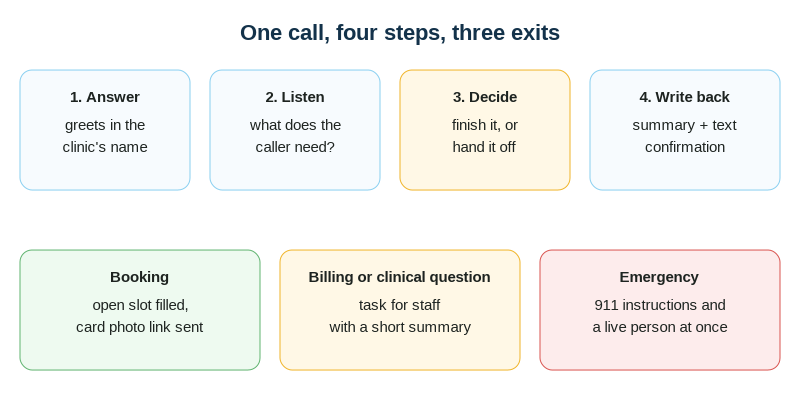
In words, the diagram shows four steps and three exits:
- Answer: the agent greets the caller in the clinic’s name.
- Listen: it asks what the caller needs.
- Decide: it finishes the routine request or hands it off.
- Write back: it saves a summary and texts a confirmation.
- Exit 1: a booking fills an open slot and a card photo link is sent.
- Exit 2: a billing or clinical question becomes a task for staff, with a summary.
- Exit 3: an emergency gets 911 instructions and a live person at once.
Which calls can an AI receptionist finish, and which must go to a person?
An AI receptionist can finish scheduling, rescheduling, hours, directions, forms and do you take my plan
calls. Chest pain, medication questions, test results and angry callers go to a person, because those need judgment and a license.
| Call | Agent finishes it? | What happens |
|---|---|---|
Can I book a new patient visit? | Yes | Books an open slot, texts a link for the intake form and insurance card photo |
I need to move Thursday. | Yes | Offers two times, books one, frees the old slot |
Are you open Saturday? Where do I park? | Yes | Answers from the clinic’s own notes |
Do you take my insurance? | Partly | Collects the plan and member ID; staff or an eligibility check confirms |
I have a question about my bill. | No | Task for staff with a summary |
My face is swelling and I can’t breathe. | No | 911 instructions and a live person at once |
In short, everything on the list that is about time and place belongs to the agent, and everything about money in dispute or the body belongs to your team.
A good agent is told to say so plainly. If it is unsure, the rule should be to hand over, not to guess.
Does an AI phone receptionist need a HIPAA business associate agreement?
Yes. A vendor that answers your calls and holds recordings, transcripts or patient names acts for you, so it is a business associate and must sign a written agreement with you before it touches patient information.
HHS defines business associates in 45 CFR 160.103, and its page on business associates explains the written contract. HHS also publishes sample agreement provisions you can hold a vendor’s draft against.
HHS’s cloud computing guidance adds that a service storing only encrypted patient data, without the key, is still a business associate. So the we can’t see your data
line does not remove the agreement.
The voice stack matters too. A call usually passes through a phone carrier, speech-to-text, a language model, text-to-speech and a transcript store. Ask which of those see patient information and whether each one is covered.
Where do vendors disagree about HIPAA and price?
Vendors disagree sharply. Retell AI says its agreement is signed by the practice at no extra charge, while Vapi’s pricing page lists a $2,000 monthly HIPAA add-on, and other sources quote older or different figures.
| Platform | Base price | HIPAA agreement |
|---|---|---|
| Retell AI | $0.07 to $0.31 a minute, no platform fee | Self-signed BAA, no extra charge reported |
| Vapi | $0.05 a minute plus model and voice costs | Add-on listed at $2,000 a month |
Older articles quote about $1,000 a month for Vapi’s add-on, and one comparison hosted by a competitor blurs which vendor charges what. We trust each maker’s own current page over any third-party roundup, and so should you.
Many “AI receptionist” products for clinics sit on top of platforms like these. When you buy one, ask which platform sits underneath and whether that platform signed a BAA with the reseller.
How much does an AI phone receptionist cost for a small clinic?
For 800 three-minute calls a month, the per-minute fees on Retell’s listed range come to $168 to $744, against $880 of staff time at $22 an hour. Vapi’s $2,000 add-on alone is larger than that range.
| Way of answering | Math | Monthly cost |
|---|---|---|
| Front desk answers every call | 2,400 min = 40 hours x $22 | $880 |
| Retell at its lowest listed rate | 2,400 x $0.07 | $168 |
| Retell at a mid rate (a third party’s example of about $0.15) | 2,400 x $0.15 | $360 |
| Retell at its highest listed rate | 2,400 x $0.31 | $744 |
| Vapi base fee plus HIPAA add-on, before model and voice costs | 2,400 x $0.05 + $2,000 | $2,120 or more |
Assumptions: $22 an hour is a rough loaded front desk cost, three minutes per call is our estimate, and the agent answers every call. Real clinics have a mix of calls the agent finishes and calls it hands off, so staff time never drops to zero.
The cost the table can’t show is the call nobody answered. A cash-pay new-patient visit is worth far more than a month of minutes.
Is an AI voice call out to patients treated differently from a call in?
Yes. A patient who calls you starts the conversation, but a call you place to a patient with an AI voice falls under the Telephone Consumer Protection Act, which the FCC confirmed on February 8, 2024.
The voice is the easy part. The agreement, the handoff and the emergency script are what make it safe to switch on.
The FCC’s Declaratory Ruling 24-17 says AI-generated voices, including cloned voices, are “artificial” under the TCPA. Law firm summaries from Cooley and Wiley read it the same way: prior express consent is needed unless an exemption applies.
Wiley adds that the ruling clarified existing rules rather than creating new ones, so AI voices are regulated, not banned. For recall and reactivation calls, keep consent on file and ask your counsel which exemption, if any, fits.
For many clinics the safer first step is text. Our guides on no-show texts and two-way text scheduling cover that side.
How does an AI phone receptionist pre-verify insurance from a card photo?
The agent collects the plan name and member ID on the call, then texts a secure link. The patient photographs the card, an AI vision step reads the payer and ID, and an eligibility check runs before the visit.
Reading a card photo is a separate job from answering the phone, done by a backend server rather than the voice agent. It turns the image into a payer name, a member ID and a group number, which an eligibility request then uses.
The result lands in the chart notes and, if something looks off, on the staff task list. Our guide to automated insurance verification walks through that workflow in detail.
A person still reviews anything the reading is unsure about. Blurry photos and unusual plans are exactly where a mistake costs a surprise bill.
Why does a cash-pay clinic hear the most from a good first call?
A cash-pay or out-of-network clinic is chosen on experience, so the first call is part of the product. A patient who is willing to pay out of pocket will not wait through voicemail for a callback.
These clinics also tend to get more calls that start with a question about price or coverage. The agent can say what the clinic’s own notes allow and promise a call from a named person for the rest.
Keep price negotiations and clinical details off the agent. Let it book the visit and send the intake link, and let a person talk money.
What should you check before a voice agent answers your clinic’s phone?
Check the agreement, the data trail, the handoff and the emergency rule first, because an agent repeats any gap in them on every call.
- A business associate agreement is signed with the vendor, and the vendor’s subprocessors are listed.
- You know what is stored (audio, transcript), for how long, and who can read it.
- A recording notice fits your state’s consent rules.
- The emergency script gives 911 instructions and rings a live person.
- Clinical, billing and
I want a person
calls hand off every time. - The agent only offers real open slots, of the right length and provider.
- Staff get a summary of every call by the next morning.
- Outbound AI calls have consent on file, or are text instead.
- Card photos arrive through a secure link, not by email.
- You can turn the agent off in one step.
How do you start an AI phone receptionist in the first month?
Start with after-hours and overflow calls only, read every summary in week 2, add booking in week 3, and widen to lunch and busy mornings in week 4 if the summaries look right.
- Week 1: sign the agreement, write the emergency script, and send after-hours calls to the agent.
- Week 2: read every summary by hand and note what the agent got wrong.
- Week 3: let it book routine visits into a limited set of slots.
- Week 4: count calls answered, visits booked, handoffs and staff minutes, then decide what to widen.
After a month you will have your own numbers: how many calls came when the desk was closed, and how many became visits.
How we researched this
- Read the Retell AI healthcare page and the Vapi pricing page, and compared the prices and HIPAA terms each lists, on November 28, 2026.
- Searched for the FCC ruling, the HHS cloud guidance and the HHS business associate pages. HHS and FCC pages refused our automated reader, so we relied on the law firm summaries linked above and on the search excerpts of the HHS text, and we do not quote those pages word for word.
- Searched for clinic staff discussion on Reddit about AI receptionists; the results were almost all vendor marketing pages, so we state no staff opinion as fact.
- Built the cost table from the listed per-minute prices and our stated assumptions (800 calls, 3 minutes, $22 an hour).
- What we did not do: install or test any voice agent, listen to calls, or confirm any vendor’s BAA terms directly.
Start with after-hours calls, read every summary for a week, and let the agent earn the daytime.
Sources and further reading
- Retell AI: AI voice agent for healthcare (price and BAA)
- Vapi: pricing (per minute and HIPAA add-on)
- HHS: Business associates
- HHS: Sample business associate agreement provisions
- HHS: Guidance on HIPAA and cloud computing
- 45 CFR 160.103: HIPAA definitions (business associate)
- FCC 24-17: Declaratory Ruling on AI-generated voices under the TCPA
- Cooley: FCC and AI-generated robocalls under the TCPA
- Wiley: FCC extends TCPA to AI-generated voices
Questions and answers
Can I use AI to answer the phone for my medical clinic?
Yes. An AI phone receptionist can answer in your clinic’s name, book and move routine visits, answer simple questions and hand everything else to staff with a summary. You need a signed business associate agreement first, an emergency script that reaches a person, and a clear rule that clinical questions are never answered by the agent.
Is an AI receptionist HIPAA compliant?
It can be, but only with work on your side. The vendor must sign a business associate agreement, and you should know what it stores, for how long and which subprocessors see patient data. A signed agreement alone does not make a tool compliant, so have counsel read the contract.
How much does an AI phone receptionist cost per minute?
Platform prices start low. Retell AI lists $0.07 to $0.31 a minute, and Vapi lists $0.05 plus model costs and a $2,000 monthly HIPAA add-on, checked November 28, 2026. At 800 three-minute calls a month, Retell’s range comes to $168 to $744. Confirm the current price with the maker.
Can an AI receptionist call patients back about recalls?
Yes, but outbound calls are regulated. The FCC ruled on February 8, 2024 that AI-generated voices are artificial under the TCPA, so prior express consent is needed unless an exemption applies. Many clinics start with text recalls and ask counsel before using AI voice calls.
What should an AI receptionist never handle in a clinic?
It should never give clinical advice, discuss test results or medications, or settle billing disputes. Emergencies must get 911 instructions and a live person at once. Any caller who asks for a human, or any call the agent is unsure about, should be handed to staff with a summary.