Guides › Crossbow shot placement on deer
Crossbow Shot Placement on Deer: Broadside, Quartering and Tree Stand Angles
Disclosure: this guide contains Amazon affiliate links. As an Amazon Associate we earn from qualifying purchases, at no extra cost to you.
A crossbow makes it easy to put a bolt exactly where you aim - so where you aim is everything. The goal is a quick, clean kill and a short tracking job, and that comes down to hitting the heart and lungs. The best way to learn it is shooting at a 3-D deer target from the angles you'll hunt, with a rangefinder (both on Amazon) to know the distance.
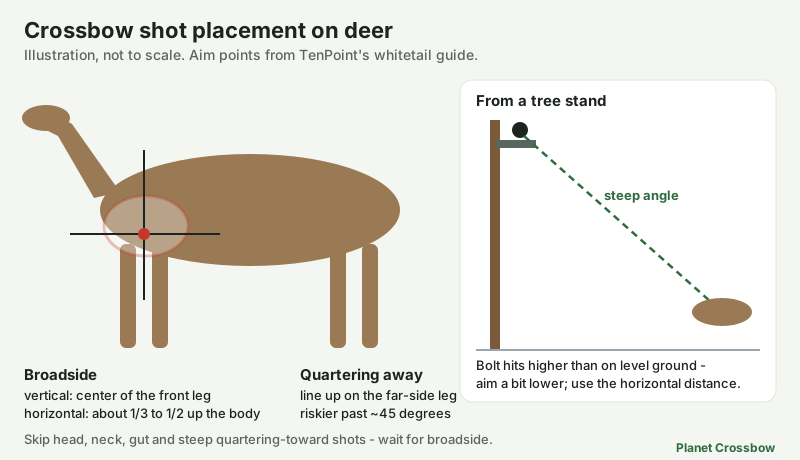
Short answer: on a broadside deer, line your vertical reticle up with the center of the front leg and hold about one-third to one-half of the way up the body. Quartering away, line up with the off-side leg. Take quartering-toward shots only when the angle is slight and there's no better option, and skip head, neck and gut shots. From a tree stand, bolts hit higher than on level ground, so aim a little lower and use the horizontal distance.
Why the vitals
Hunter-education courses teach hunters to limit shots to the vital organs - the heart and lungs. That area holds major blood vessels, so a hit causes heavy bleeding and a quick kill, and if the deer does run, it leaves a trail that's easy to follow. Shots that miss that zone are likely to cause bad wounds. Hunter education specifically warns against head and neck shots and says plainly: don't shoot the abdomen.
Where to aim, angle by angle
TenPoint's whitetail guide gives aim points in terms of your scope's reticle:
| Deer's position | Vertical reticle | Horizontal reticle |
|---|---|---|
| Broadside | Center of the front leg | About 1/3 to 1/2 way up the body |
| Quartering away | Off-side (far) leg or shoulder | About 1/3 to 1/2 way up the body |
| Quartering toward | Inside edge of the near-side leg | About 1/3 to 1/2 way up - only if the angle is slight and conditions are right |
- Broadside is the best shot - the biggest target and the cleanest path into the heart and lungs.
- Quartering away is a great shot too, but TenPoint warns it gets riskier once the angle is steeper than about 45 degrees.
- Quartering toward puts the shoulder in the way. Most of the time it's better to wait for the deer to turn.
- Head-on and straight away leave a tiny vital target behind bone or the gut - pass and wait.
Tree stand angles
Shooting down from a stand changes two things:
- The bolt hits higher. TenPoint explains that from an elevated position, your point of impact may be higher than your point of aim - and the steeper the angle, the higher it hits. Their example: a 30-yard shot from the ground might mean aiming for 20 yards from a tree stand.
- The path through the deer is angled. Aim so the bolt exits low on the far side through the vitals - picture the path, not just the entry point.
Use the horizontal distance to the deer, not the line-of-sight distance. An angle-compensating rangefinder does this for you. And practice from your stand height before the season.
Wait for the right moment
- Let the deer settle. A relaxed, still, broadside deer is the shot you want.
- Know your range and stay inside the distance you've practiced (see sighting in at 20, 30 and 40 yards).
- Mind the noise. A deer can react to the sound of the shot before the bolt arrives (why crossbow noise matters), so closer, calmer deer mean better hits.
- Check your window clearance if you hunt from a blind (ground blind tips).
A simple pre-season practice drill
- Set a 3-D deer target broadside at 20 yards and put three bolts in the vitals from a rest.
- Turn it quartering away and aim at the far-side leg line.
- Climb into your stand (safety harness on) and shoot it again from height.
- Move it to 30 yards and repeat. If your groups open up, that's your limit for now.
After the shot
- Watch where the deer runs and mark the last spot you saw it.
- Stay put and wait before following - longer for a hit you're unsure of.
- Mark the spot where the deer stood and look for your bolt and blood.
- Follow the trail slowly, marking blood as you go.
Sharp broadheads matched to your bolts make the biggest difference to how far a well-hit deer goes (bolts and broadheads).
Frequently asked questions
Where do you aim on a deer with a crossbow?
Broadside: line the vertical reticle up with the center of the front leg and hold about one-third to one-half of the way up the body - the heart and lungs.
Should I take a quartering-toward shot with a crossbow?
Only if the angle is slight, conditions are right and there's no better option. The shoulder blocks much of the vitals, so waiting for the deer to turn is usually better.
Do I aim lower from a tree stand?
Usually, yes. Downward shots hit higher than on level ground, and the steeper the angle the bigger the difference. Use the horizontal distance and practice from your stand height.
Is a neck or head shot a good idea with a crossbow?
No. Hunter education teaches limiting shots to the vital organs; head and neck shots are small targets and likely to wound.
Sources and further reading
- TenPoint: ideal shot placement for crossbow hunting whitetails - reticle aim points by angle, tree stand effect
- TenPoint: compensating for shot angle - 30 yards on the ground vs 20 from a stand
- Hunter-ed.com: where to shoot - vital organs only; no head, neck or abdomen
- National Bowhunter Education Foundation (NBEF) - bowhunter education
How this guide was written: Based on TenPoint's whitetail shot-placement and shot-angle guides, hunter-education course material (hunter-ed.com), and bowhunter education principles. Practice on a 3-D target from the angles you'll hunt.