Guides › Speed-dial scope calibration
Calibrating a Crossbow Speed-Dial Scope When Your Bolts Don't Match the Box Speed
Disclosure: this guide contains Amazon affiliate links. As an Amazon Associate we earn from qualifying purchases, at no extra cost to you.
Here's a common head-scratcher: your scope's speed dial is set to exactly what the crossbow box says, your top reticle is dead on at 20 yards, but the 30- and 40-yard aiming points keep hitting high or low. The reason is simple - your real bolt speed isn't the box speed. The fix takes an afternoon and, ideally, an archery chronograph and a crossbow-rated target (both on Amazon).
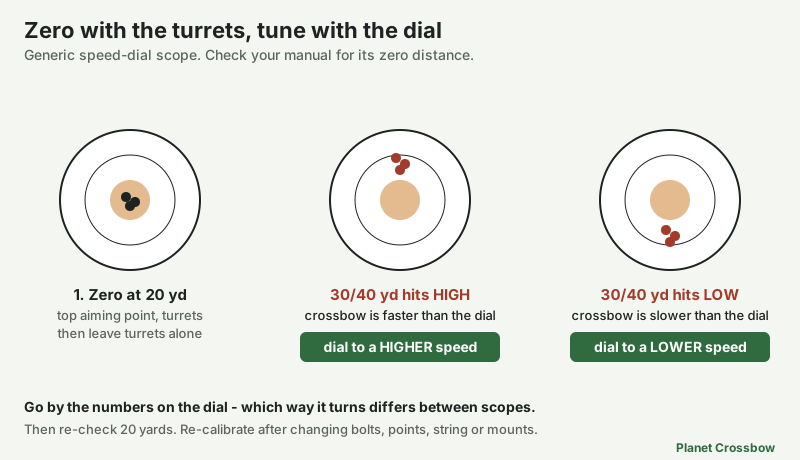
Short answer: box speeds are measured with the lightest bolt allowed, so your hunting setup is slower. Measure your real speed if you can and set the dial to it, zero the top reticle at the distance your scope's manual says (often 20 yards) using the turrets, then shoot a lower aiming point and fine-tune the speed dial - not the turrets. Hitting high means turn the dial toward a higher speed; hitting low, toward a lower speed.
Why the box speed is wrong for you
Crossbow makers measure advertised speed with the lightest bolt they allow. A heavier hunting bolt with a broadhead leaves slower - often noticeably. A speed-dial scope spaces its lower aiming points for whatever speed you set. Set it to the box speed with a slower real setup, and the bolt drops more than the scope expects, so your 30- and 40-yard points hit low. (See why advertised speeds run high.)
Step 1: find your real speed
- Best: shoot your exact hunting bolts (with field points of your broadhead weight) through a chronograph. Many archery shops will do it for you.
- No chronograph? Start the dial somewhat below the box speed, then let the fine-tuning in step 3 find the right setting.
- Check your scope's range. If your real speed falls outside the dial's numbers, the scope can't be matched exactly - you'll need to learn your real holds or use a scope made for that speed range.
Step 2: zero the top aiming point
- Set the dial to your real (or estimated) speed.
- From a steady rest, shoot three-bolt groups at the distance your manual gives for the top aiming point - often 20 yards, but some scopes zero at a longer distance.
- Use the elevation and windage turrets until the group centers on the bullseye.
- Now leave the turrets alone. From here on, the speed dial does the work.
Our step-by-step sighting-in guide covers the safety basics and turret directions.
Step 3: fine-tune the speed dial
Move back and shoot a lower aiming point - one widely published method uses the second aiming point at 30 yards, then checks the third at 40. Then:
| Group lands... | Means | Turn the speed dial... |
|---|---|---|
| High | Crossbow is faster than the dial setting | Toward a higher speed number |
| Low | Crossbow is slower than the dial setting | Toward a lower speed number |
| On target | Dial matches your speed | Leave it |
Make small changes and shoot again. Which way the ring physically turns differs between scopes, so go by the numbers on the dial, not "clockwise". When it's right, check the farthest aiming point you'd actually use and go back to confirm 20 yards.
When it still won't match
- Re-check the zero - a loose mount or scope ring moves everything.
- Use the same bolts - mixed weights or point weights spread your groups.
- Cock consistently - an off-center string moves impact left or right, not up and down.
- Check broadheads separately - they can fly differently from field points (bolts and broadheads).
- Write it down. If one aiming point is still off by a bit, note the real distance it hits at and tape the card to the stock.
Re-calibrate when you change anything
New bolts, different point weight, a new string or cables, or a scope remount all change where bolts hit. Re-zero and re-check the dial each time - and before every season.
Frequently asked questions
Why does my crossbow hit low at 40 yards with the speed dial set to the box speed?
Your real bolt speed is lower than the box speed, which is measured with the lightest allowed bolt. Turn the dial toward a lower speed number until the 40-yard point hits where you aim.
Should I use the turrets or the speed dial at longer range?
Use the turrets only to zero the top aiming point. After that, fix longer aiming points with the speed dial, or you'll throw off the zero.
What distance do I zero a speed-dial crossbow scope?
Often 20 yards for the top aiming point, but some scopes use a longer zero. Check your scope's manual.
Do I need a chronograph?
It's the quickest way to set the dial, but not required. Start below the box speed and fine-tune the dial at 30 and 40 yards.
Sources and further reading
- Louisiana Sportsman: crossbow scopes 101 - sight them in correctly - zero at 20 with turrets, speed ring at 30, check 40, high/low directions
- Crossbow Nation forum: sighting in a speed-ring scope - community method
- TenPoint arrow and bolt FAQs - bolt weight and broadhead checks
- National Bowhunter Education Foundation (NBEF) - shot ethics
How this guide was written: Based on how speed-adjustable crossbow scopes work, published sighting-in procedures (Louisiana Sportsman, crossbow forums) and scope makers' general guidance. Zero distances and dial directions differ by scope - your scope's manual wins.