Freight Broker and Small Fleet Automation in El Paso, Texas
Every El Paso dispatcher is about to learn that the bridge a load crossed last year may not be the one it crosses in 2028.
Most border cities get a bigger bridge when freight grows, but El Paso is the one that is about to lose a truck bridge while the freight keeps coming.
I spent an afternoon with the El Paso Chamber’s Bridge of the Americas page, the news report on the government’s decision, the CBP page for Ysleta and the Bureau of Labor Statistics release for the El Paso area.
Three things stood out. Ysleta moved $112.4 billion of truck freight in 2025, up 34.8%. Commercial trucks leave the Bridge of the Americas when construction starts in early 2028. And the Chamber and the government do not agree on whether that is settled.
Short answer: Freight broker and small fleet automation in El Paso, Texas means a cloud server reads your dispatch email and rate cons, checks which border crossing is open and how long its line is, texts the driver, and files the POD. Your dispatcher approves any change of crossing; your customs broker still files the paperwork.
Why is freight in El Paso, Texas being reshuffled?
El Paso freight is growing at its Ysleta crossing while the Bridge of the Americas is scheduled to stop handling trucks, so loads are being re-sorted across three other crossings.
The Bridge of the Americas (BOTA) handled $12 billion of two-way truck trade in 2025 and ranked second among major U.S.-Mexico ports in truck export value and in commercial truck crossing growth, according to the El Paso Chamber. The government’s May 2025 record of decision removes commercial traffic from it.
That is a local fact no other Texas border city has in the same form. Laredo’s story is more paperwork per truck, as we cover in freight broker automation in Laredo. El Paso’s story is more decisions per truck: which crossing, which hours, which line.
What do the public numbers say about El Paso freight?
Ysleta carried $112.4 billion of truck freight in 2025, 17.5% of all U.S.-Mexico truck trade by value and up 34.8% on the year.
| Fact | Figure | Source |
|---|---|---|
| Ysleta truck freight, 2025 | $112.4 billion, up 34.8%, 17.5% of US-Mexico truck trade | BTS annual report 2025 (as summarized; see the research box) |
| Santa Teresa, New Mexico truck freight, 2025 | $33.0 billion, down 14.9% | BTS annual report 2025 |
| Bridge of the Americas two-way truck trade, 2025 | $12 billion, second among major ports in export value and crossing growth | El Paso Chamber |
| Commercial traffic at BOTA | Ends when construction begins in early 2028; work finishes by summer 2031 | KFOX, Sept 11, 2026 |
| Transportation and material moving, share of El Paso jobs, May 2024 | 9.7% (8.9% nationally); mean $19.59 an hour vs $23.44 | BLS, June 17, 2025 |
The newest BLS El Paso release we could find covers May 2024, so the job share is a year older than the trade numbers. Treat it as a size check, not a trend.
Where will the Bridge of the Americas trucks go?
About 64% of the trucks are expected to move to Ysleta, 34% to Santa Teresa and under 2% to Tornillo, while about 11% of the traffic leaves the region.
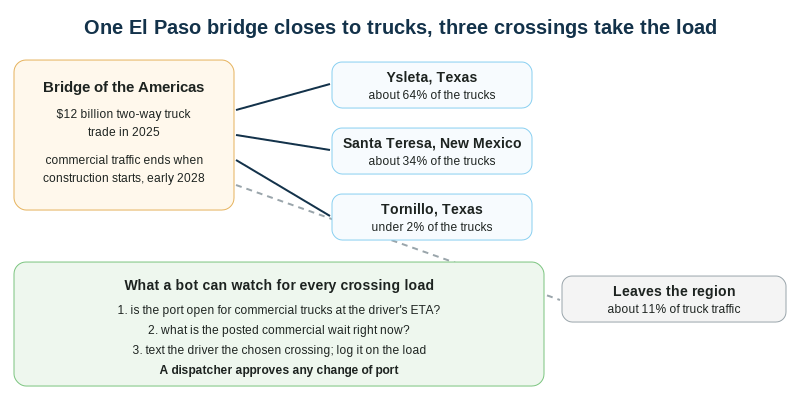
Our arithmetic from the Chamber’s $12 billion: 64% is about $7.7 billion of trade shifting to Ysleta, 34% about $4.1 billion to Santa Teresa. Against Ysleta’s $112.4 billion in 2025, the extra is about 6.9%. It is small per year and large for a dispatcher who now has three crossings to compare.
That is value, not trucks, so it is a rough guide to direction rather than a truck count. The Chamber says that without port expansion the region reaches operating capacity in 2034, and that closing BOTA would pull that to 2031.
Is the Bridge of the Americas decision final?
The government says the decision is final, and the Chamber’s study argues it should be paused, so a broker should plan for 2028 without assuming it.
- The government’s side: KFOX quoted a CBP official on September 11, 2026 saying the decision was final and would not be reversed, with construction starting in early 2028.
- The Chamber’s side: a study by the Hunt Institute at UTEP, released in September 2026, projects a $2.3 billion loss in output and more than 9,500 jobs between 2028 and 2036 if commercial traffic is removed, and asks officials to pause. Its own page lists a January 2026 request for proposals and a June 2025 request to reconsider.
- Who paid: the Chamber commissioned the study, so read its numbers as the Chamber’s case.
The practical gap none of the pages answer is what a small brokerage should do in the meantime. The answer is to stop hard-coding a crossing into rate cons and routing guides. Let the choice be made load by load.
Which El Paso crossing is open when your driver arrives?
Ysleta’s commercial operations run Monday to Friday 6 a.m. to midnight and Saturday 6 a.m. to 2 p.m. Mountain time, and are closed on Sunday, per CBP.
That is 98 hours a week out of 168, or 58%, by our count: five days of 18 hours plus 8 on Saturday. The CBP Ysleta page (last modified January 2, 2026) also says all vehicle exports are processed at Tornillo.
Border Report reported that the new CBP field office leader is considering 24-hour commercial hours at Ysleta. We found no confirmation that it happened.
| Day | Hours | Hours open |
|---|---|---|
| Monday to Friday | 6:00 a.m. to 12:00 a.m. | 18 each day |
| Saturday | 6:00 a.m. to 2:00 p.m. | 8 |
| Sunday | Closed | 0 |
CBP’s live wait-time page can show a different label from the port page, and wait numbers move through the day. A bot should read both and treat the port page as the schedule.
How much time does checking crossing, hours and wait by hand cost?
On our assumptions, a brokerage with 20 crossing loads a day spends about an hour a day just deciding where the truck should cross and telling the driver.
Here’s the quiet win: when the bot has already checked the hours and the line at each crossing, the choice reaches your dispatcher as a yes or no, not a morning of tabs.
| Crossing loads a day | Minutes per load | Hours a day | Hours a month (21 workdays) |
|---|---|---|---|
| 10 | 3 | 0.5 | 10.5 |
| 20 | 3 | 1.0 | 21 |
| 20 | 5 | 1.7 | 35 |
| 40 | 5 | 3.3 | 70 |
Assumptions: three to five minutes to look up the hours and the posted wait for the crossings in play, pick one, and message the driver. These are our own estimates, not a vendor figure; time yourself for one morning and replace them.
How can an El Paso broker or small fleet automate border crossing dispatch?
A cloud server reads each load, looks up the crossings’ hours and waits, proposes one, and texts the driver once your dispatcher agrees.
- Read. Rate cons and dispatch emails land in one inbox. AI reads the stops, the appointment and the crossing note and returns structured JSON. See TMS email integration.
- Look up. The server reads CBP’s Border Wait Times pages and the port hours, and compares them with the driver’s ETA.
- Propose. It suggests Ysleta, Santa Teresa or Tornillo, and shows why: open at ETA, shortest posted wait.
- Approve. The dispatcher taps yes or no. Nothing goes to a driver or customer without that tap in the first weeks.
- Write. The chosen crossing goes into the TMS, such as McLeod, Tai, Aljex or Rose Rocket, through its API or import route.
Can automated check calls and POD requests work for El Paso drivers?
Yes, a short text asking for location, ETA at the crossing or the POD photo works for drivers around El Paso, and the text can be in English or Spanish.
A messaging service such as Twilio delivers the driver’s photo reply to your server, where AI vision reads the signature and date and attaches the POD to the load. Our guides on automated driver check calls, SMS tracking and POD collection cover the details.
FMCSA bans texting while driving a commercial vehicle, so messages should be timed for a stop. One question per text, and a sentence naming the crossing, works best.
What stays with your dispatcher and your customs broker?
The decisions and the legal filings stay with people, and the bot only reads, looks up and reminds.
- Crossing choice: a person approves it, since a wrong choice costs hours and the bot reads posted waits, not the future.
- Filings: a licensed customs broker or the carrier files the cargo and entry documents. Our Laredo guide lists them.
- Hours changes: CBP can change them. The bot reads the page on each run, and someone still reads CBP notices.
- Bad photos: an AI model can misread one, so low-confidence reads wait for a human.
What does a sensible first week look like in El Paso?
Start in shadow mode on one customer and one lane, and let the bot only suggest a crossing.
- Day 1: forward a week of real rate cons and note which crossing your team chose and why.
- Days 2 and 3: the bot suggests crossings in the background; compare its picks with yours.
- Days 4 and 5: let it write the chosen crossing into the TMS and text drivers for ETAs and PODs.
- End of week: count the minutes saved and the picks you would have changed.
If it does not save real time on your own loads, it is not worth keeping.
How we researched this
- Read on November 29, 2026: the El Paso Chamber’s Bridge of the Americas page, a KFOX report (September 11, 2026), the CBP Ysleta port page (last modified January 2, 2026), the BLS El Paso occupational release (June 17, 2025), and search summaries of the Hunt Institute study, Border Report and CBP wait-time pages.
- The BTS annual report page refused our automated reader (HTTP 403), so the Ysleta, Santa Teresa and El Paso figures are as reported in search summaries of that page. Check them on the BTS page.
- The BLS release we found covers May 2024; a May 2025 El Paso release did not turn up.
- Compared: government and Chamber statements on the bridge, and the hours on CBP’s port page with its live wait label.
- Our own calculations: the shift in trade value, weekly open hours and the time-cost table, with assumptions stated.
- Not done: no hands-on testing of any product, no interviews, and no Reddit threads quoted. We did not find El Paso threads on this we could use.
Pick one lane, run the suggestions in shadow mode for a week, and let the crossing lookups take care of themselves.
Sources and further reading
- El Paso Chamber: Bridge of the Americas (BOTA) modernization and trade effects
- KFOX: Bridge of the Americas to end commercial truck traffic as work starts in 2028 (Sept 11, 2026)
- CBP: Ysleta, El Paso, Texas port page (commercial hours)
- CBP: Border Wait Times
- BTS: Transborder Freight Data Annual Report 2025
- BLS: Occupational Employment and Wages in El Paso, May 2024 (June 17, 2025)
- Border Report: CBP El Paso field office leader on bridge expansion
- Twilio: incoming message webhook request (media URLs)
Questions and answers
Can I use AI to automate freight broker work in El Paso, Texas?
Yes. A cloud server can read dispatch emails and rate cons with AI, check each border crossing’s hours and posted wait, suggest where the truck should cross, text the driver, and file the POD on the load. Your dispatcher approves any change of crossing and your customs broker still files the legal paperwork.
Why is El Paso a good place for freight automation?
Ysleta carried $112.4 billion of truck freight in 2025, up 34.8%, and the Bridge of the Americas is planned to stop handling trucks when construction begins in early 2028. Loads will be re-sorted across Ysleta, Santa Teresa and Tornillo, which means more crossing decisions per load.
When does the Bridge of the Americas stop taking trucks?
Commercial truck processing is due to stop when construction begins in early 2028, with work finishing by summer 2031, according to KFOX’s September 2026 report on the GSA plan. The El Paso Chamber has asked officials to pause the plan, so check current news.
What are the Ysleta commercial hours?
CBP lists commercial operations at Ysleta Monday to Friday from 6 a.m. to midnight and Saturday from 6 a.m. to 2 p.m. Mountain time, closed Sunday. A CBP official is reported to be considering 24-hour hours, but we found no confirmation, so read the CBP page for the latest.
Does automation replace my customs broker?
No. Customs filings stay with licensed people or the carrier through CBP’s own systems. Automation reads documents, looks up hours and waits, and reminds your team; it does not file for you.