Freight Broker and Small Fleet Automation in Laredo, Texas
Every Laredo dispatcher knows the record headline means more paperwork per truck, not fewer trucks.
Every few months a new record headline says Laredo is moving more freight than ever, and every dispatcher there knows the same record means more paperwork per truck.
I spent an afternoon with the Bureau of Labor Statistics release for the Laredo metro, The Bridge’s analysis of Port Laredo’s trade, and the CBP rules for truck manifests.
Three things stood out. Port Laredo’s trade passed $400 billion over 12 months for the first time, with September 2026 its biggest month ever at $38.9 billion. Trucks did not grow nearly as fast. And every one of those trucks needs documents that must agree with each other.
Short answer: Freight broker and small fleet automation in Laredo, Texas means a cloud server reads dispatch emails, rate cons, invoices and PODs with AI, checks that the cross-border documents match, writes the data into your TMS as JSON, and texts drivers for check calls and POD photos. Your customs broker still files the pedimento; the bot only watches the paperwork.
Why is freight in Laredo, Texas growing?
Laredo is the busiest land port between the United States and Mexico, and trade through it keeps setting records even when truck counts barely move.
The Bridge reported on November 9, 2026 that Port Laredo handled $402.7 billion of trade in the 12 months through September 2026, the first 12-month stretch above $400 billion. The Bureau of Transportation Statistics reported $353.94 billion for calendar 2025, with trucks carrying about $296.2 billion of it.
| Fact | Figure | Source |
|---|---|---|
| Trade, 12 months through September 2026 | $402.7 billion | The Bridge, Nov 9, 2026 |
| Record month, September 2026 | $38.9 billion | The Bridge |
| Truck trade, calendar 2025 | about $296.2 billion (46.1% of US-Mexico truck trade) | BTS annual report 2025 |
| Northbound truck crossings, Oct 2025 to Sep 2026 | 2,980,096 (about 8,165 a day) | The Bridge |
| Transportation and material moving jobs, May 2025 | 15,640, or 14.3% of local jobs (8.8% nationally) | BLS, Aug 13, 2026 |
| Heavy and tractor-trailer truck drivers | 5,460 jobs, mean $25.71 an hour | BLS, Aug 13, 2026 |
In short: trade value is at a record, 14.3% of local jobs are in moving things (against 8.8% nationally), and the 5,460 local truck drivers share the road with a stream of cross-border trucks.
How many trucks cross at Laredo, and what does that mean for a small broker?
About 8,165 northbound trucks cross at Port Laredo on an average day, which is one truck roughly every 11 seconds around the clock.
That count is for October 2025 through September 2026 (2,980,096 crossings). The Bridge also reports that 2025 itself fell 2.7% to 2,945,388, the first annual drop since 2020, and that every month from June to September 2026 ran 2.5% to 4.9% above the year before.
Our arithmetic: 86,400 seconds in a day divided by 8,165 trucks is 10.6 seconds. A small brokerage cannot add people at that pace. It can stop retyping the same documents.
Which documents does one Laredo cross-border load carry?
A load crossing at Laredo carries six documents, and four of them must agree with each other on value, quantity and description.
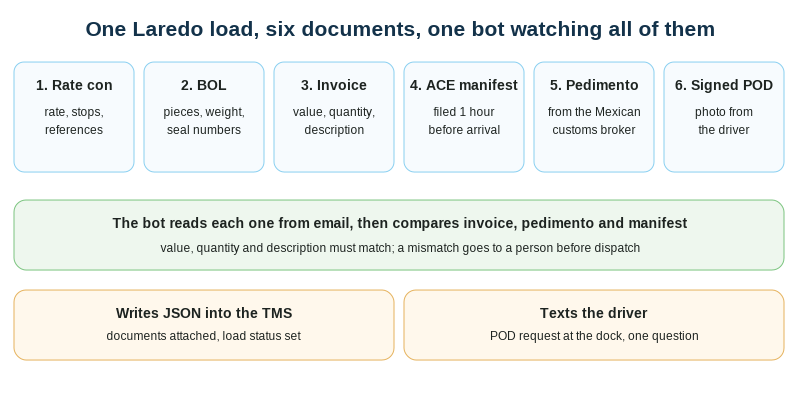
| Document | Who makes it | What a bot checks |
|---|---|---|
| Rate confirmation | Broker or shipper | Rate, stops, reference numbers |
| Bill of lading | Shipper | Pieces, weight, seal numbers |
| Commercial invoice and packing list | Shipper | Value, quantity and description present |
| ACE truck e-manifest | Carrier, or a customs broker under the dual-party option | Filed before arrival, matches the BOL |
| Pedimento | Registered Mexican customs agent (agente aduanal) | Matches the commercial invoice |
| Signed POD | Receiver, photographed by the driver | Signature, date, exceptions |
CBP’s truck e-manifest FAQ explains that highway carriers must send cargo information electronically before the truck reaches the border. The deadline is commonly given as 1 hour before arrival, or 30 minutes for FAST shipments, but check the current CBP guidance for your lane.
Cross-border guides, such as the one from AB Global Logistics, say the pedimento has to match the commercial invoice exactly, and that a mismatch is among the most common causes of delay.
Why do the Laredo numbers differ between sources?
Laredo figures differ because sources count different things: calendar years or trailing 12 months, trade value or crossings, northbound only or both directions.
- Trucks: One article reports 3,026,632 northbound crossings in 2024 and says traffic is rising. The Bridge shows that 2024 was the peak and 2025 fell 2.7%, with growth only returning in mid 2026.
- Two directions: A total of 6,071,720 truck crossings in 2024 counts both directions; 3,026,632 is northbound only.
- Value: Trade value is climbing faster than truck counts, and The Bridge ties a large part of the 12-month increase to computers, phones and computer parts, which are high value and light.
The lesson for a small broker: a record trade headline does not mean more trucks to book. It means more value, more scrutiny and more documents on each load.
How much time does checking cross-border paperwork cost a small broker?
On our assumptions, hand-checking six documents per load costs a 20-load-a-day brokerage about 4.7 hours a day.
| Loads a day | Documents per load | Minutes per document | Hours a day | Hours a month (21 workdays) |
|---|---|---|---|---|
| 10 | 6 | 2 | 2.0 | 42 |
| 20 | 6 | 2 | 4.0 | 84 |
| 20 | 7 | 2 | 4.7 | 98 |
| 40 | 7 | 2 | 9.3 | 196 |
Assumptions: two minutes to open, read and compare one document, six documents on a standard cross-border load and seven when a carta porte or permit is also needed. These are our own estimates, not a vendor figure; time yourself for one morning and replace them.
How can a Laredo broker or small fleet automate this paperwork?
A cloud server watches your dispatch inbox, reads every document with AI vision, compares them, and writes the result into your TMS.
Here’s the quiet win: when the bot has already compared the invoice, the pedimento and the manifest, the call from the bridge stops being a surprise.
- Collect. Rate cons, BOLs, invoices and manifests arrive at one shared mailbox. The server is told the moment mail lands.
- Read. AI vision reads PDFs and phone photos, including scans with stamps, and returns the fields as structured JSON. See how it works for rate confirmations and for bills of lading.
- Compare. Rules check that invoice, pedimento and manifest agree on value, quantity and description, that the seal number matches, and that the manifest was filed before the truck is due.
- Write. Clean data goes into the TMS through its API: McLeod, Tai, Aljex or Rose Rocket. The route is covered in our guide to TMS email integration.
- Warn. A mismatch goes to a person before dispatch, not after the truck is parked at the bridge.
Can automated check calls and POD requests work for Laredo drivers?
Yes, a text asking for location, ETA or the POD photo works well for drivers around Laredo, and the message can be sent in English or Spanish.
A messaging service such as Twilio delivers the driver’s photo reply to your server, where AI vision reads the signature and date and attaches the POD to the load. The same reply thread can answer the where is my truck at the bridge
question.
Keep each message to one question, and respect federal rules: FMCSA bans texting while driving a commercial vehicle, so texts wait for a stop. Details are in our guides on automated driver check calls and proof of delivery collection.
What stays with your customs broker and your people?
The legal filings stay with licensed people, and the bot only reads, compares and reminds.
- Pedimento: one guide notes that only a registered agente aduanal can file it. A bot can check it against the invoice but not replace the filing.
- ACE manifest: carriers file it through CBP’s ACE portal or tested software, and the bot can only remind you when it is missing.
- Mismatches and exceptions: a person decides what to do about a short count or a changed value.
- Safety: an AI model can misread a bad photo, so low-confidence reads wait for a human.
What does a sensible first week look like in Laredo?
Start in shadow mode on one lane, such as a single Laredo to Monterrey customer, and let the bot only draft.
- Day 1: forward a week of real documents for that lane and list the checks you do by hand.
- Days 2 and 3: the bot compares documents in the background; your team compares its flags with what they catch.
- Days 4 and 5: let it write clean loads into the TMS and ask drivers for PODs by text.
- End of week: count minutes saved and mismatches caught before dispatch.
If it does not save real time on your own paperwork, it is not worth keeping.
How we researched this
- Read on November 28, 2026: the BLS Laredo occupational employment release (August 13, 2026), The Bridge’s Port Laredo analysis (November 9, 2026), search summaries of the BTS 2025 transborder annual report, CBP’s truck e-manifest FAQ and two cross-border documentation guides.
- Compared: truck counts, trade values and local job shares across those sources, and noted where they differ.
- Our own calculations: trucks per second and the time-cost table, with assumptions stated.
- Not done: no hands-on testing of any product, no interviews, and no Reddit threads quoted. A search for r/FreightBrokers cross-border threads returned none we could use.
- The BTS page refused our automated reader, so its figures are as reported in search summaries; check them on the BTS page.
Pick one lane, run it in shadow mode for a week, and let the paperwork checking take care of itself.
Sources and further reading
- The Bridge: Laredo Passed $400 Billion. Follow the Trucks. (Nov 9, 2026)
- BLS: Occupational Employment and Wages in Laredo, May 2025 (Aug 13, 2026)
- BTS: Transborder Freight Data Annual Report 2025
- CBP: Required advance electronic cargo information for truck carriers (FAQ)
- AB Global Logistics: Cross-border documentation 101 (BOL, commercial invoice, pedimento)
- FMCSA: registration and USDOT/MC numbers
- Twilio: incoming message webhook request (media URLs)
Questions and answers
Can I use AI to automate freight broker work in Laredo, Texas?
Yes. A cloud server can read dispatch emails, rate cons, bills of lading, invoices and PODs with AI vision, check that the cross-border documents match, write the data into your TMS and text drivers for check calls and POD photos. Your customs broker still files the pedimento and a person reviews mismatches.
Why is Laredo a good place for freight automation?
Port Laredo handled $402.7 billion of trade in the 12 months through September 2026, and 14.3% of local jobs are in transportation and material moving. Every cross-border load adds documents that must agree, which is repetitive checking a bot can do.
Does automation replace my customs broker?
No. Guides say only a registered Mexican customs agent can file the pedimento, and carriers file ACE manifests through CBP’s portal or tested software. Automation reads, compares and reminds; the filings stay with licensed people.
How many trucks cross at Laredo each day?
The Bridge counts 2,980,096 northbound truck crossings from October 2025 to September 2026, about 8,165 a day. Other sources count both directions, which roughly doubles the figure, so check which one a number means.
Which TMS can a Laredo brokerage connect to?
McLeod, Tai, Aljex and Rose Rocket all offer ways for outside programs to connect, through an API, an approved partner or an import file. Ask your rep which route your plan includes before you build anything.