
Can AI Explain Your Medicare Letter or Medical Bill? What It Gets Right and Wrong
Disclosure: this page contains Amazon affiliate links. As an Amazon Associate we earn from qualifying purchases, at no extra cost to you.
Well hello there, paperwork detective — put the kettle on and fetch that envelope you’ve been eyeing from across the room, because AI chatbots turn out to be wonderfully patient readers of Medicare mail, and I’ve worked out exactly where they shine and where the letter still wins! A Medicare envelope lands on the kitchen table, and in 2026 the first helper many families reach for is an AI chatbot. Before the photo, the snapping and the questions, it helps to have the paper itself in one place — a simple accordion file organizer for Medicare letters and bills on Amazon keeps every notice where you can find it again.
Short answer: Yes — ChatGPT, Gemini, Copilot and Claude can turn a Medicare letter or medical bill into plain words, list what it asks of you and draft questions to ask. What an AI chatbot can’t know is your plan’s rules, your deadline or whether a charge is right: the date printed on your letter, 1-800-MEDICARE and a free SHIP counselor settle those.
The six facts that sum up AI, Medicare letters and medical bills in November 2026:
- 17% of insured adults pick understanding their bill as the single biggest burden of getting health care, beyond cost (KFF Health Tracking Poll, published February 2, 2026).
- 1 of 14: of the 14 mailings on Medicare.gov’s costs-and-coverage list, only one — the premium bill (CMS-500) — asks you to pay (our count).
- Every 6 months people with Original Medicare who got care receive a Medicare Summary Notice, and Medicare.gov says plainly:
It’s not a bill.
- October 15 — December 7, 2026 is Medicare Open Enrollment, the window when the Annual Notice of Change your plan mailed in September matters most (CMS, September 28, 2026).
- January 1, 2026: Medicare’s WISeR Model began using AI and machine learning, with human clinical review, for prior authorization in Original Medicare in six states (CMS).
- 69% of adults 50+ say they’re not comfortable sharing their health information with AI-powered health tools (AARP Research, June 11, 2026).
Why are older adults asking AI to explain letters and bills?
Older adults ask AI to explain letters and bills because health paperwork is genuinely hard to read, and plain-language explaining is exactly what AI chatbots are good at. In KFF’s January 2026 poll, 17% of insured adults named understanding their bill as their biggest health care burden apart from cost, and AARP found adults 50+ want AI to simplify information.
The KFF Health Tracking Poll Prior Authorizations Rank as Public’s Biggest Burden When Getting Health Care
(Ashley Kirzinger, Julian Montalvo III and Liz Hamel; 1,426 adults, January 13-20, 2026) asked insured adults which part of getting care, beyond costs, is the single biggest burden: prior authorizations 34%, getting needed appointments 19%, understanding their bill 17% and finding providers who accept their insurance 15%. KFF’s brief Americans’ Challenges with Health Care Costs
(updated October 23, 2026) adds that 22% of adults had problems paying or couldn’t pay medical bills in the past 12 months.
Older adults are asking for this kind of help by name. AARP Research’s January 13, 2026 report Older Adults Want AI to Show Up in Practical Ways
(Brittne Kakulla; 1,148 adults 50+) lists simplifying health information among the top jobs adults 50+ want AI to do, and says AI could remind customers about upcoming bills and simplify financial language in documents
. The caution is just as clear: in AARP’s June 11, 2026 survey, 11% of AI users 50+ had shared health documents with an AI tool and 69% of adults 50+ weren’t comfortable sharing health information with one.
Which Medicare letter is this, and is it a bill?
Most Medicare mail is not a bill: of the 14 mailings Medicare.gov lists under costs and coverage, only the Medicare premium bill (form CMS-500) asks you to send a payment. The rest are notices — summaries, plan changes and premium explanations — and knowing which one you’re holding is the best first question to put to an AI chatbot.
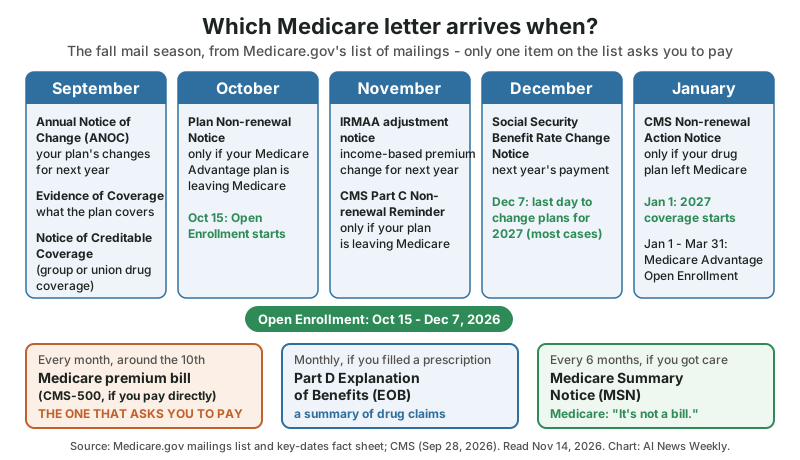
The chart as text — September: Annual Notice of Change (ANOC), Evidence of Coverage, Notice of Creditable Coverage (group or union drug coverage). October: Plan Non-renewal Notice (only if your Medicare Advantage plan is leaving Medicare); Open Enrollment starts October 15. November: IRMAA adjustment notice (income-based premium change for next year); CMS Part C Non-renewal Reminder (only if your plan is leaving). December: Social Security Benefit Rate Change Notice; December 7 is the last day to change plans for 2027 in most cases. January: CMS Non-renewal Action Notice (only if your drug plan left Medicare); 2027 coverage starts January 1; Medicare Advantage Open Enrollment runs January 1 — March 31. Regular mail: Medicare premium bill (CMS-500) every month around the 10th — the one that asks you to pay; Part D Explanation of Benefits monthly if you filled a prescription; Medicare Summary Notice every 6 months if you got care — It’s not a bill.
| Mailing | Who gets it | When it arrives | Asks you to pay? | A good question for the AI |
|---|---|---|---|---|
| Medicare Summary Notice (MSN) | Original Medicare, if you got services | Every 6 months | No — It’s not a bill | What does each column mean? |
| Medicare premium bill (CMS-500) | People who pay Part A, Part B or Part D IRMAA directly | About the 10th of each month | Yes | Which part of Medicare is this premium for? |
| Medicare Easy Pay premium statement (CMS-20143) | People paying premiums through Medicare Easy Pay | About the 10th of each month | No — shows the bank deduction | What does this breakdown show? |
| Part D Explanation of Benefits (EOB) | Part D members who filled a prescription last month | Monthly | No — summarizes drug claims and costs | Explain these drug-cost totals. |
| Plan Annual Notice of Change (ANOC) | Medicare health or drug plan members | September | No — next year’s changes | List every change from this year to next. |
| Evidence of Coverage | Medicare health or drug plan members | September | No — coverage and costs in detail | Find the section on [service]. |
| Notice of Creditable Coverage | People with group or union drug coverage | September | No | What does creditable mean for me? |
| Plan Non-renewal Notice | Medicare Advantage members whose plan is leaving | October | No — prompts a new choice | What do I need to do, and by when? |
| CMS Part C Non-renewal Reminder Notice | Members whose Part C plan is leaving | November | No | What happens if I do nothing? |
| IRMAA adjustment notice | Part B or D members whose income-based premium changes | November | No — explains next year’s premium | Why did this change? |
| Initial IRMAA notice | Part B or D members Social Security found IRMAA applies to | Any time | No — explains a surcharge | What is IRMAA in plain words? |
| Social Security Benefit Rate Change Notice | Social Security recipients whose payment changes | December | No | What changes in my payment? |
| CMS Non-renewal Action Notice | Part D members whose drug plan left Medicare | January | No — prompts a new drug plan | What do I need to choose? |
| ESRD coverage ending letter | People whose ESRD-based Medicare is ending | A few months before it ends | No — prompts other coverage | What are my next steps? |
What is a Medicare Summary Notice, and why isn’t it a bill?
A Medicare Summary Notice (MSN) is a statement, not a bill: it lists the services and supplies your providers billed to Original Medicare, what Medicare paid and the most you may owe. Medicare.gov’s Medicare Summary Notice page says it arrives at least twice a year — every 6 months if you got services in that period — and advises: Keep your receipts and bills, and compare them to your MSN.
Three Medicare Summary Notice facts worth knowing before you ask an AI chatbot about one:
- Electronic MSNs come faster. Sign up and Medicare sends an email with a link to your MSN for any month you have a processed claim.
- Denied claims start with the provider. If a service was denied, Medicare.gov suggests contacting your provider’s office.
- The appeal instructions are on the letter. The last page of the MSN gives step-by-step directions on when and how to file an appeal.
Why does the Annual Notice of Change matter right now?
The Annual Notice of Change (ANOC) matters right now because Medicare Open Enrollment runs October 15 to December 7, 2026, and it’s the letter that lists what your health or drug plan changes for 2027. CMS asks people in a plan to review materials like the ANOC to confirm the plan will still meet their needs next year.
CMS announced the 2027 plan year on September 28, 2026, projecting 34 million people in Medicare Advantage in 2027, about 47.4% of people with Medicare, with CMS Administrator Dr. Mehmet Oz saying CMS is fighting to keep high-quality care options affordable and accessible.
Medicare.gov’s Remember Key Medicare Dates
fact sheet gives the dates that follow: December 7 is, in most cases, the last day to change coverage for next year, new coverage starts January 1, and people in a Medicare Advantage Plan get another chance to change from January 1 to March 31.
An ANOC is long, and a side-by-side list is where an AI chatbot earns its keep: paste the “changes” pages (without your name or member ID) and ask for every change in a two-column table, this year and next. Then check the ones that matter to you against the plan’s own pages or Medicare’s Plan Finder.
What does AI get right with Medicare letters and medical bills?
AI chatbots get the language right: they’re good at turning insurance terms, form names and dense paragraphs into plain words, at listing what a letter asks you to do, and at drafting questions and phone scripts. That’s the job AARP’s older adults asked for — simplifying, not deciding.
Five jobs ChatGPT, Gemini, Copilot and Claude handle well with a Medicare letter or medical bill:
- Naming the letter.
Is this a bill or a notice?
— with the table above as your cross-check. - Translating terms. Deductible, coinsurance, Medicare-approved amount, Explanation of Benefits, IRMAA — one plain line each.
- Listing actions. What the letter asks you to do, quoting the exact line rather than paraphrasing it.
- Comparing pages. This year’s and next year’s plan changes side by side, or a provider’s bill next to the insurer’s statement.
- Preparing the call. Three questions for 1-800-MEDICARE, your plan or the billing office, and a short polite script.
Anthropic describes a similar plain-language role for health information: its January 11, 2026 announcement says Claude can explain test results in plain language
and prepare questions for appointments
. The same habits carry over to Medicare mail.
Where does AI get Medicare letters and medical bills wrong?
AI chatbots go wrong where the answer isn’t on the page they were shown: your deadline, your plan’s rules this year, and whether a charge was actually right. A chatbot only sees the lines you paste; it can’t look up your claim, your account or the provider’s records, and it may fill a gap with a confident guess.
- Deadlines
- Medicare.gov’s Original Medicare appeals page says
You must file your appeal by the date in the MSN.
The date is on your letter — read it yourself rather than asking an AI to work it out. - Your plan’s rules
- Plans change every year (that’s what the ANOC is for), so a chatbot’s general answer about “Medicare Advantage plans” may not match your plan in 2027.
- Whether a charge is correct
- Only the records can say: compare the bill with your MSN or EOB and ask the billing office for an itemized bill.
- Codes it can’t see
- A photo cut off at the edge, or a code without its description, invites a guess. Ask the AI to say
I can’t see that
instead. - Who to call
- Never take a phone number from a chatbot; use the number printed on the letter, your Medicare card or Medicare.gov.
How often do chatbots misread this kind of paperwork? Nobody seems to have measured it yet: we found no published study testing how accurately AI chatbots explain Medicare notices or medical bills (searched November 14, 2026). Until there is one, treat the AI’s reading as a draft and the letter as the record.
Is Medicare itself using AI on claims in 2026?
Yes, in a limited way: since January 1, 2026, Medicare’s WISeR Model has used AI and machine learning, together with human clinical review, for prior authorization of selected services in Original Medicare in six states — Arizona, New Jersey, Ohio, Oklahoma, Texas and Washington. CMS says licensed clinicians, not machines, make any final decision against coverage.
Can I share my favorite discovery from this one? Out of fourteen kinds of Medicare mail, exactly one asks you to pay. Fourteen envelopes, one bill. I find that weirdly soothing — most of the scary-looking mail is just Medicare keeping you posted.
Per the CMS WISeR (Wasteful and Inappropriate Service Reduction) Model page (last modified October 19, 2026), the model runs from January 1, 2026 to December 31, 2031, covers services such as skin and tissue substitutes, electrical nerve stimulator implants and knee arthroscopy for knee osteoarthritis, and excludes inpatient-only services, emergency services and services where a delay would put patients at substantial risk. The page states that WISeR does not apply to people with Medicare Advantage and will have no impact on them.
When CMS announced the model on June 27, 2025, it said final decisions would be made by licensed clinicians, not machines
, and quoted the CMS Administrator:
CMS is committed to crushing fraud, waste, and abuse, and the WISeR Model will help root out waste in Original Medicare.
What it means for a letter on your table: WISeR doesn’t change what Original Medicare covers, per CMS, and the usual appeal route still applies — Medicare.gov lists five levels of appeal for Original Medicare, starting with a redetermination, with a decision usually within about 60 days. If you live in one of the six states and a letter mentions prior authorization, an AI chatbot can explain the words; your doctor’s office and 1-800-MEDICARE can tell you where the request stands.
How do you hide personal details before showing AI a letter?
Cover every line that identifies you or opens an account before an AI chatbot sees a letter: name, address, Medicare Number, Social Security number, birth date, and claim, member or account numbers. The AI doesn’t need any of them to explain the words — the service, the date and the amounts are enough.
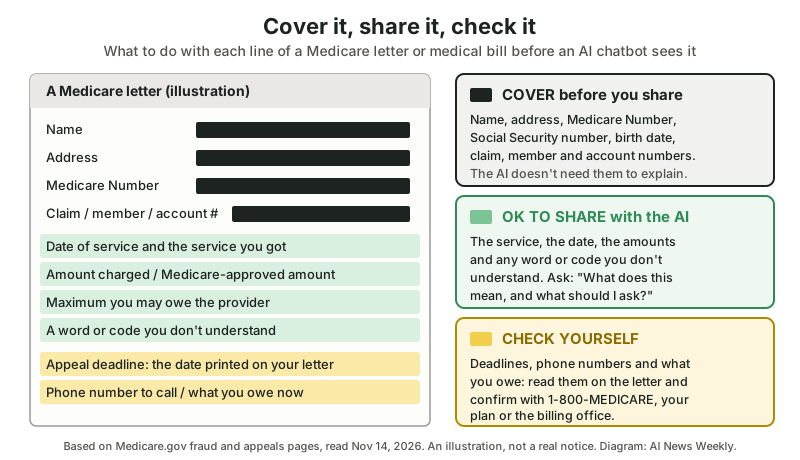
The diagram as text — Cover before you share: name, address, Medicare Number, Social Security number, birth date, claim, member and account numbers. OK to share with the AI: the service, the date, the amounts and any word or code you don’t understand. Check yourself: deadlines, phone numbers and what you owe — read them on the letter and confirm with 1-800-MEDICARE, your plan or the billing office.
Four ways to cover the details, from easiest to most careful:
- Type, don’t upload. Copy only the lines you have a question about. Nothing else leaves the house.
- Cover, then photograph. Lay a strip of paper or a sticky note over the top of the letter before you take the photo.
- Crop the photo. Use the phone’s own crop tool so only the table of services and amounts is left.
- Shred what you’re done with. Old statements with your Medicare Number on them belong in a cross-cut paper shredder, not the recycling bin.
Medicare.gov’s fraud page asks you to guard your Medicare card and number, sharing them with your doctor and the few others who need them — and a chatbot isn’t one of them. Part 3 of this series has more on what never to paste into an AI chatbot.
Which privacy settings should you use in ChatGPT, Gemini, Copilot and Claude?
Each of the four big AI assistants has a more private way to chat — ChatGPT’s Temporary Chat, Gemini with Keep Activity off, Claude’s incognito chats and Copilot’s model-training opt-out — and none of them is a reason to skip covering your details first. Here’s what each maker (or, for ChatGPT, a named report) says:
| Assistant | More private setting | Used to train AI? | How long it’s kept |
|---|---|---|---|
| ChatGPT (OpenAI) | Temporary Chat — a blank slatethat doesn’t draw on memories (TechCrunch) | Not confirmed by us (OpenAI’s page refused our fetch) | OpenAI may keep a copy of Temporary Chat conversations for up to 30 daysfor safety (TechCrunch) |
| Gemini (Google) | Keep Activity off | No for future chats, unless you send feedback | 72 hours; chats seen by human reviewers are kept up to three years |
| Claude (Anthropic) | Incognito chat — not saved to history or memory | No — Incognito chats are not used for training | 30 days by default |
| Copilot (Microsoft) | Opt out of model training (signed in) | Yes by default, including uploaded files (de-identified), unless you opt out | Conversation activity 18 months by default |
Google’s Gemini Apps Privacy Hub puts the rule in one sentence that fits every assistant: Please don’t enter confidential information that you wouldn’t want a reviewer to see.
The details: Anthropic’s “Using incognito chats”, Microsoft’s Copilot privacy FAQ and TechCrunch’s Kyle Wiggers on ChatGPT’s Temporary Chat.
What prompt gets a clear explanation of a Medicare letter?
A good prompt for a Medicare letter asks the AI chatbot to name the letter, explain each term, quote rather than guess any deadline, and suggest questions for a real person. Our own example, for ChatGPT, Gemini, Copilot or Claude:
Here are some lines from a Medicare letter. I covered my
name, address and Medicare Number. In plain, simple
words, please:
1. Tell me what kind of letter this is and whether it
   asks me to pay anything.
2. Explain each term I might not know, one line each.
3. List anything it asks me to do. Quote the exact line -
   do not guess or calculate any date.
4. Give me 3 questions to ask 1-800-MEDICARE or my plan.
If a word or number is cut off, say so instead of guessing.
[paste the lines here]
What prompt helps check a medical bill against the insurance statement?
A good prompt for a medical bill puts the provider’s bill next to the insurance statement — the MSN for Original Medicare, or your plan’s Explanation of Benefits — and asks the AI chatbot to point out where they disagree. Our own example:
Below are lines from a medical bill and the matching lines
from my Medicare Summary Notice (or my plan's Explanation
of Benefits). Names and account numbers are removed.
- What was I billed for, line by line, in plain words?
- What does the statement say was approved and paid,
  and the most I may owe?
- Do the two papers disagree anywhere? Quote both lines.
- Write a short, polite script for calling the billing
  office to ask for an itemized bill and explain any gap.
Don't guess at codes or amounts you can't see.
[paste the bill lines]
[paste the statement lines]
What should you do if a medical bill looks wrong?
If a medical bill looks wrong, compare it with your Medicare Summary Notice or your plan’s Explanation of Benefits, then call the provider’s billing office and ask for an itemized bill. If the claim was denied, the appeal instructions and deadline are on the notice itself.
Medicare.gov’s fraud page suggests comparing the dates and services on your calendar with the Medicare statements you get, and calling the provider’s office if you think a charge is incorrect. A bill for something you never received is a different problem — that’s a possible fraud report, covered in the help lines below.
What protects you from surprise medical bills?
The No Surprises Act protects people from unexpected out-of-network bills for emergency care and for some care at in-network hospitals and surgery centers, and it gives uninsured or self-pay patients a right to a good faith estimate. CMS’s “Medical bill rights” page (updated October 5, 2026) explains the rules:
- Protection from unexpected out-of-network bills for emergency room visits, non-emergency care tied to a visit to an in-network hospital, hospital outpatient department or ambulatory surgical center, and air ambulance services.
- A good faith estimate, usually, if you’re uninsured or paying yourself and you ask for one or schedule care at least 3 business days ahead.
- A possible dispute if the bill is at least $400 more than the estimate.
- The No Surprises Help Desk: 1-800-985-3059, phone support 7 days a week.
The CMS page doesn’t address Medicare. If you have Medicare, ask 1-800-MEDICARE or your SHIP counselor which billing protections apply to your situation — an AI chatbot’s general answer isn’t enough here.
Who can check the AI’s answer for free?
Medicare, your state’s SHIP and the Senior Medicare Patrol can all check what an AI chatbot told you, at no cost. 1-800-MEDICARE answers by phone or live chat around the clock, and SHIP counselors give one-on-one help with plans, coverage and costs.
- 1-800-MEDICARE
- 1-800-633-4227 (TTY 1-877-486-2048); phone or live chat 24 hours a day, 7 days a week, except some federal holidays (Medicare.gov)
- SHIP — State Health Insurance Assistance Program
- Free, one-on-one counseling on plans, coverage and costs; find your state’s office at shiphelp.org or call the SHIP national center at 877-839-2675
- SMP — Senior Medicare Patrol
- Helps people with Medicare
prevent, detect, and report health care fraud
; toll-free 877-808-2468 (smpresource.org) - Medicare Advantage or drug plan fraud
- I-MEDIC: 1-877-7SAFERX (1-877-772-3379), per Medicare.gov
- Surprise bills
- No Surprises Help Desk: 1-800-985-3059 (CMS)
For a step-by-step version with one assistant, our sister site How To With Claude AI is publishing a matching seniors series with screens and prompts for Claude.
What are the key numbers on AI, Medicare letters and medical bills?
The key numbers on Medicare mail, medical bills and AI help, gathered from KFF, AARP, Medicare.gov and CMS:
| Finding | Number | Source |
|---|---|---|
| Insured adults naming understanding their bill as the biggest burden beyond cost | 17% | KFF, Jan 13-20, 2026 poll |
| Insured adults naming prior authorization as the biggest burden | 34% | KFF, Jan 13-20, 2026 poll |
| Adults with problems paying or unable to pay medical bills in the past 12 months | 22% | KFF, May 2026 survey |
| Adults 50+ not comfortable sharing health information with AI tools | 69% | AARP Research |
| Medicare costs-and-coverage mailings that ask you to pay | 1 of 14 (the CMS-500 premium bill) | Our count from Medicare.gov |
| How often a Medicare Summary Notice arrives | Every 6 months, if you got care | Medicare.gov |
| Medicare Open Enrollment for 2027 coverage | October 15 — December 7, 2026 | CMS |
| People projected in Medicare Advantage in 2027 | 34 million (about 47.4%) | CMS |
| WISeR AI-assisted prior authorization in Original Medicare | 6 states, January 1, 2026 — December 31, 2031 | CMS |
| Levels of appeal in Original Medicare | 5 | Medicare.gov |
The surveys measure different groups — KFF counts insured adults or all adults, AARP adults 50+ — so compare numbers within a row, not across sources.
The short version for families: an AI chatbot is a patient, tireless reader for Medicare mail and medical bills, and it’s genuinely good at the words. The decisions — the deadline, the plan, whether a charge is right — still belong to the letter, the people on 1-800-MEDICARE and a free SHIP counselor.
So here’s your little case file for the week, detective: sort the pile into bill or not-a-bill, cover your name and Medicare Number with a sticky note, let any AI assistant write you three questions, and then make one call to 1-800-MEDICARE or your SHIP counselor with those questions in hand. Mystery solved, kettle still warm.
Sources and further reading
- Costs & coverage mailings (Medicare.gov) — 14 mailings: who gets each, when, what it is for; read Nov 14, 2026
- Medicare Summary Notice (Medicare.gov) — "It’s not a bill", every 6 months, compare receipts, electronic MSNs; read Nov 14, 2026
- Original Medicare appeals (Medicare.gov) — "You must file your appeal by the date in the MSN", 5 levels, ~60-day decision; read Nov 14, 2026
- Reporting Medicare fraud & abuse (Medicare.gov) — compare statements, protect your Medicare Number, "Medicare will never call you", I-MEDIC; read Nov 14, 2026
- Talk to someone (Medicare.gov) — 1-800-633-4227, TTY 1-877-486-2048, 24/7 phone and live chat, SHIP; read Nov 14, 2026
- Remember Key Medicare Dates (Medicare.gov fact sheet) — Dec 7 last day in most cases, Jan 1 coverage, Jan 1 — Mar 31 Medicare Advantage Open Enrollment
- Medicare Advantage and Medicare Prescription Drug Programs Expected to Remain Stable in 2027 (CMS) — Sep 28, 2026; Open Enrollment Oct 15 — Dec 7, 2026; 34 million / 47.4% projected MA enrollment; Dr. Mehmet Oz quote
- Medicare Open Enrollment partner resources (CMS) — review the Annual Notice of Change; last updated Mar 4, 2026
- WISeR (Wasteful and Inappropriate Service Reduction) Model (CMS Innovation Center) — Jan 1, 2026 — Dec 31, 2031; six states; AI/ML with human clinical review; not Medicare Advantage; last modified Oct 19, 2026
- CMS Launches New Model to Target Wasteful, Inappropriate Services in Original Medicare (CMS) — June 27, 2025; "licensed clinicians, not machines"; Dr. Mehmet Oz quote
- Medical bill rights — No Surprises Act (CMS) — surprise-bill protections, good faith estimates, $400 dispute, 1-800-985-3059; updated Oct 5, 2026
- KFF Health Tracking Poll: Prior Authorizations Rank as Public’s Biggest Burden When Getting Health Care (KFF) — Feb 2, 2026; 1,426 adults, Jan 13-20, 2026; 34% / 19% / 17% / 15%
- Americans’ Challenges with Health Care Costs (KFF) — updated Oct 23, 2026; 22% had problems paying medical bills (May 2026 survey)
- Older Adults Want AI to Show Up in Practical Ways (AARP Research, Brittne Kakulla) — Jan 13, 2026; simplifying health information a top job; "simplify financial language in documents"
- Adults Age 50-Plus and AI-Powered Health Tools Survey (AARP Research, Brittne Kakulla) — June 11, 2026; 11% shared documents; 69% not comfortable sharing
- Gemini Apps Privacy Hub (Google) — updated Oct 26, 2026; "Please don’t enter confidential information…"; 72 hours; reviewed chats up to 3 years
- Using incognito chats (Claude Help Center, Anthropic) — not saved to history or memory, not used for training, 30 days by default
- Privacy FAQ for Microsoft Copilot (Microsoft Support) — classic Copilot app; opt out of model training; uploaded files; 18 months
- ChatGPT will now remember — and forget — things you tell it to (TechCrunch, Kyle Wiggers) — Feb 13, 2024; Temporary Chat, copy kept up to 30 days for safety
- Temporary Chat FAQ (OpenAI Help Center) — the maker’s own page; it refused our fetch on Nov 14, 2026, so details here come from TechCrunch
- Advancing Claude in healthcare and the life sciences (Anthropic) — Jan 11, 2026; "explain test results in plain language", "prepare questions for appointments"
- SHIP — State Health Insurance Assistance Program (SHIP TA Center) — one-on-one Medicare counseling; 877-839-2675
- Senior Medicare Patrol (SMP Resource Center) — prevent, detect and report health care fraud; 877-808-2468
Questions and answers
Can ChatGPT explain my Medicare Summary Notice?
Yes. ChatGPT — or Gemini, Copilot or Claude — can explain the columns and terms on a Medicare Summary Notice in plain words if you type the lines or photograph them with your name, address and Medicare Number covered. It can’t tell whether a claim is right or work out your deadline: Medicare says you must appeal by the date in the MSN, and 1-800-MEDICARE (1-800-633-4227) can confirm.
Is a Medicare Summary Notice a bill?
No. Medicare.gov says of the Medicare Summary Notice: It’s not a bill.
It lists what providers billed to Original Medicare, what Medicare paid and the most you may owe, and arrives every 6 months if you got care. Any bill comes from the provider, so compare the two.
Is it safe to upload a medical bill to AI?
It’s safer if you cover your name, address, Medicare Number, birth date and account numbers first, or type only the lines you have questions about. Google’s Gemini privacy page says not to enter confidential information you wouldn’t want a reviewer to see. ChatGPT’s Temporary Chat, Gemini with Keep Activity off and Claude’s incognito chats keep less.
Who can help me understand my Medicare letter for free?
1-800-MEDICARE (1-800-633-4227, TTY 1-877-486-2048) answers by phone or live chat 24 hours a day, 7 days a week, except some federal holidays. Your State Health Insurance Assistance Program (SHIP, shiphelp.org) gives free one-on-one counseling, and the Senior Medicare Patrol (877-808-2468) helps with suspected fraud.
Does Medicare use AI to deny claims?
In a limited way. Since January 1, 2026, CMS’s WISeR Model has used AI and machine learning with human clinical review for prior authorization of selected services in Original Medicare in six states: Arizona, New Jersey, Ohio, Oklahoma, Texas and Washington. CMS says licensed clinicians, not machines, make final decisions, and WISeR doesn’t apply to Medicare Advantage.