How to Automate Hygiene Recall Outreach in a Dental Office
Every office I read about agrees that recall fills the hygiene schedule, and almost none of them work the list.
Every dental office says recall is the lifeblood of hygiene, and almost every office has a recall list nobody works.
I read the Open Dental recall pages, the Cochrane review of check-up intervals and the FCC’s health care text rule so you don’t have to.
Three things stood out: the software already knows who is due, six months is not right for everyone, and the rules for texting are tighter than most vendors say.
Short answer: To automate hygiene recall outreach, let your practice software supply who is due, then send a text before and after the due date, answer replies with real open hygiene slots, add a voice call for patients 31 to 90 days late, and give a person only the leftovers. Every step stops on a booking or a STOP reply.
- What triggers it
- A recall due date in Open Dental, Dentrix or Eaglesoft with no hygiene visit booked
- What goes out
- Text first, then a voice call, then a person’s call
- What it writes back
- A booked appointment, a recall status and a note
- What stays human
- Cost, pain, insurance and unhappy-patient replies
What does it mean to automate hygiene recall outreach?
To automate hygiene recall outreach means the reminders, the replies and the follow-up calls for overdue cleanings run on a schedule without a staff member starting each one.
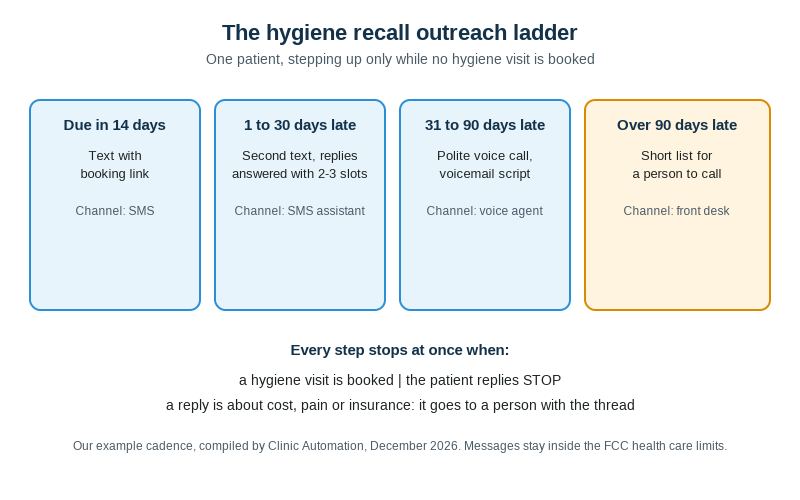
In words, the picture shows four steps:
- 14 days before the due date: a text with a booking link.
- 1 to 30 days late: a second text, and an assistant that answers replies with 2 or 3 open slots.
- 31 to 90 days late: a polite voice call with a voicemail script.
- Over 90 days late: a short list for a person to call.
The practice software keeps the facts. The automation only reads who is due and writes back what happened.
Why does a dental recall list stall at the front desk?
A dental recall list stalls because working it is a cold call that loses every time to the patient standing at the window.
Sources that write about recall for a living agree on the shape of the fix. One vendor guide suggests texts and emails starting 4 to 6 weeks before the due date and calls for patients already overdue, and several say recall should have a named owner rather than sit on everyone’s to-do list.
Here’s the catch: the same guides are written by vendors who sell the fix, and none we read gave a measured result with a method behind it. Treat any 20 to 40 percent
figure as a vendor claim until you count your own.
The cheapest recall step needs no software at all: book the next hygiene visit before the patient leaves the chair.
How often should an automated recall message go to an overdue patient?
An overdue patient can get a text before the due date and one or two after it, then a call, with at most 1 message a day and 3 a week as the legal ceiling.
| Where the patient is | Touch | Who handles replies |
|---|---|---|
| 14 days before due | Text with booking link | SMS assistant |
| 7 days after due | Text, different wording | SMS assistant |
| 30 days after due | Text offering two named slots | SMS assistant |
| 45 and 75 days after due | Voice call plus voicemail script | Voice agent, then a person if asked |
| Over 90 days after due | Name goes on a call list | Front desk or hygienist |
In short: three texts, two calls, then a human, and a booking at any point ends it. After about 90 days many offices treat the patient as reactivation, which is its own guide: reactivation texts for dormant patients.
How much staff time does manual hygiene recall take?
Working 100 overdue hygiene patients by hand takes about 14 staff hours a month in our example, against roughly 1.3 hours of replies when texts and calls are automated.
| Patients due, unscheduled | Manual hours (5 attempts each) | Cost at $22/hour | Reply hours, automated |
|---|---|---|---|
| 50 | 7.0 | $154 | 0.6 |
| 100 | 14.0 | $308 | 1.3 |
| 200 | 28.0 | $616 | 2.5 |
Assumptions: 5 attempts per patient (calls, voicemails, notes) at about 1.7 minutes each of actual desk time averaged after unanswered rings, $22 an hour as a rough loaded desk cost, and 1 patient in 4 replying at 3 minutes a reply. Subscription and texting fees are extra and vary by vendor. Swap in your own numbers.
The number that matters more is one open hygiene hour. Count what one empty hour costs your office, and compare it with the hours above.
Should every patient get the same six-month recall message?
No. Every patient should get a message tied to their own recall type, because the evidence does not support one interval for everyone.
The Cochrane review of dental check-up intervals (October 14, 2020) pooled 1,736 people in two randomised trials and found that six-monthly and risk-based check-ups look similar for decay, gum disease and quality of life in adults. It adds that longer intervals (up to 24 months) between check-ups may not negatively affect these outcomes.
That is about healthy adults. A patient on 3-month perio maintenance has a different clinical need, and the reminder must say so.
So the automation should read each patient’s recall type and interval from your software, not apply a blanket 6 months. Sources disagree with the “every six months” slogan, and your hygienist’s chart notes win.
How does automated hygiene recall run, step by step?
Automated hygiene recall runs as a loop: read who is due, send, listen for the reply, book or hand off, and write the result back.
- Read. Each night the automation pulls patients due with no booked hygiene visit, their recall type and contact consent.
- Send. It sends the next touch on the ladder, one per patient, never over the daily and weekly limits.
- Listen. A reply like “Thursday after 3?” is read, and 2 or 3 real open hygiene slots are offered.
- Book. The chosen slot is booked through a connection your software maker allows, and a confirmation goes out.
- Write back. The recall status and a short note are saved so the list stays honest.
- Hand off. Cost, pain, insurance, “I moved” and “call me” replies go to a person with the thread attached.
The calls for 31 to 90 days late work the same way, with a voice agent in place of the text assistant. For the phone side, see the AI phone receptionist guide.
What does Open Dental or Dentrix already send for hygiene recall?
Open Dental and Dentrix already track recall due dates and can send reminders, but both leave free-text replies and phone follow-up to your team.
The software already knows who is due. What it leaves to your team is the reply, the second text and the call nobody has time to make.
The Open Dental manual says status updates should typically be done through the Recall List
, and that setting a status directly in Edit Recall does not update the count of reminders sent. So the list is the place automation should write to.
Dentrix pairs Continuing Care with a separate add-on for sending; we cover its timing in the Dentrix automated recall system guide, and Open Dental’s texting in Open Dental two-way SMS scheduling.
| Job | Built-in | Added assistant |
|---|---|---|
| Know who is due | Yes | Reads it |
| Send reminders | Yes, by add-on or eService | Can replace or extend |
Answer can I come Saturday? | A person | Offers real slots |
| Call the 60-day late patient | A person | Voice agent |
What rules apply to automated recall texts and calls?
Automated recall texts fall under the FCC’s health care exemption and HIPAA’s treatment rules.
The FCC rule at 47 CFR 64.1200(a)(9)(iv) allows appointment reminders and wellness checkups to the number the patient gave you, with at most 1 message a day and 3 a week, 160 characters or fewer, your name and contact details, no advertising or billing content and an easy opt-out.
The HHS FAQ for smaller providers says appointment reminders are part of treatment and can be made without an authorization. A vendor that handles replies still needs a business associate agreement under HHS business associate rules.
The ladder above sends 3 texts and 2 calls over 90 days, far under the ceiling. A promotion stacked on a recall text is where offices drift over it.
How should a cash-pay or out-of-network office handle recall?
A cash-pay or out-of-network office should lean harder on recall, because no insurer’s “use your benefits” letter is nudging those patients back.
Keep prices and offers out of the text; a reminder with a discount can be read as advertising under the FCC rule. Say what the visit is and offer a time.
Make sure membership-plan and custom-fee-schedule patients carry a recall type. Otherwise the list never shows them, and the best-paying patients stay silent.
What should you check before turning on recall outreach?
Check your data and consent first, because automation repeats every mistake at scale.
- Each patient has the right recall type and interval, including 3- and 4-month perio maintenance.
- Broken and placeholder appointments are cleared so nobody looks booked by mistake.
- Mobile numbers are current and “do not contact” flags are respected.
- Your intake form asks for consent to texts about appointments and care.
- Message wording is under 160 characters and carries your office name and number.
- The vendor signs a business associate agreement.
- A named person owns the exception list every working day.
- You counted this month’s overdue patients before switching on, so you can compare.
What should the first month of automated hygiene recall look like?
Week one is cleanup, week two is the first texts to your most recent overdue group, week three adds reply handling and week four adds the calls.
Read every reply the same day for the first two weeks. Count texts sent, replies, bookings, STOP replies and staff minutes, then decide where the calls are worth it.
Done well, the recall list stops being a guilt pile. It becomes a short list of patients who need a human voice, and a hygiene schedule that fills itself a little each week.
How we researched this
- Read the Cochrane review of dental check-up intervals (October 14, 2020), the Open Dental manual’s recall page, 47 CFR 64.1200 and the HHS HIPAA FAQ for smaller providers, November 2026.
- Read public vendor guides on recall cadence and reactivation; none gave a method for its percentages, so we do not repeat them as fact.
- Searched for dental-office discussions on Reddit and found none we could quote; we did not use forum posts.
- The cadence and time-cost tables are our own examples with stated assumptions, not measurements.
- We did not install or test any recall product.
Start with your most recent overdue group, read every reply for two weeks, and let the ladder do the rest.
Sources and further reading
- Cochrane: Dental check-ups for adults, how often (October 14, 2020)
- Open Dental manual: Recall
- 47 CFR 64.1200: FCC rules for automated calls and texts, health care messages
- HHS HIPAA FAQ: Smaller providers and businesses (appointment reminders)
- HHS: Business associates
- Dentrix: Patient Engage Suite
- The Dental App: Dental recall software (vendor guide)
Questions and answers
Can I use AI to automate hygiene recall outreach in a dental office?
Yes. Your practice software already knows who is due; an AI assistant can send the texts, answer replies with real open hygiene slots, book the visit and call patients who ignore texts. Use a connection your software maker allows and a vendor that signs a business associate agreement, and keep cost, pain and insurance questions with a person.
How often should I text a patient who is overdue for a cleaning?
Far less than the legal ceiling. The FCC health care rule allows at most 1 message a day and 3 a week per patient, 160 characters or fewer, with your name, contact details and an opt-out. A sensible plan is one text before the due date, then texts at about 7 and 30 days late, then a call.
Do automated recall reminders need patient permission?
Appointment reminders count as treatment under HIPAA and need no separate authorization, per the HHS FAQ for smaller providers. For texts, the FCC rule applies to the number the patient gave you, with an easy opt-out honored right away. Asking for text consent on your intake form is the safe habit.
Is six months the right recall interval for every patient?
No. A 2020 Cochrane review of 1,736 adults found six-monthly and risk-based check-ups gave similar results for decay and gum disease. Patients with gum disease may need 3 to 4 month perio maintenance, so automation should read each patient’s own recall type.
What should a person still handle in automated recall?
Cost and insurance questions, pain or swelling, an unhappy patient, anyone who asks for a person and patients more than about 90 days overdue. The automation passes these on with the whole conversation attached, so the patient is not asked twice.