Guides › Spring turkey with a crossbow
Getting Ready for Spring Turkey With a Crossbow: Shot Placement, Broadheads and Blind Setup
Disclosure: this guide contains Amazon affiliate links. As an Amazon Associate we earn from qualifying purchases, at no extra cost to you.
Spring gobbler season is months away, which makes winter the perfect time to get your crossbow ready for it. Turkeys are a different challenge from deer: the target is tiny, the birds see color and movement well, and they're often in your lap before you get a shot. You'll want a turkey decoy and a ground blind (both on Amazon) on the list, but the first job is learning where to aim.
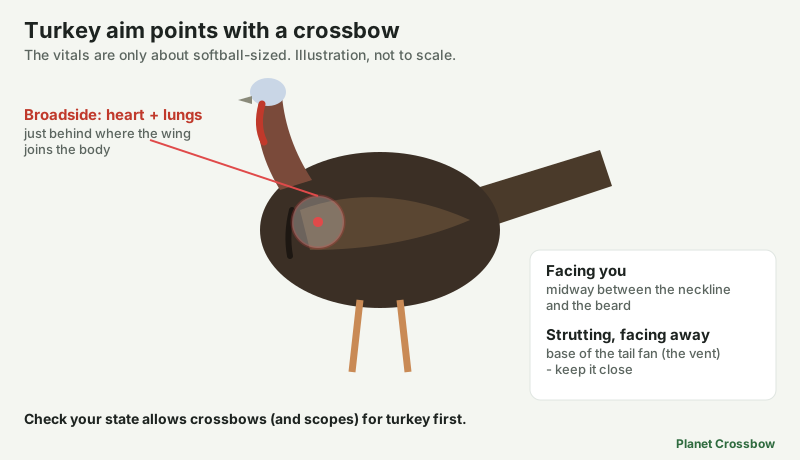
Short answer: first make sure crossbows (and scopes on them) are legal for turkey where you hunt - not every state allows it. Then learn the vital zone for each pose: it's only about softball-sized. On a broadside bird, aim just behind where the wing joins the body; facing you, midway between the neckline and the beard; strutting and facing away, the base of the tail fan. Practice at 10 to 30 yards from a sitting position in a blind.
First: is it legal where you hunt?
Ravin's turkey guide puts it plainly: hunting turkey with a crossbow is not legal in all states, and some states also restrict magnified scopes. Many states also set rules on broadheads for turkey, such as minimum cutting width. Check your state wildlife agency's spring turkey regulations before you plan anything.
Where to aim
A turkey's vital area is small - TenPoint calls it about the size of a softball, Ravin about the size of a baseball - and a strutting gobbler's feathers hide where the body really is. Aim points from the makers:
| Bird's position | Where to aim |
|---|---|
| Broadside | Just behind where the wing joins the body, about an inch below the neckline and a few inches into the body (heart and lungs). The best shot for newer turkey hunters. |
| Facing you | Midway between where the neck meets the body and the beard. |
| Strutting, facing away | The base of the tail fan (the vent) - a shot into the vitals from behind. Best kept close. |
When in doubt, wait. A strutting tom often turns or drops out of strut, giving you a better angle.
Broadheads for turkey
- Legal first: follow your state's turkey broadhead rules.
- Big cutting diameter helps on a small vital zone - many turkey hunters choose wide mechanical heads made for crossbows.
- Don't count on a pass-through. Ravin notes it's rare on turkeys because their thick feathers act like armor.
- Check flight. Shoot your turkey broadheads before the season to make sure they hit with your field points (see sighting in).
- Stay in spec. Keep total bolt weight within your crossbow's manual (bolts and broadheads).
Blind and decoy setup
Turkeys have sharp eyes, so most crossbow turkey hunters sit in a ground blind:
- Set the blind up a few days early if you can, or brush it in well.
- Wear black inside and keep the windows behind you closed.
- Place decoys close - many hunters set them 10 to 20 yards out - so the bird comes into easy range and stops.
- Check your window and limb clearance from a sitting position (see crossbow ground blind tips).
- Cock before birds are close; the noise and movement can blow a setup (quieting your crossbow).
Common turkey mistakes with a crossbow
- Aiming at the middle of a strutting bird. The puffed-up feathers make the body look much bigger than it is - the vitals sit higher and further forward than you'd guess.
- Shooting too soon. A bird that's still strutting and turning will often give you a clean broadside a few seconds later.
- Moving at the wrong time. Turkeys catch movement fast. Get the crossbow up on its rest before the bird is close.
- Forgetting the angle. From a chair in a blind you're shooting slightly up or level; practice from the same height.
- Not following up. Watch where the bird goes after the shot and mark the spot - with no pass-through, the trail can be thin.
Your winter practice plan
- Check the rules for your spring season.
- Practice at turkey ranges - 10, 20 and 30 yards - from a chair at blind height.
- Use a turkey target so you learn the aim points for each pose.
- Test your broadheads for flight.
- Practice cocking quietly and loading while sitting.
Over winter, it's also a good time for crossbow care - check the string and cables, and wax and lube as your manual says (crossbow maintenance).
Frequently asked questions
Can I hunt turkey with a crossbow?
In many states, yes - but not all, and some restrict magnified scopes on crossbows. Check your state wildlife agency's spring turkey rules.
Where do you shoot a turkey with a crossbow?
Broadside: just behind where the wing joins the body. Facing you: midway between the neckline and the beard. Strutting and facing away: the base of the tail fan. The vitals are only about softball-sized.
What broadhead is best for turkey with a crossbow?
One that's legal in your state, made for crossbow speeds and with a wide cutting diameter. Check it flies with your field points before the season.
How far should I shoot a turkey with a crossbow?
Keep shots close - most setups bring birds in within 10 to 30 yards with decoys. Practice at those distances from a sitting position.
Sources and further reading
- TenPoint: shot placement is vital when crossbow hunting for turkeys - softball-sized vitals, aim points
- Ravin: turkey hunting with a crossbow - legality, scopes, aim points, pass-throughs
- National Wild Turkey Federation (NWTF) - turkey hunting education
- List of U.S. state fish and wildlife agencies - spring turkey rules
How this guide was written: Based on crossbow makers' turkey guidance (TenPoint and Ravin), turkey-hunting resources from the National Wild Turkey Federation, and wildlife-agency rules. Turkey rules - including whether crossbows and scopes are allowed - vary by state.