
Wholesale Distributor and Food Supplier Automation in Dallas-Fort Worth
Every Dallas-Fort Worth order desk knows the metro keeps adding kitchens, and the new ones usually start by sending a text.
Every few months another headline says Dallas-Fort Worth is the place restaurants keep opening, and every order desk at a DFW distributor feels it as one more text at 10:47 p.m.
I spent an afternoon with the Census Bureau’s 2025 metro population release, the Bureau of Labor Statistics’ Dallas-Fort Worth data and the metro wholesale jobs series, then lined them up next to the restaurant counts.
Three things stood out. The metro added 123,557 residents in a year, second only to Houston. It has about 16,000 restaurants. And the number of people employed by nondurable-goods wholesalers fell 3.7% between October 2025 and October 2026.
Short answer: Wholesale distributor and food supplier automation in Dallas-Fort Worth means a cloud server transcribes order voicemails, reads texts, photos and emailed PDFs with AI, matches each fuzzy item name to an exact SKU, and writes a draft sales order into your ERP. Your order desk approves only what is flagged.
Why is Dallas-Fort Worth such a busy market for food distributors?
Dallas-Fort Worth adds more people than almost any other US metro, and a large kitchen count follows them.
The Census Bureau’s release puts the metro at 8,477,157 people on July 1, 2025, up 123,557 in a year. That is the second-largest numeric gain in the country, behind Houston’s 126,720. The Dallas Morning News, using Bureau of Labor Statistics data, counted about 16,000 restaurants in D-FW in March 2025, up from about 14,000 in 2019.
| Fact | Figure | Source |
|---|---|---|
| Metro population, July 1, 2025 | 8,477,157 (+123,557, about 1.5%) | Census Bureau, 2025 metro estimates |
| Numeric growth rank among US metros | 2nd, behind Houston (+126,720) | Census Bureau |
| Restaurants in D-FW | about 16,000 (about 14,000 in 2019) | Dallas Morning News, Mar 13, 2025 |
| Transportation and material moving share of jobs, May 2025 | 10.5% locally vs 8.8% nationally | BLS, Aug 13, 2026 |
| New Performance Food Group cold-storage building, Fort Worth | 355,000 sq ft, 69,000 sq ft at -10°F, 46,000 sq ft cooler | ARCO National Construction |
In short: more people, about two thousand more restaurants than in 2019, and big national distributors building freezer space in Fort Worth to serve them.
Is the wholesale workforce in Dallas-Fort Worth growing with the market?
No. Nondurable-goods wholesale employment in the Dallas-Fort Worth-Arlington metro fell from 69.3 thousand in October 2025 to 66.7 thousand in October 2026, a drop of 3.7%.
That series, from the BLS state and metro employment survey as published by FRED, is seasonally adjusted and covers all merchant wholesalers of nondurable goods, which includes groceries, beverages and other goods, not only food. It peaked in our window at 69.7 thousand in August 2025 and has slid in most months since.
Our reading: the order desk is the place where a distributor feels this. Orders keep coming from a growing customer base, and the same few people key them. This is our interpretation of two public series, not a finding from either source.
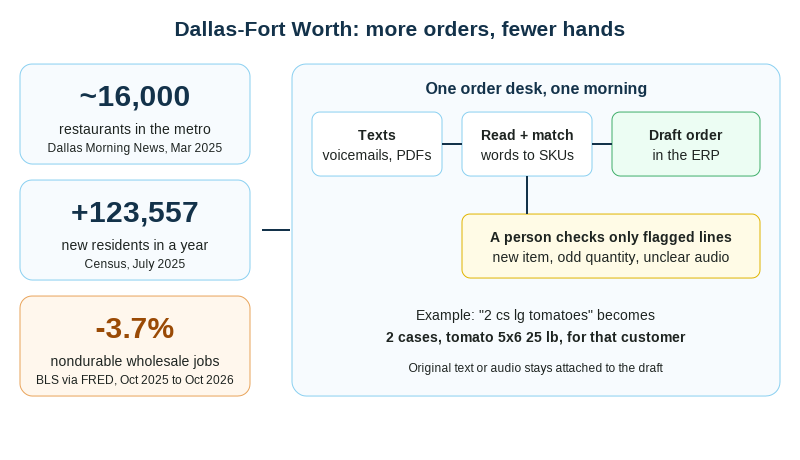
The picture in words: 16,000 restaurants (Dallas Morning News, March 2025); 123,557 new residents (Census, July 2025); minus 3.7% nondurable wholesale jobs (BLS via FRED, October 2025 to October 2026); and four order-desk steps, read, match, draft and flagged-lines review.
Do Dallas-Fort Worth restaurant numbers agree between sources?
No, they differ because sources count different areas, different years and different things.
- Area: About 16,000 restaurants is the whole D-FW metro. One third-party site estimates about 5,470 for Dallas city alone, and that is not a competing figure, just a smaller map.
- Closures against openings: RestaurantData, as reported by The Dallas Express, counted 1,039 Texas closures in the first half of 2026, about 240 of them in D-FW. The same report quotes the Texas Restaurant Association’s chief executive saying D-FW opened more new restaurants than any part of the country in June.
- Growth versus profit: The same association leader said only about 60% of restaurants turned a profit last year.
Those pages refused our automated reader, so these figures come from search summaries of them; check the pages before you quote them. The lesson for a distributor is the churn: accounts open, close and reopen under new owners, and each new kitchen brings a new way of ordering.
How much time does keying restaurant orders cost a DFW distributor?
On our assumptions, hand-keying 100 orders a day costs about 12.5 hours a day, while reviewing machine-made drafts costs under 2.
| Orders a day | Hand-keying, hours a day | Monthly cost at $22 an hour (22 days) | Reviewing drafts, hours a day | Monthly cost |
|---|---|---|---|---|
| 60 | 7.5 | $3,630 | 1.0 | $484 |
| 100 | 12.5 | $6,050 | 1.7 | $807 |
| 200 | 25.0 | $12,100 | 3.3 | $1,613 |
Assumptions, all ours: 7.5 minutes is the midpoint of the seven to eight minutes that Choco says one 40-line order takes to enter. That is a vendor claim for a long order, so a short chef’s text will take less.
$22 an hour is a rough loaded desk cost, and the review minute is a guess to be replaced by your own stopwatch.
Time one morning at your own desk and put your numbers in. If your average order is 10 lines, the hand-keying column shrinks a lot, and so does the case for automating it.
How can a DFW distributor turn texts, voicemails and PDFs into ERP orders?
A cloud server captures each message, reads it, matches every line to a SKU and writes a draft sales order that your desk approves.
Here’s the quiet win: when the 10:47 p.m. text is already a checked draft, the morning goes to the three lines that look wrong, not the hundred that look fine.
- Capture. Customers text or call one business number. Twilio sends each incoming text, with links to any photos, to your server as a web request.
- Transcribe. Voicemail audio goes to a speech-to-text service such as Google Cloud Speech-to-Text.
- Read. Photos of handwritten sheets and emailed PDFs go to a document reader such as Azure AI Document Intelligence, which extracts printed and handwritten text.
- Match. An AI model maps
2 cs lg tomatoes
to the exact SKU and unit using that customer’s order history. Our guide on matching customer names to SKUs shows how. - Draft. The order is created in your ERP, such as NetSuite or QuickBooks, with the original message attached.
More detail on the full flow is in our guides to automating phone and text orders and voicemail to sales order software.
Can the system read voicemails left in Spanish or English?
Yes, speech-to-text services list Spanish alongside English, so a voicemail in either language can be transcribed.
Google’s page of supported languages lists many languages and regional variants, Spanish included. Accuracy varies by audio quality and by kitchen noise, so test it on your own saved voicemails before you trust it.
A good setup keeps the audio next to the transcript and flags low-confidence lines. Mixed phrases like dos cajas de limones, large
are exactly the kind of thing to put in your first test batch.
What should your order desk still decide?
A person still decides anything new, odd or unclear, and approves the first weeks of drafts.
- New items and substitutions: a customer asks for something not in their history, and a person decides what to offer.
- Odd quantities: “20 cases” from a customer who usually takes two gets a flag, not a sale.
- Credit and pricing: your terms stay with your ERP rules and your people.
- Texting rules: automated texts to customers need the carrier registration described in Twilio’s A2P 10DLC overview.
What does a sensible first week look like in Dallas or Fort Worth?
Pick ten steady accounts that already text you and let the system draft their orders in the background.
- Day 1: gather a week of saved texts, voicemails and sheets from those ten accounts.
- Days 2 and 3: run them through and compare each draft with what your desk keyed.
- Days 4 and 5: count wrong lines and fix the item-name matches that failed.
- End of week: compare minutes saved with minutes spent reviewing.
If it does not save real time on your own orders, it is not worth keeping.
How we researched this
- Read on November 29, 2026: the Census Bureau 2025 metro population release, the BLS Dallas-Fort Worth occupational release (August 13, 2026), the FRED series for DFW nondurable-goods wholesale employment (BLS data), the Dallas Morning News restaurant count (March 2025), ARCO National Construction’s project page, and Choco, Twilio, Google Cloud and Microsoft documentation.
- Compared: restaurant counts, closure and opening reports, and wholesale employment against population growth.
- Our own calculations: the percent change in wholesale jobs (66.706 against 69.282 thousand) and the order-entry time table, with assumptions stated.
- Not done: no hands-on testing of any product, no interviews. A search for Reddit threads from DFW distributors returned none we could use. The Dallas Express, WFAA and UT Dallas pages refused or failed our automated reader, so their figures are as reported in search summaries.
Pick ten steady accounts, let two weeks of their orders draft themselves, and let your own count of minutes saved decide the rest.
Sources and further reading
- Census Bureau: 2025 population estimates for metro and micro areas
- BLS: Occupational Employment and Wages in Dallas-Fort Worth-Arlington, May 2025
- FRED: Merchant Wholesalers, Nondurable Goods in Dallas-Fort Worth-Arlington (BLS)
- Dallas Morning News: how DFW restaurants did during five years after COVID
- The Dallas Express: Texas restaurant closures, first half of 2026
- ARCO National Construction: Performance Food Group, Fort Worth
- Choco: OrderAgent (vendor claims)
- Perishable News: Pepper’s Series A announcement (2021)
- Twilio: incoming message webhook request
- Twilio: A2P 10DLC overview
- Google Cloud: Speech-to-Text supported languages
- Microsoft: Azure AI Document Intelligence Read model
Questions and answers
Can I use AI to automate wholesale distributor and food supplier orders in Dallas-Fort Worth?
Yes. A cloud server can transcribe order voicemails, read texts, photos and emailed PDFs, match fuzzy item names to exact SKUs and create draft sales orders in your ERP. Your order desk approves anything new, odd or unclear before it is picked.
Why is Dallas-Fort Worth a good place for order-entry automation?
The metro added 123,557 residents in the year to July 2025 and has about 16,000 restaurants, while nondurable-goods wholesale employment fell 3.7% from October 2025 to October 2026. More orders and fewer hands make the typing the first thing to hand off.
Do DFW restaurants really still order by text and voicemail?
Many do. Pepper’s 2021 funding announcement said restaurants and grocers leave 80% of their distributor orders on voicemail. That is a vendor figure, so count your own orders by channel for one week.
Can it understand Spanish voicemails?
Speech-to-text services such as Google Cloud Speech-to-Text support Spanish as well as English. Test it on your own saved recordings, because kitchen noise and accents change accuracy.
Which ERP can the orders go into?
NetSuite, QuickBooks and most distribution ERPs accept orders through an API or an import file. Ask your vendor which route your plan includes before building anything.