How to Stop Unnecessary Plumber Dispatches at Your Rentals
Every manager has paid a plumber to turn one valve, and wondered if the text could have said so first.
Every plumber invoice that reads reset valve, no charge for parts
still costs you the trip.
On November 29, 2026 I read Property Meld’s own troubleshooting guide, the EPA’s Fix a Leak Week page and a BiggerPockets landlord thread about a $75 service call, instead of the listicles that quote each other.
The BiggerPockets call found a working dishwasher and a tripped GFCI outlet. Property Meld lists unclogging drains and resetting outlets among problems a resident can handle. The EPA says an old flapper can silently leak thousands of gallons a year.
Three sources, one pattern: many “plumber” texts are a two-minute fix, and a few are real emergencies you must never filter.
Short answer: You stop unnecessary plumber dispatches by putting three checks between the tenant’s text and the vendor: a danger check, a short list of simple fixes sent by text, and a confirm step. Only danger or a failed fix books the plumber, with the photo and what was tried attached.
Which plumbing calls are unnecessary plumber dispatches?
An unnecessary dispatch is a plumber visit for a problem the tenant could have fixed in minutes with no tools, or one that is not plumbing at all.
| Tenant says | What it often is | One text that may settle it |
|---|---|---|
| Toilet clogged | A clog a plunger clears | Plunger steps; second photo if the bowl rises |
| Toilet runs by itself | A worn flapper or a stuck chain | Food coloring test, jiggle the handle, then the flapper |
| Disposal dead | A tripped reset button or a jam | Power off, reset button, one hex-key turn if the model has it |
| Kitchen outlet or dishwasher dead | A tripped GFCI, an electrical item | Press reset on the outlet; this is not a plumber |
| Drain slow | Hair or soap at the stopper | Clear the stopper; photo if it persists |
| Faucet drips | A loose handle or aerator | Photo; book a handyman, not a plumber |
Property Meld’s guide names unclogging drains and resetting power outlets among simple issues, and says better preparation reduces the likelihood of unnecessary trips or missed parts
.
Why do property managers send a plumber for everything?
Coordinators send a plumber because a wrong “no” on a leak is expensive and a wrong “yes” is only a bill.
The tenant’s word is the only information at 8 p.m., and “leak” covers a burst line and a damp trap alike. Without a photo, the safe choice is the van. That safety is not free: Property Meld notes that a vendor sent blind may bring the wrong part, which can cause a second trip charge.
The cost is not only money. Vendors booked weeks out, as that post says, are slow to return, so a wasted visit also delays the repair that really needs one.
How does a filter stop plumber dispatches without risking a flood?
The filter asks three questions in order, danger first, and books the plumber unless a simple fix is on your list and works.
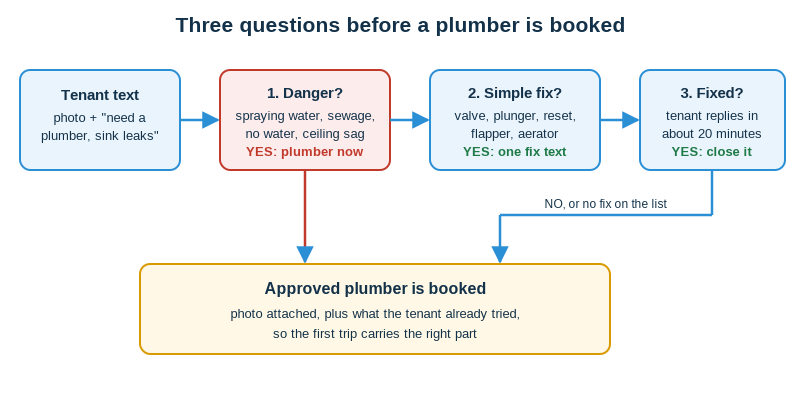
The diagram in words:
- Danger check. Spraying water, sewage, no water at all, a sagging ceiling or any word like gas or sparks books the approved plumber and calls a person at once.
- Simple fix list. Plain code matches the problem to one item on your own list and sends one text with one step and a photo request.
- Confirm. If the tenant does not reply “fixed” in about 20 minutes, or the photo shows more water, the plumber is booked with the photo and what was tried.
A vision model can read the photo and name the item, as in our guide to AI photo diagnosis for tenant repair requests. The list and the 20-minute rule should be code you own. The text script itself is covered in the tenant troubleshooting text bot guide.
Which plumbing problems should never be filtered?
Active spraying or flowing water, sewage backing up, no water at all and a ceiling stain that is sagging should always go to the plumber and a person, with no fix text first.
- [ ] Water you cannot stop. If the tenant cannot close the shutoff, book now.
- [ ] Sewage or multiple drains backing up. This is not a plunger job.
- [ ] Water near electrical. Tell the tenant to stay clear and call the emergency vendor.
- [ ] Unclear photo of water. Treat it as urgent, never as a guess.
- [ ] A failed fix. One try, then the plumber. The bot does not suggest a second repair.
Our stance: the filter earns trust on easy calls, so keep it strict on danger. One missed flood costs more than a year of saved trips, and the after hours call center path should take over at night.
How do you check a running toilet without a plumber?
Put a few drops of food coloring in the tank; if color shows in the bowl within 10 minutes, the flapper is leaking.
Here’s the quiet win: a short, written list of fixes the tenant can try, with danger always skipping the line.
That is the test on the EPA’s Fix a Leak Week page. The same page says old or worn flappers can cause leaks and that a flapper can cause your toilet to flush on its own or silently leak thousands of gallons a year
.
- Average household leak
- More than 9,300 gallons a year (EPA).
- Homes with big leaks
- 9 percent leak 50 gallons or more per day (EPA).
- Dripping faucet
- One drip per second wastes over 3,000 gallons a year (EPA).
A flapper is a part the tenant may not change under your lease, so the text can send the dye test and then book a handyman, not a plumber, if it fails.
What do maintenance tools already do before they send a vendor?
Property Meld lets managers set up auto-triaging instructions based on keywords in a work order, and its MAX assistant asks residents for photos and coaches simple fixes.
| Feature | What the page says |
|---|---|
| Keyword triage | Auto-triaging instructions set by keywords in work orders |
| MAX troubleshooting | In many cases, residents are able to troubleshoot simple issues on their own |
| MAX result (vendor claim) | Technician visits per work order 1.14 without MAX, 1.09 with it; satisfaction 4.11 to 4.36 out of 5 |
In short: a 4.4 percent drop in visits is the vendor’s figure, not ours, and shows how modest the gain can look across all repair types. Plumbing is where one avoided trip is worth the most.
If you do not use Property Meld, see Buildium work order routing, AppFolio maintenance request automation and automating vendor dispatch for where the filter plugs in.
How much do unnecessary plumber trips cost a 300-unit portfolio?
At the $75 call in the BiggerPockets thread, 8 avoided plumber trips a month is $600 a month, or $7,200 a year, for 300 units.
| Units | Plumbing requests a month (0.1 per unit) | Avoidable (25%) | Saved a year at $75 |
|---|---|---|---|
| 100 | 10 | 2.5 | $2,250 |
| 300 | 30 | 7.5 | $6,750 |
| 600 | 60 | 15 | $13,500 |
| 1,000 | 100 | 25 | $22,500 |
The 0.1 requests per unit and the 25 percent are our round working numbers, not measurements. The 8 trips above round the 7.5. Pull last year’s invoices marked “no repair needed” and put your own figure in.
Can you charge the tenant for an unnecessary plumber visit?
Sometimes, but it depends on your lease and your state, so have your attorney write the clause before any charge-back.
The BiggerPockets thread is a landlord asking exactly this about the $75 call. A text log helps: it shows what the tenant was asked to try and when. Do not treat that log as a legal right to bill. Better still, aim for fewer wasted trips so the question rarely comes up.
Our own logic from the numbers above: the filter pays for itself on the cheapest calls, the ones a 20-minute text settles, which means the first rule to write is the plunger, not the exotic leak.
How we researched this
- Read November 29, 2026: Property Meld’s MAX page, its property maintenance troubleshooting guide and its resident photos post, the EPA’s Fix a Leak Week page, and Anthropic’s vision documentation.
- Read one BiggerPockets landlord thread on a $75 service call that was a tripped GFCI.
- Compared which common “plumber” texts have a simple fix and which must never be filtered.
- Did not do: install or test any tool or measure how often tenants succeed. Performance numbers are Property Meld’s claims. The cost table is our own arithmetic with its assumptions shown.
Pick three easy fixes, run them in shadow mode for two weeks, and let the plumber save his trips for real leaks.
Sources and further reading
- Property Meld: Meet MAX (troubleshooting, visits per work order)
- Property Meld: guide to property maintenance troubleshooting
- Property Meld: why residents need to submit photos on work orders
- EPA WaterSense: Fix a Leak Week (toilet dye test, leak figures)
- BiggerPockets forum: Do I bill tenant for repair service charge? ($75 call, tripped GFCI)
- Anthropic: Claude vision documentation
Questions and answers
Can I use AI to stop unnecessary plumber dispatches at my rentals?
Yes, for the easy calls. AI can read the tenant’s photo, match it to a short list of simple fixes and send one text, and your code books the plumber if the fix fails or danger shows. It should never decide alone on active water, sewage or no water at all.
What if the fix text makes it worse?
Keep every fix to one low-risk step, such as a plunger or a reset button, and never ask a tenant to open a pipe or use tools. If the photo after the step shows more water, the plumber is booked at once. Ask your attorney about lease wording on tenant repairs.
Which plumbing problems are safe to troubleshoot by text?
Plunging a toilet, pressing a disposal’s reset button, clearing a stopper, a dye test for a running toilet and checking that a shutoff is open. Spraying water, sewage backup, no water and ceiling sag are not safe and go straight to the plumber.
Will tenants resent being asked to try a fix?
Not if it is short and offered with a fast fallback. Property Meld reports resident satisfaction rising from 4.11 to 4.36 out of 5 with its MAX assistant, a vendor figure. Say that a plumber is booked if the step does not work.
How long should the tenant have to try?
About 20 minutes for a simple fix is our working rule, not an industry standard. Anything with active water gets no waiting period. Set the time with your plumber’s availability and your state’s repair deadlines in mind.