
Accounting and Bookkeeping Firm Automation in Denver, Colorado
Every Denver bookkeeper knows the client who sells in one more city than the checklist says.
Every filing season someone in a Denver firm discovers a client has been selling in a city nobody put on the checklist.
I spent an afternoon with the Bureau of Labor Statistics release for the Denver metro, the Census population table and the Colorado Department of Revenue’s own pages on local sales tax.
Three things stood out. Denver has 22,720 accountants and auditors, 1.51 times the national concentration. The metro added 31,748 people in a year. And Colorado lets its home-rule cities run their own sales tax, so a bookkeeper has to check each city, not only each client.
Short answer: Accounting and bookkeeping firm automation in Denver, Colorado means software that reads each client’s sales by city, checks every city against the state’s SUTS list, drafts the combined return and flags cities that must be filed directly. Denver has one of the highest accountant concentrations of any large metro, and your team approves every filing.
Why does Denver have so many accountants for its size?
Denver employs 22,720 accountants and auditors, a location quotient of 1.51, which means about 51% more of them per job than the national average.
The BLS release for the Denver-Aurora-Centennial metro, covering May 2025 and published August 5, 2026, also lists 970 tax preparers (quotient 1.22) and 169,260 business and financial operations jobs (quotient 1.55). Competition for clients and for staff is local, and so are the wages.
| Fact | Figure | Source |
|---|---|---|
| Accountants and auditors, May 2025 | 22,720 jobs, concentration 1.51 | BLS, Aug 5, 2026 |
| Mean wage, accountants and auditors | $51.74 an hour, $107,620 a year | BLS, Aug 5, 2026 |
| Tax preparers | 970 jobs, concentration 1.22, $34.69 an hour | BLS, Aug 5, 2026 |
| Business and financial operations jobs | 169,260, concentration 1.55 | BLS, Aug 5, 2026 |
| Other metros, accountant concentration | Boston 1.47, Washington 1.42, Sacramento 1.31, Seattle 1.14 | BLS metro releases, May 2025 |
In short: among the large metros we read, Denver’s accountant concentration was the highest, and the mean accountant wage is above $100,000, so every hour a firm spends on repeat checking is expensive.
How fast is the Denver metro growing?
The Denver-Aurora-Centennial metro reached 3,052,498 people on July 1, 2024, up 31,748 (1.05%) in one year.
Those figures come from the Census Bureau’s Vintage 2024 metro table. Our arithmetic: the 2020 base was 2,963,806, so the metro is up 88,692 people (3.0%) in four years.
That is steady, not explosive. Houston added 198,171 in the same year, so Denver is not the fastest. Its pull for a local firm is different: a dense, well-paid professional market where new small businesses keep opening, each needing books and, for sellers, a sales tax setup.
Why can one Denver client owe sales tax to several cities?
Colorado lets home-rule cities collect their own sales tax, so a client selling in several cities can owe several returns with different rules.
The Department of Revenue says all Colorado counties that impose a sales tax are state-collected, except Denver County and Broomfield County,
and that self-collecting cities have the right to establish their own regulations
on what is taxed. Details are on its local government sales tax page.
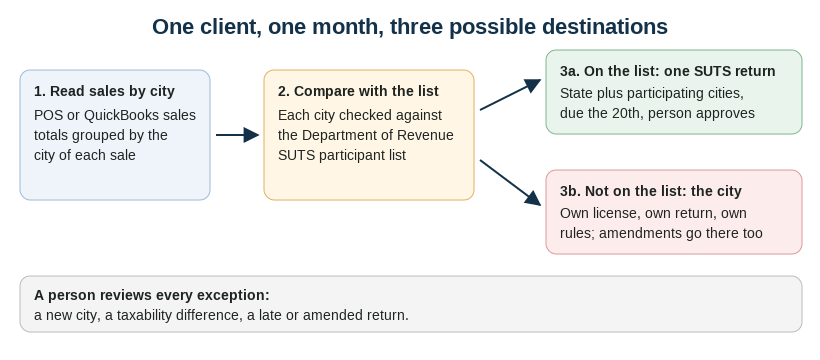
To make this easier the state runs the Sales and Use Tax System, SUTS. It files the state, state-collected and “participating home-rule self-collecting” jurisdictions in one place. Cities that are not in it still need their own license and return.
| Situation | What the state says | Source |
|---|---|---|
| City participates in SUTS | Filed on the combined return; the city must follow the business’s state filing frequency | SUTS FAQ |
| City does not participate | Contact the city directly; the city sets its own rules | Local government sales tax |
| Amended return, participating city | SUTS does not support it; contact the city directly | SUTS FAQ |
| Late return, penalty waiver | SUTS calculates penalty and interest; ask the city directly for a waiver | SUTS FAQ |
| Monthly return due date | The 20th of the following month; next business day if it falls on a weekend or holiday | DR 0100 instructions |
| Local license | SUTS does not require one before filing, but local rules vary and you check | SUTS FAQ |
In short: the portal combines the easy cases, and everything unusual, such as a new city, an amended return or a waiver, goes back to the city.
How many Colorado cities are in SUTS?
It depends on the source and the date: we found 60 on the state’s list, about 40 in a 2024 article, and about 72 self-collecting cities in a QuickBooks page.
- State list: the SUTS jurisdictions page marks 60 municipalities with an asterisk as participants, plus two marked
coming soon effective 01/01/2026
. That count is ours, from reading the page. The page does not say how many do not participate. - TaxJar, November 2024: its SUTS article says SUTS files for
approximately 40 of Colorado’s 70+ home rule cities.
The list has simply grown since. - QuickBooks: its Colorado calculator page says about 72 municipalities, plus Denver and Broomfield counties, administer their own sales tax. That counts all self-collecting cities, not only SUTS ones.
- Denver itself: on our reading of the state list, Denver’s sales tax status was not clear. One third-party guide says Denver participates. Ask the Department or check the live list before you rely on either.
The lesson for a firm: no fixed number is safe to hardcode. The list changes, so a check must read the current list each month.
How much time does checking cities by hand cost a Denver bookkeeping firm?
On our assumptions, a firm with 60 retail clients spends about 9 hours a month on city checks and extra city returns, roughly 108 hours a year.
| Retail clients | Also file with a non-SUTS city | Hours a month | Hours a year | Cost a year at $51.74 an hour |
|---|---|---|---|---|
| 25 | 5 | 3.75 | 45 | $2,328 |
| 60 | 12 | 9.0 | 108 | $5,588 |
| 120 | 30 | 19.5 | 234 | $12,107 |
Assumptions: 6 minutes per client per month to check each city’s sales against the current list, and 15 minutes for each extra city return. The rate is the Denver mean accountant wage from BLS, which is high for bookkeepers. These are our own estimates, not a vendor figure; time one month and replace them.
How can a Denver firm automate Colorado sales tax checks?
A small program reads each client’s sales by city, compares every city with the state’s list, and drafts the work for a person to approve.
Here’s the quiet win: when the list of cities is checked the same way every month, the surprise notice stops being a surprise.
- Read. At month end it pulls sales totals by city from the client’s point-of-sale system or accounting file.
- Compare. Each city is checked against the current SUTS jurisdictions list. A city that is new this month, or not on the list, is flagged.
- Draft. Listed cities become the lines of one SUTS return; the totals must match the books before it moves on.
- Route. Unlisted cities go to a short task for the city’s own return, with the due date.
- Remind. The client gets one message with only the open items, as in our guide to monthly client check-ins.
What do QuickBooks, TaxJar and SUTS cover, and what do they leave?
They cover calculation and the state’s part of filing well; Colorado’s non-participating cities and amendments remain a manual step.
- QuickBooks Online: calculates tax from the ship-to address. Its Colorado page says home-rule city taxes are filed with the city or through SUTS where the city takes part. Community threads show users still adding missing local jurisdictions by hand.
- TaxJar: its 2024 article says it supports state-administered filings in Colorado and that customers
must file returns for home rule jurisdictions manually.
Check its current page before relying on that. - SUTS: free from the state, with an XML bulk filing option
for third-party companies that opt to file and pay sales taxes on behalf of multiple businesses,
per the SUTS FAQ. - Your practice software: a task in Karbon or a similar tool carries the review step; see Karbon workflow automation.
For the same reason, automated categorizing helps only if the city is right on the sale. See QuickBooks receipt categorization for the matching step, and bookkeeping firm workflow automation for how the month fits together.
What stays with your team and the city?
Every filing decision stays with a person, and every city exception stays with the city.
- Approval: a person signs off the return before it is filed and paid.
- Taxability: home-rule cities can tax different goods and services, so a rule difference is a judgment call.
- Amended, late and waiver requests: the state says to contact the city directly.
- Bad data: if a point-of-sale system records the wrong city, the draft is wrong. A balance check against the books catches totals, not the city.
What does a sensible first month look like?
Start with five retail clients in more than one city and let the program only draft.
- Week 1: list each client’s cities and mark the ones missing from the SUTS list.
- Week 2: the program reads last month’s sales by city and your team compares its draft with what was filed.
- Week 3: fix the mismatches and add the cities to each client’s onboarding sheet.
- Week 4: run the current month; count minutes saved and cities caught.
If it does not save real time on your own clients, it is not worth keeping.
How we researched this
- Read on November 29, 2026: the BLS Denver occupational release (August 5, 2026), the Census Vintage 2024 metro population table, the Colorado Department of Revenue pages on local government sales tax, SUTS, SUTS jurisdictions and the SUTS FAQ, the DR 0100 instructions, TaxJar’s SUTS article and QuickBooks’ Colorado page.
- Compared: accountant concentration across the BLS metro releases we found, and the three different counts of Colorado cities.
- Our own calculations: one-year and four-year metro growth, and the time-cost table, with assumptions stated.
- Not done: no hands-on testing of any product, no interviews. A search for r/Accounting and r/Bookkeeping threads on Colorado sales tax returned none we could use.
- Limits: our automated reader could not clearly show Denver’s SUTS status or a list of non-participating cities, and the DR 0100 instructions were read as extracted text. Confirm both on the Department’s live pages.
Pick five multi-city clients, let the draft run beside your own filing for a month, and see which city it caught first.
Sources and further reading
- BLS: Occupational Employment and Wages in Denver-Aurora-Centennial, May 2025 (Aug 5, 2026)
- Census Bureau: Vintage 2024 metro population estimates table
- Colorado Department of Revenue: Local government sales tax
- Colorado Department of Revenue: Sales & Use Tax System (SUTS)
- Colorado Department of Revenue: SUTS participating jurisdictions
- Colorado Department of Revenue: SUTS frequently asked questions
- Colorado Department of Revenue: DR 0100 retail sales tax return instructions
- TaxJar: What you need to know about Colorado’s SUTS
- QuickBooks: Colorado sales tax calculator and local rules
Questions and answers
Can I use AI to automate bookkeeping and sales tax checks for Denver clients?
Yes, for the reading, comparing and drafting. A program can read each client’s sales by city, compare every city with the Colorado SUTS list, draft the combined return and flag cities to file directly. A person still approves every filing and handles amended or waiver requests with the city.
Why is Denver a good place for accounting firm automation?
BLS counts 22,720 accountants and auditors in the Denver metro, a concentration of 1.51 times the national average, at a mean wage of $107,620. Firms compete hard on price and speed, and Colorado’s home-rule sales tax adds repetitive city checks that software can do.
What is SUTS and does it cover every Colorado city?
SUTS is the Colorado Department of Revenue’s Sales and Use Tax System. It files the state, state-collected and participating home-rule jurisdictions together. Cities that do not take part still need their own license and return, so check the live participant list each month.
When are Colorado sales tax returns due?
Monthly returns are due the 20th of the following month, and the next business day if that is a weekend or legal holiday, according to the DR 0100 instructions. Quarterly and annual filers have their own dates, and self-collecting cities may set different ones.
Do QuickBooks or TaxJar file Colorado home-rule city returns for me?
Not fully. QuickBooks says home-rule city taxes are filed with the city or through SUTS where the city takes part, and TaxJar’s 2024 article says customers file home-rule returns manually. Check each vendor’s current page, because both can change.