Commercial HVAC, Plumbing & Electrical Automation in Phoenix
Hello to every Phoenix shop whose phone rings hardest the minute the office closes.
Every Phoenix summer, the same sentence shows up in the news: this one is among the hottest on record.
I spent an afternoon reading the Census Bureau’s growth tables, the National Weather Service’s summer rankings, Arizona’s contractor license rule and the vendors’ own help pages, to see what that means for a commercial HVAC, plumbing or electrical shop’s phone.
The turning points are easy to check. Phoenix set a record with 54 days at 110 degrees or hotter in 2023, 2024 averaged 98.9 degrees for the summer, and 2025 still produced 9 such days in June and 12 in July. In the year to July 2024 the metro added 84,938 residents.
Short answer: In Phoenix, commercial contractors automate by letting an AI voice and text line answer overflow and after-hours calls, ask what is failing, sort emergencies from routine work, and book straight into ServiceTitan or Jobber. Estimate follow-ups and invoice reminders then run on a schedule, so techs stop writing quotes and chasing payments at night.
What does automation look like for a commercial HVAC, plumbing or electrical contractor in Phoenix?
It is two small systems working together: one that catches every call, and one that chases every unpaid piece of paper.
- Intake: a cloud voice line, for example built on Twilio ConversationRelay, answers overflow and after-hours calls, qualifies urgency, books onto your calendar through the API and texts the caller a confirmation.
- Follow-up: estimates get a text and an email on a schedule that stops when the customer says yes, and invoices get reminders with a pay link.
- People: the on-call tech gets a text with the site, the problem and the callback number, and a person still handles safety calls.
Each piece already exists in the software many shops pay for. This guide is about how it fits a Phoenix contractor’s year.
Why do Phoenix summers overload a contractor’s phone?
Because a hot Valley summer stacks no-cooling calls into the same evening hours when your office is closed.
| Year | Average summer temperature (Valley) | Rank |
|---|---|---|
| 2024 | 98.9°F | 1st |
| 2023 | 97.0°F | 2nd |
| 2020 | 96.7°F | 3rd |
| 2025 (through Aug 6) | 95.7°F | 4th so far |
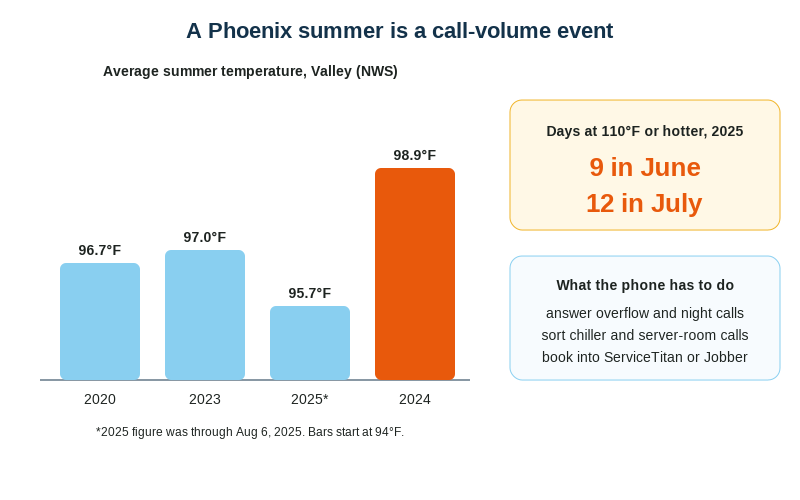
Text version of the chart: 2020 averaged 96.7°F, 2023 97.0°F, 2025 so far 95.7°F and 2024 98.9°F. In 2025, June had nine days at 110°F or higher and July had twelve (azfamily.com, Aug 6, 2025).
National Weather Service meteorologist Mark O’Malley told azfamily: It’s only because of the past couple years have been extremely hot that this summer seems relatively mild.
Heat is also a health matter here. Maricopa County counted 645 heat-related deaths in 2023, 608 in 2024 and a preliminary 427 in 2025, in its March 23, 2026 heat plan release. That is why a dead cooling system at a care facility, a restaurant or an office is not a routine call.
How does Phoenix’s growth add work for commercial contractors?
More people and more buildings mean more systems to install, service and keep running through July.
| Area | Population July 1, 2024 | Gain in one year | Rank among top 10 by numeric growth |
|---|---|---|---|
| Phoenix-Mesa-Chandler metro | 5,186,958 | 84,938 | 6th of the metros |
| Maricopa County | 4,673,096 | 57,471 | 3rd of the counties |
The source is the Census Bureau’s county and metro population release. The metro stood at 4,851,322 at the April 2020 base, so it has added roughly 335,600 people since.
Big commercial projects add to it.
AZBEX reported on January 16, 2026 that Takanock’s Project Baccara near Luke Air Force Base plans two data centers of about a million square feet each, with construction targeted for the third quarter of 2026, and that NTT is reshaping its Mesa campus (AZBEX). Neither article gives a megawatt figure, so we state none.
Not every project will proceed. AZBEX notes residents have started a petition against Baccara. For a service contractor the point is simpler: a bigger installed base of chillers, panels and plumbing means more calls in every future summer.
What do missed emergency calls cost a Phoenix contractor?
At $500 to $5,000 a job, a few missed calls a week add up to tens of thousands of dollars a month in revenue.
| Missed calls a week | Job worth $500 | Job worth $2,500 | Job worth $5,000 |
|---|---|---|---|
| 3 | $3,200 | $16,200 | $32,500 |
| 5 | $5,400 | $27,100 | $54,100 |
| 10 | $10,800 | $54,100 | $108,200 |
Assumptions: 4.33 weeks a month, and half of the callers would have booked had someone answered. Those are our round numbers, not measured Phoenix data. The table shows revenue, not profit, so use your own margin and close rate.
ServiceTitan’s own data suggests the evening matters. In its 2025 numbers, 14.1 percent of inbound residential HVAC calls came outside business hours in June, against 9.8 percent in October, concentrated between 5 p.m. and 9 p.m. ServiceTitan adds that Off-hours calls also tend to be high-intent moments.
The data is national, not Phoenix, and ServiceTitan says it is not nationally representative (State of the Trades, June 3, 2026).
How does AI intake turn a 9 p.m. call into a booked job?
It follows the steps your best dispatcher follows, and writes each one down in your software.
- Ring over. After four rings or after hours, your number forwards to the cloud line.
- Answer and identify. The agent greets the caller as an automated assistant, matches the phone number to a customer and site on file, or asks for the site address.
- Qualify. It asks what is failing, since when, whether anyone is at risk, and who can give access.
- Sort. Your rules decide: emergency now, or the first open slot tomorrow.
- Book. It reads open shifts and arrival windows and creates the job through the ServiceTitan API or Jobber’s API.
- Tell people. The caller gets a confirmation text and the on-call tech gets the summary.
ServiceTitan also sells this natively: its AI Voice Agent books new jobs for residential companies, and Jobber’s Receptionist does the same inside Jobber. A custom Twilio line fits when you want commercial-specific questions. The full walk-through is in our HVAC answering service guide.
Which commercial calls should wake the on-call tech?
Only the ones where waiting until morning costs more than the overtime, and you write that list yourself.
| Trade | Wake the on-call tech | Book first slot tomorrow |
|---|---|---|
| HVAC | Rooftop or chiller down in an occupied building, server room cooling lost, walk-in cooler failing | Warm but working, noisy unit, thermostat questions |
| Plumbing | Active leak or burst line, sewage backup, no water to a restaurant or clinic | Slow drain, dripping faucet, fixture replacement |
| Electrical | Burning smell, sparking, whole-building outage, tripped main | One dead outlet, lighting upgrade, panel quote |
One line for the whole table: a failure that stops a tenant from operating or puts someone at risk wakes a person, and everything else gets a real slot and a text. Gas smells, carbon monoxide alarms and fire go to the gas utility or 911 first, then a person.
The routing side is covered in automated emergency dispatch call routing, and the plumber’s and electrician’s versions in 24/7 plumbing call answering software and AI receptionist for electrical contractors.
Why does an Arizona license class matter to an intake line?
Because Arizona splits work by trade license, and an intake line that books the wrong trade creates a job you cannot legally send anyone to.
Here’s the kind truth about a 115-degree evening: the caller isn’t trying to be difficult, they just want to hear that someone is coming. A clear time and a text is most of what they need.
Under Arizona rule R4-9-104, the dual classifications CR-11 (electrical), CR-37 (plumbing) and CR-39 (air conditioning and refrigeration) each allow the scopes of work of the matching commercial C-class and residential R-class licenses.
So a shop that holds CR-39 can book a rooftop unit but not a panel upgrade. Give the intake agent a short list of the trades you are licensed for, and let it route anything else to a person or politely decline.
How do estimate follow-ups and invoice reminders finish the job?
They take over the evening work your technicians do in their trucks, writing quotes and chasing money.
- Estimates: once the tech sends a quote, a text goes out the next day and an email on day three, and the sequence stops when the customer approves or declines. See how to automate HVAC estimate follow-up.
- Invoices: a reminder with a pay link goes out on the due date and again later, and stops when paid. See Jobber automated invoice reminders.
- Your people: a facility manager who is slow to approve gets a phone call from you, not a fifth text.
What does nobody publish about Phoenix call volume?
We could find no public data on how many calls Phoenix contractors miss, or how many arrive after hours in the Valley.
The ServiceTitan figures above are national and residential HVAC, and the missed-call table is our arithmetic. Phoenix answering-service vendors quote their own anecdotes, which we leave out. Count your own: pull last July’s call log, mark each unanswered call and its time, and use those numbers instead.
What can go wrong with automated intake?
- Texts that never arrive. Twilio says US text senders on 10-digit numbers
must register for A2P 10DLC.
Register before launch (Twilio’s guide). - Wrong trade booked. Limit the job types the agent may create.
- A caller who needs a human. Offer a person on request, and always for safety calls.
- Quiet failures. Forwarding breaks unnoticed, so compare calls answered with jobs booked every morning.
The honest limit: the agent books and informs, a person judges.
How do you start before the next heat wave?
- Day 1: write your triage table and list the trades you are licensed for.
- Days 2 and 3: forward only after-hours calls to the line, with a person confirming each booking.
- Days 4 to 6: read every call summary and fix any question it asked badly.
- Day 7: count answered calls, booked jobs and techs woken, then add daytime overflow.
How we researched this
- Read November 29, 2026: the Census Bureau’s Vintage 2024 county and metro release, azfamily.com’s report of the National Weather Service summer rankings, Maricopa County’s March 23, 2026 heat release, AZBEX’s January 16, 2026 data center article, Arizona rule R4-9-104, ServiceTitan’s State of the Trades page, and the ServiceTitan, Jobber and Twilio help pages.
- Compared: growth, heat and license facts per source, and what each says about call volume.
- Calculated ourselves: the missed-call table (assumptions stated beside it).
- Not done: no hands-on testing, no Phoenix contractor interviews, no Reddit threads quoted (our tools returned none), and no Bureau of Labor Statistics wage figures, because we could not open the official table.
Forward one week of after-hours calls before the next heat wave, read every summary the next morning, and let the board fill itself.
Sources and further reading
- U.S. Census Bureau: county and metro population estimates, Vintage 2024
- azfamily.com: Phoenix sees 4th hottest summer on record so far in 2025 (National Weather Service figures)
- Maricopa County: 2026 heat plan and heat-related death counts
- AZBEX: 2 data center projects advancing in metro Phoenix
- Arizona Administrative Code R4-9-104: dual contractor license classifications
- ServiceTitan State of the Trades: HVAC off-hours summer call spike
- ServiceTitan Help: AI Voice Agent FAQ
- ServiceTitan developer platform
- Jobber Help: Receptionist powered by Jobber AI
- Jobber Developer Center
- Twilio Docs: ConversationRelay
- Twilio Docs: A2P 10DLC registration
Questions and answers
Can I use AI to automate my commercial HVAC, plumbing or electrical business in Phoenix?
Yes, for the repeatable office work. An AI voice and text line can answer after-hours calls, sort emergencies, book into ServiceTitan or Jobber, and send estimate and invoice follow-ups. Keep a person on safety calls, upset callers and complex commercial accounts.
Why is Phoenix different from other cities for contractor phone calls?
Summer heat concentrates no-cooling calls into evenings. The National Weather Service ranked summer 2025 as the Phoenix area’s 4th hottest so far, with 9 days at 110°F or higher in June and 12 in July, after 2024 averaged 98.9°F.
Will an AI line book into ServiceTitan or Jobber directly?
Yes. ServiceTitan’s AI Voice Agent and Jobber’s Receptionist book inside their own products, and a custom line can create jobs through each company’s API once shifts, arrival windows and job types are set up.
Does an Arizona contractor license affect what an AI intake line can book?
It should. Dual classes such as CR-11, CR-37 and CR-39 each cover the matching commercial and residential scope, so the agent should only book trades you hold a license for and send other work to a person.
How much revenue could missed calls cost a Phoenix contractor?
Our calculation, not measured data: three missed calls a week at $500 jobs is about $3,200 a month, and ten a week at $5,000 jobs is about $108,200, assuming half of callers would have booked. Use your own call log to replace the assumptions.