
Law Firm Automation in Phoenix, Arizona (2026): Crash Files, Immigration, Ethics
Phoenix has been outgrowing its own paperwork since the 1950 census put it in the country’s top 100.
Phoenix has been outgrowing its own paperwork for as long as it has been counted.
You probably won’t find this in a law-firm blog, but Boston University’s table of Phoenix census counts lists 65,414 people in 1940 and 106,818 in 1950, the year the city first made the country’s top 100.
On November 29, 2026 I read that beside the Census Bureau’s 2024 county estimates, ADOT’s 2025 crash release and TRAC’s September 2026 report, instead of the blogs that quote each other.
Three numbers stood out. Maricopa County added 57,471 people in one year, Arizona logged 1,156 road deaths in 2025, and the average Arizona immigration case now runs 681 days.
Short answer: Phoenix boutique law firms can automate the first pass through case paperwork. Paralegals upload scanned PDFs to a secure portal, a server reads them with OCR and AI vision, then builds a cited timeline or checklist and drafts a summary. A paralegal checks every flag, and an attorney signs off.
Why does Maricopa County add so many new clients each year?
Because it is one of the fastest growing counties in the country by headcount: third in the nation in the year to July 2024, and fourth most populous. More residents means more crashes, more immigration filings and more estates.
The Census Bureau’s Vintage 2024 release puts the Phoenix-Mesa-Chandler metro at 5,186,958 people on July 1, 2024, up 84,938, sixth among metros. Maricopa County reached 4,673,096, up 57,471.
| Area | Population, July 1, 2024 | Added in one year | National rank by numeric growth |
|---|---|---|---|
| Phoenix-Mesa-Chandler metro | 5,186,958 | 84,938 | 6th among metros |
| Maricopa County | 4,673,096 | 57,471 | 3rd among counties |
In one line: the metro added about 232 residents a day (84,938 divided by 366 days), and the county about 157. Houston’s county added more, as our Houston guide shows, but Phoenix is the third-largest county gain.
What do Arizona’s road deaths mean for a Phoenix personal injury records room?
They mean thick files. ADOT counted 1,156 traffic deaths and 118,052 crashes on Arizona roads in 2025, and every serious crash leaves police reports, EMS notes, hospital charts and bills for a paralegal to put in order.
ADOT’s August 27, 2026 release says deaths fell 5.2% from 2024, the third straight yearly decline, and crashes fell 4.4% from 123,535. KTAR’s report carries the same totals. Falling is still 118,052 crashes.
We could not open ADOT’s county table for 2025, so we give no Maricopa-only death count. A search summary of ADOT’s dashboard says about 83,877 of 117,932 reported crashes were in Maricopa County, roughly 71%. Treat that as a pointer, not a quote.
The pain is rarely the crash. It is the 1,000 pages after it, as medical chronology software for personal injury explains, and the demand that has to follow, covered in how to automate demand letter drafting.
Why does Arizona’s 681-day immigration timeline matter to a document file?
Because the longer a case runs, the more of the file goes stale. A client’s address, job, marriage, children and travel papers can all change in 22 months, and every change means a recheck.
TRAC report 780, published September 11, 2026, gives Arizona’s average days from Notice to Appear to a removal order. It rose from 300 in July 2024 to 448 in July 2025 and 681 in July 2026.
| July | Arizona | United States | Arizona as a share of U.S. |
|---|---|---|---|
| 2024 | 300 | 597 | 50% |
| 2025 | 448 | 676 | 66% |
| 2026 | 681 | 901 | 76% |
Arizona’s average is still shorter than the national one, but it more than doubled (681 divided by 300 is 2.27) in two years. The same report says the average pending case nationally had waited 940 days.
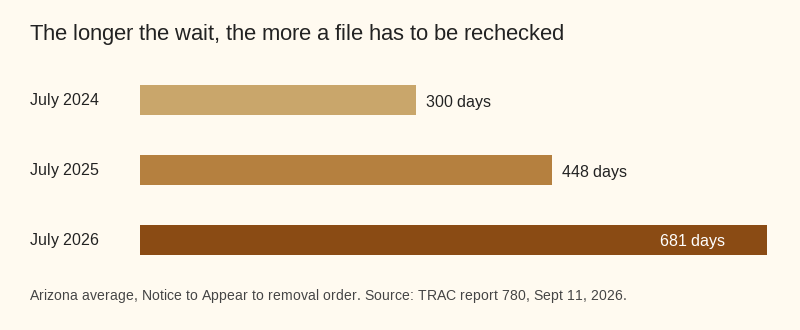
The bars’ text: 300 days in July 2024, 448 in July 2025, 681 in July 2026. A checklist reader earns its place here. Our guide to immigration law document checklist automation shows how each upload is read against the case checklist, so an expired passport or a missing translation is flagged the day it arrives.
How many immigration cases are pending in Phoenix right now?
We could not find a current Phoenix court figure. The numbers we found are old, and the 2026 TRAC reports we read give national totals and Arizona wait times, not a Phoenix count.
| Source | Phoenix figure | Caveat |
|---|---|---|
| TRAC, January 2021 snapshot | 12,209 pending, average wait 1,487 days | Five years old; found through a search summary |
| An undated article citing TRAC | nearly 10,000 for four judges, 882 days | No date we could verify |
| TRAC report 780, September 2026 | no Phoenix figure | Gives Arizona wait times and a national backlog over 3 million |
In short: do not quote a Phoenix backlog to a client from memory. TRAC’s immigration court backlog tool is where the current court-level count lives.
How does one upload portal serve a Phoenix injury and immigration practice?
Both practices share the same first steps: a paralegal uploads scanned PDFs to a secure portal, your server reads every page with OCR and AI vision, and the output is a cited timeline or checklist with flags for doubtful pages.
The kindest thing a cited first pass does for a Phoenix paralegal is give back the first day of a file, so the judgment stays with the people trained for it.
- Personal injury: a dated chronology with page cites, then a first-draft demand for an attorney to read.
- Immigration: a checklist showing what arrived, what is missing and what looks expired, rechecked each time a long-waiting file is reopened.
- Estate: a sorted index of deeds, wills and statements, plus draft-ready answers. See how to automate estate planning client questionnaires. We found no current Maricopa probate counts, so we make no claim about that docket’s size.
The sorting step is described in legal document indexing and summarization tool. A 24/7 phone intake line can send a new caller the secure link before they hang up.
What does the State Bar of Arizona say about using AI on client files?
It says lawyers may use AI but must protect confidential data and bill honestly. Arizona has no numbered ethics opinion on generative AI as of 2026; it has guidance instead.
The State Bar’s billing guidelines for using AI say lawyers may bill actual time spent using, supervising and verifying AI, may not bill time AI saved, and may not bill for learning general AI tools.
Never put confidential client information into free, public AI tools.
The same page calls disclosing AI use and getting informed consent the best practice. Separately, the Arizona Supreme Court’s AI steering committee published Generative AI: Ethical Best Practices for Lawyers and Judges
on November 14, 2024; we could not open its text, so we cite only its title and date.
What still needs a Phoenix paralegal and attorney?
A person still decides what a page means, signs off on every output and handles anything the reader marked as doubtful.
- Doubtful pages: a blurry fax, a handwritten chart note, a document in Spanish.
- Dates that disagree: a date of service that falls before the date of the crash.
- Legal judgment: which treatment links to the injury and which document satisfies the checklist.
- The draft: every demand, summary and letter is a first draft for an attorney to read.
Everything before those four checks can run without a person. The BLS lists paralegal pay nationally, so use your own payroll to price the hours you free.
How should a Phoenix boutique firm start?
Start with one practice area and one real packet you already finished by hand, run it through the pipeline, and compare the two line by line before trusting it on a live file.
- Week 1: pick one closed file and write down hours spent and pages read.
- Week 2: upload the same file and read the cited output next to your own.
- Week 3: note every miss and every catch, and set which pages go to a person.
- Week 4: run one live packet with a paralegal checking the flags, and count the minutes.
Put the two Arizona facts together and a pattern appears: Arizona’s immigration cases now last 2.27 times longer than two years ago, so an immigration file in Phoenix gets reopened and rechecked more often. That makes a reader that re-flags stale documents on every reopening worth more there than one that only sorts a new upload once.
How we researched this
- Read the Census Bureau’s Vintage 2024 county and metro release, TRAC report 780, ADOT’s 2025 crash release (through KTAR and search summaries; ADOT’s own page refused our reader) and the State Bar of Arizona’s AI billing page on November 29, 2026.
- The Boston University population table is a secondary source for the 1940 and 1950 counts. ADOT’s county crash tables, the Supreme Court committee PDF and the State Bar’s main AI guidance page could not be opened, so we cite only what we read.
- Phoenix immigration court counts and Maricopa probate counts were not found for 2026, and we say so rather than estimate. Our Reddit searches returned no usable threads. We did not test any tool or set up any system for this article.
Try one closed Phoenix file through the pipeline beside your team, and see which pages it sorts and which it sends to a person.
Sources and further reading
- U.S. Census Bureau: Vintage 2024 county and metro population estimates
- ADOT: traffic fatalities on Arizona roads decline for third year in a row (August 27, 2026)
- KTAR: traffic fatalities fell in 2025, but Arizona situation still dire
- TRAC: rising completion times in immigration court (report 780, September 11, 2026)
- State Bar of Arizona: billing guidelines for using AI
- Boston University: Phoenix population history (census counts 1940 and 1950)
- U.S. Bureau of Labor Statistics: Paralegals and Legal Assistants
Questions and answers
Can I use AI to automate a boutique law firm’s case paperwork in Phoenix, Arizona?
Yes. A secure portal can take scanned PDFs, a server can read them with OCR and AI vision, and the output can be a cited timeline or checklist with draft summaries. The State Bar of Arizona says never to put confidential client information into free public AI tools, so use a vendor with a data contract and have a person review every result.
Why is Phoenix a good market for personal injury and immigration firms?
The Census Bureau counted 84,938 new residents in the Phoenix metro and 57,471 in Maricopa County in the year to July 2024, the third-largest county gain in the country. Arizona had 118,052 crashes and 1,156 road deaths in 2025, and immigration cases there now average 681 days.
How long do immigration cases take in Arizona?
TRAC report 780 puts Arizona’s average at 681 days from Notice to Appear to a removal order in July 2026, up from 448 in July 2025 and 300 in July 2024. The U.S. average was 901 days. These are averages for removal orders, not a promise for any one case.
Can Arizona lawyers bill clients for time AI saved?
No. The State Bar of Arizona’s billing guidance says lawyers may bill actual time spent using, supervising and verifying AI, but not time that AI saved and not time spent learning general AI tools. It also calls informed-consent disclosure the best practice.
How many immigration cases are pending in the Phoenix immigration court?
We could not confirm a current figure. TRAC’s January 2021 snapshot listed 12,209 for Phoenix, and the 2026 TRAC reports we read give only national totals and Arizona wait times. Check TRAC’s immigration court backlog tool for the current court-level count.