
AI Translation Is What Older Adults Want Most: The Best Ways to Use It in 2026
Disclosure: this page contains Amazon affiliate links. As an Amazon Associate we earn from qualifying purchases, at no extra cost to you.
Hello there, family bridge-builder — pull up a chair at the big table, because AI translation finally got good enough to help Grandma and the grandkids actually chat, and I’ve sorted out which app fits which moment (and the one moment where no app should be in charge)! Translation is the AI job older adults are most interested in, and 2026 is the year it moved from typing phrases into a phone to real-time conversations in headphones and on phone calls. If you’d rather have a gadget that does only this, two-way pocket translator devices on Amazon are another way in.
Short answer: The best way for older adults to use AI translation in 2026 is to match the tool to the moment: Google Translate’s live translate or AirPods Live Translation at the table, Apple or Samsung live translation on calls, a chatbot for letters — and a free human interpreter for anything medical, legal or about money.
The six facts that sum up AI translation for families in November 2026:
- 74% of adults surveyed by AARP Research are interested in AI-powered translation — the top job on its list (January 13, 2026).
- 56.3% of Americans 65+ who speak another language at home speak English less than “very well”, against 24.1% of children 5-17 (our sums of the Census Bureau’s 2024 American Community Survey).
- 70+ languages: Google’s Gemini 3.5 Live Translate, announced June 9, 2026, is rolling out in the Google Translate app on Android and iOS and works with any headphones.
- 24 languages for Samsung Galaxy AI’s Live Translate on calls since October 14, 2026; Apple’s Live Translation covers 15 languages in Messages and 9 in Phone, FaceTime and AirPods.
- Accuracy is uneven: in a UCSF study, 16% of ChatGPT-4’s and 24% of Google Translate’s Spanish instruction sets had at least one error — and 56% and 66% in Russian.
- Free by law: health programs covered by the federal rule 45 CFR 92.201 must offer a qualified interpreter at no cost, and machine-translated critical text must be checked by a qualified human translator.
Why is translation the AI job older adults want most?
Translation tops older adults’ AI wish list because it solves a daily, practical problem: talking with family, neighbors, doctors and shop staff across a language barrier. In AARP Research’s January 2026 survey, 74% were interested in AI-powered translation services, ahead of home monitoring at 71%.
AARP Research’s Older Adults Want AI to Show Up in Practical Ways
(Brittne Kakulla, published January 13, 2026) surveyed 1,661 adults, including 1,148 people over age 50, from January 8 to 20, 2025. Its headline finding reads plainly: a solid 74% have an interest in AI-powered translation services
. By comparison, just 34% were interested in AI for pet care and 36% in driving assistance.
The gap between wanting it and using it is still wide. Pew Research Center’s How opinions and use of AI differ by age
(June 17, 2026) found that 23% of adults 65 and older use AI chatbots, against 49% of all U.S. adults. Translation is a good first reason to try: the result is easy to check with a bilingual relative, and the payoff — a real conversation — is immediate.
How big is the language gap between grandparents and grandchildren?
The language gap is large: among people in the U.S. who speak a language other than English at home, 56.3% of those 65 and older speak English less than “very well”, compared with 39.2% of adults 18-64 and 24.1% of children 5-17. In many families, the grandchild is fluent in English and the grandparent is not.
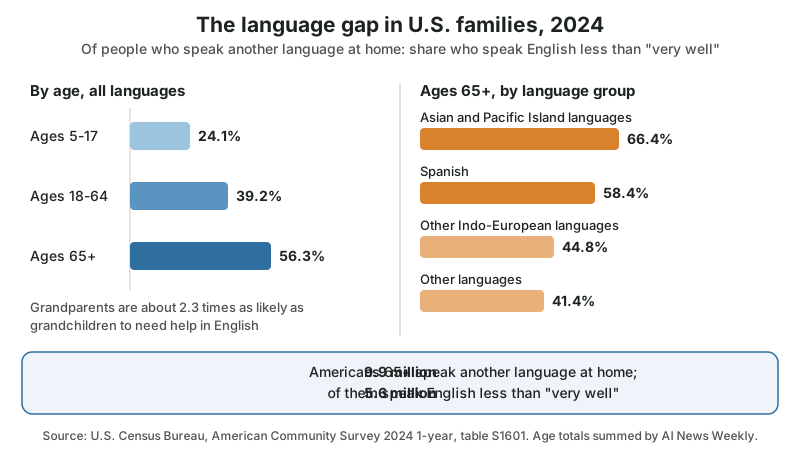
The chart as text — share of people who speak another language at home who speak English less than “very well” (U.S. Census Bureau, American Community Survey 2024 1-year, table S1601): ages 5-17, 24.1% (2,893,239 of 12,028,981); ages 18-64, 39.2% (20,460,146 of 52,130,195); ages 65+, 56.3% (5,565,363 of 9,891,657). Ages 65+ by language group: Asian and Pacific Island languages 66.4%, Spanish 58.4%, other Indo-European languages 44.8%, other languages 41.4%.
We added up the table’s four language groups for each age band ourselves; the Census Bureau publishes the language groups, not the age totals. Across all ages, 74,050,833 people 5 and older spoke a language other than English at home in 2024, and 28,918,748 of them (39.1%) spoke English less than “very well” — the source is the ACS 2024 table S1601 on data.census.gov.
What changed in AI translation in 2025 and 2026?
AI translation went from text to live speech: since mid-2025, ChatGPT’s voice mode keeps interpreting until told to stop, Apple added Live Translation to calls and AirPods, Google turned any headphones into a live translator with Gemini, and Samsung grew Galaxy AI’s call translation to 24 languages.
- — ChatGPT voice. TechCrunch (Kyle Wiggers, June 9, 2025) reported that after the weekend update, if you
ask ChatGPT to interpret, and it will continue translating the conversation until you tell it to stop or switch to another language
, at first for paid users. - — Apple Live Translation. Apple’s Newsroom announced Live Translation in Messages, FaceTime and Phone and with AirPods, with
on-device processing, so personal conversations stay personal
. - — Gemini in Google Translate. Google’s Rose Yao announced Gemini text translation for idioms and slang and a beta of live speech-to-speech translation with any headphones, in 70+ languages, on Android in the U.S., Mexico and India.
- — iOS and 12 countries. TechCrunch (Aisha Malik, March 26, 2026) reported the headphone feature reaching iOS and 12 countries; Google suggested using it to follow
dinnertime conversations with relatives who speak another language
. - — Gemini 3.5 Live Translate. Google’s announcement (Anuda Weerasinghe and Tony Lu) brought near real-time speech-to-speech translation in 70+ languages to Google Translate on Android and iOS.
- — Samsung reaches 24 languages. Samsung Newsroom added Hungarian and Malay to Call Assist, Interpreter and Live Translate,
bringing features such as Live Translate to 24 languages
.
Google describes the June 2026 model this way: It delivers fluid audio without awkward pauses and stays just a few seconds behind the speaker throughout the session.
Google also says All audio generated by our models is watermarked with SynthID
, its marker for AI-made content. A few seconds’ lag is fine for a story at dinner and awkward for a quick back-and-forth, so it helps to speak in short sentences.
Which AI translation tool fits which family moment?
The right AI translation tool depends on where you are and what’s at stake: a phone app or AirPods in person, built-in call translation on an iPhone or Samsung Galaxy phone, a chatbot for a letter, and a qualified human interpreter for a doctor, pharmacist, lawyer or bank.
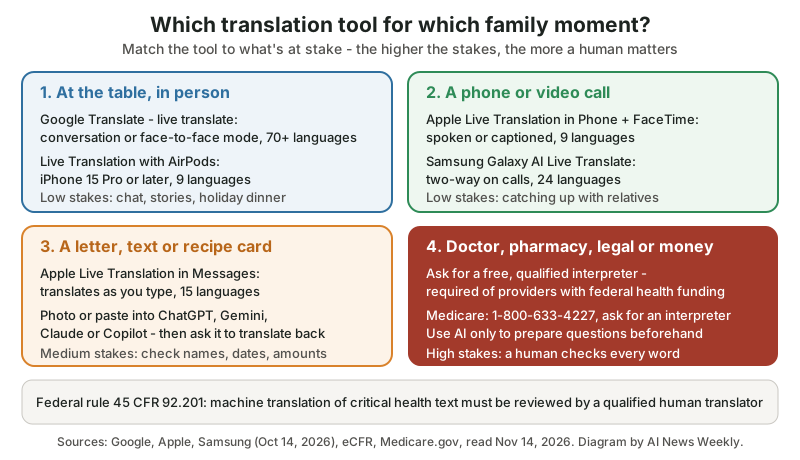
The diagram as text — 1. At the table, in person (low stakes): Google Translate live translate, conversation or face-to-face mode, 70+ languages; or Live Translation with AirPods, iPhone 15 Pro or later, 9 languages. 2. A phone or video call (low stakes): Apple Live Translation in Phone and FaceTime, 9 languages; or Samsung Galaxy AI Live Translate, 24 languages. 3. A letter, text or recipe card (medium stakes): Apple Live Translation in Messages, 15 languages; or a photo or paste into ChatGPT, Gemini, Claude or Copilot, then ask it to translate back. 4. Doctor, pharmacy, legal or money (high stakes): a free, qualified interpreter; Medicare 1-800-633-4227; AI only to prepare questions beforehand. Federal rule 45 CFR 92.201: machine translation of critical health text must be reviewed by a qualified human translator.
| Tool | Best for | Languages | What you need |
|---|---|---|---|
| Google Translate live translate | In-person talks; listening, conversation, text-only and face-to-face modes | 73 language entries on Google’s list (“70+”) | Translate app on Android or iOS; headphones optional |
| Live Translation with AirPods (Apple) | Hearing a speaker in your language, in person or on a call | 9 | AirPods 4 (ANC), AirPods 5, AirPods Pro 2 or later or AirPods Max 2; iPhone 15 Pro or later; iOS 26 or later; Apple Intelligence on |
| Apple Live Translation in Phone and FaceTime | Calls with relatives: spoken translation on calls, captions on FaceTime | 9 | An Apple Intelligence iPhone; not every region |
| Apple Live Translation in Messages | Texting: translates your reply as you type | 15 | An Apple Intelligence iPhone |
| Samsung Galaxy AI Live Translate and Interpreter | Two-way call translation; face-to-face Interpreter | 24 | A Galaxy phone with Galaxy AI; language packs from Settings |
| ChatGPT voice (OpenAI) | Asking it to interpret a conversation until you say stop | Not listed by us | ChatGPT app; voice features vary by plan (attributed to TechCrunch) |
| Gemini, Claude or Copilot chat | Letters, texts, menus and recipe cards from a photo or pasted text | Not listed by us | Any chat that accepts text or images (our suggestion) |
How do you translate a conversation at the dinner table?
To translate a dinner-table conversation, open the Google Translate app, tap live translate, pick the two languages and choose conversation mode so translations play aloud as people take turns. Google Translate Help says The microphone automatically detects when one language stops and the other language starts
, and face-to-face mode shows each speaker their own language on half the screen. Google says live translate works with any pair of headphones, so a basic pair of wireless earbuds is enough for the listening mode, and a small phone stand keeps the screen where both people can read it.
With an iPhone 15 Pro or later and supported AirPods, Apple’s Live Translation does the listening in your ears. Apple Support’s Use Live Translation with your AirPods
(September 14, 2026) explains that you first download both languages, after which all processing takes place on your iPhone where all of your conversation data remains private
. You start it in the Translate app’s Live tab, by pressing and holding both AirPods stems, or by saying Siri, start Live Translation
; your reply is shown as a transcript or played on the iPhone speaker.
Can AI translate a phone call or video call with a relative?
Yes — on supported phones, AI translates calls as they happen. Apple says that in FaceTime users can follow along with live translated captions while still hearing their friend or family member’s voice
, and on a phone call the translation is spoken out loud in real time
. Samsung’s Galaxy AI Live Translate does two-way voice and text translation on calls in 24 languages.
The relative on the other end doesn’t need the same phone: the translation runs on your device. Check two things first — that your phone model is on the maker’s list, and that your family’s language is too (the next section has the table). Apple’s own Phone and FaceTime list is shorter than its Messages list, and its Spanish for calls is Spanish (Spain).
How do you translate a letter, a text or a recipe card with AI?
To translate a letter, text or handwritten recipe card, photograph it or paste the words into ChatGPT, Gemini, Claude or Copilot and ask for a plain translation — then ask it to translate its English back and list any words it wasn’t sure of. On an iPhone, Apple’s Live Translation in Messages also translates your reply as you type, in 15 languages.
Handwriting, old spellings and regional dialects are where a chatbot is most likely to guess. A grandmother’s recipe card written in Tagalog shorthand, or a letter in Haitian Creole, is worth a second reading by a bilingual relative before anyone relies on it — and anything about money, a contract or a medicine belongs with a human translator.
Does AI translation cover your family’s language?
For the most common family languages in the U.S., mostly yes: Google Translate’s live translate and Samsung Galaxy AI each cover 10 of the 11 most-spoken non-English languages, Apple’s Messages covers 6 and Apple’s call translation 5. Haitian Creole, spoken at home by over a million people, is on none of the four lists.
| Language at home | Speakers 5+ (2024) | English less than “very well” | Google Translate live | Samsung Galaxy AI | Apple Messages | Apple calls and AirPods |
|---|---|---|---|---|---|---|
| Spanish | 44,867,699 | 41.1% | Yes | Yes | Yes | Yes (Spain) |
| Chinese (incl. Mandarin, Cantonese) | 3,734,956 | 50.7% | Yes | Yes | Yes | Yes (Mandarin) |
| Tagalog (incl. Filipino) | 1,921,526 | 30.4% | Yes | Yes | No | No |
| Vietnamese | 1,599,409 | 57.4% | Yes | Yes | Yes | No |
| Arabic | 1,484,439 | 34.6% | Yes | Yes | No | No |
| French (incl. Cajun) | 1,276,702 | 21.9% | Yes | Yes | Yes | Yes |
| Korean | 1,150,701 | 49.2% | Yes | Yes | Yes | Yes |
| Portuguese | 1,099,503 | 35.8% | Yes | Yes | Yes | Yes (Brazil) |
| Hindi | 1,059,933 | 16.5% | Yes | Yes | No | No |
| Haitian Creole | 1,041,231 | 43.7% | No | No | No | No |
| Russian | 1,021,165 | 42.0% | Yes | Yes | No | No |
Coverage count (our tally): Google Translate live translate 10 of 11, Samsung Galaxy AI 10 of 11, Apple Live Translation in Messages 6 of 11, Apple Live Translation in Phone, FaceTime and AirPods 5 of 11. Two notes: the Census “Chinese” group includes Cantonese, while the makers’ lists name Chinese or Mandarin, so a Cantonese-speaking grandparent should test it first; and Vietnamese speakers have the highest less than very well
share in the table (57.4%) but aren’t on Apple’s call list. For a language missing from every list, a qualified human interpreter is still the dependable route — and in health care it’s free (see below).
How accurate is AI translation for health instructions?
AI translation is good but uneven for health instructions: studies find it very accurate in Spanish and noticeably weaker in languages such as Russian, Armenian, Farsi and Somali. Even in the best case, a sixth of full instruction sets had at least one error — which is why doctors and the federal rules still call for a human.
Can we pause on the grandkids for a second? Picture a twelve-year-old being asked to explain a doctor’s words about Grandpa’s heart. That’s a lot to carry — and the rules agree it shouldn’t be their job. Let the kid be the one who helps write the questions down. That’s the sweet spot.
The most recent comparison is Evaluation of the accuracy and safety of machine translation of patient-specific discharge instructions
by Kong, Khoong and colleagues at the University of California, San Francisco (BMJ Quality & Safety, February 2026 issue). They ran 50 sets (316 sentences) of real emergency department instructions through ChatGPT-4 and Google Translate into Spanish, Chinese and Russian. Sentence by sentence, both tools were 90% or more accurate in Spanish and Chinese (GPT 97% and 95%; Google Translate 96% and 90%), and less so in Russian (89% and 80%). Potential for harm was 1% or less of sentences and 6% or less of full sets.
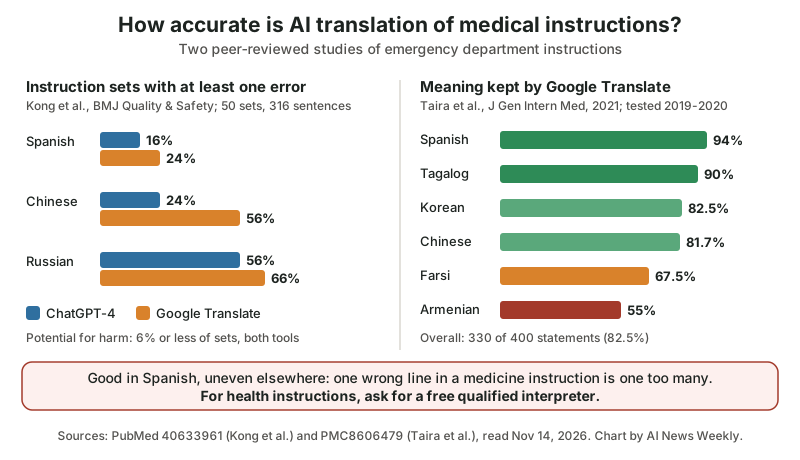
The chart as text — Kong et al., whole instruction sets with at least one inaccuracy: Spanish, ChatGPT-4 16%, Google Translate 24%; Chinese, 24% and 56%; Russian, 56% and 66%. Taira et al. (2021), Google Translate statements whose overall meaning was kept: Spanish 94%, Tagalog 90%, Korean 82.5%, Chinese 81.7%, Farsi 67.5%, Armenian 55%; overall 330 of 400 (82.5%).
The older study, A Pragmatic Assessment of Google Translate for Emergency Department Instructions
by Breena Taira and colleagues (Journal of General Internal Medicine, March 5, 2021), tested Google Translate before its Gemini upgrade and concluded it should not be relied on for patient instructions
. A newer one points the same way for languages with fewer speakers: Martos and colleagues in JAMA Network Open (September 2, 2025) compared Microsoft’s Azure AI translation with professional translators on 148 sections of 34 pediatric discharge instructions. The AI was close to professional quality in Spanish but inferior in Chinese, Vietnamese and Somali, with the greatest differences for Somali
.
Apple’s own support page says the same thing in one line:
Live Translation uses generative models, and outputs may be inaccurate, unexpected, or offensive. Check important information for accuracy.
When should you use a human interpreter instead of AI?
Use a qualified human interpreter for anything medical, legal or financial — diagnoses, medicines, consent forms, benefits, contracts and bank matters — and it is often free. Under the federal rule 45 CFR 92.201, health programs that receive federal funding from the U.S. Department of Health and Human Services must offer language help free of charge.
The rule, 45 CFR 92.201 on eCFR, says language assistance must be provided free of charge, be accurate and timely, and protect the privacy and the independent decision-making ability
of the person. It covers AI directly: if a covered provider uses machine translation for text that is critical to a person’s rights or benefits, when accuracy is essential
, or for complex or technical language, the translation must be reviewed by a qualified human translator
. A provider also can’t require you to bring or pay for your own interpreter.
For Medicare questions, Medicare.gov’s Get Medicare information in other languages
page says: Call 1-800-MEDICARE (1-800-633-4227) and ask for an interpreter, 24 hours a day, 7 days a week (except some federal holidays).
TTY users can call 1-877-486-2048, and Medicare Summary Notices and the Medicare & You handbook can be set to Spanish in your Medicare account.
Should a grandchild interpret at the doctor’s office?
No — under 45 CFR 92.201, a covered health provider must not rely on a minor child to interpret, except briefly in an emergency while a qualified interpreter is found. Adult relatives can help only if the patient asks for it privately, with a qualified interpreter present, and the request is documented.
It’s kinder to everyone. A teenager shouldn’t have to explain a grandparent’s diagnosis, and a grandparent may not say everything in front of a grandchild. The grandchild’s job can be the one AI does well: helping Grandma write her questions down in both languages before the visit.
How do you ask ChatGPT, Gemini, Claude or Copilot to translate well?
Ask an AI chatbot to translate well by naming both languages and the reader, telling it to keep names, dates, amounts and medicine names exactly as written, and asking it to translate its answer back and flag uncertain words. The back-translation is your built-in check: if the meaning drifts, the first translation probably did too.
Our own prompt for a letter or a text from family:
Please translate this message from Vietnamese into
plain, simple English for my mother, who is 78.
- Keep names, dates, places and amounts exactly
  as written.
- If a word is unclear or could mean two things,
  list it at the end instead of guessing.
- Then translate your English back into Vietnamese
  so a family member can check it matches.
[paste the message, or attach a photo]
And our prompt for getting ready for an appointment with a human interpreter:
My father speaks Spanish and has a doctor's
appointment on Tuesday. Help me write 5 short
questions he wants to ask about his new blood
pressure medicine, in Spanish and English side
by side. Use simple words. Don't give medical
advice - we'll ask the doctor and the interpreter.
Four habits help in any app: speak in short sentences, one person at a time; avoid idioms and jokes when it matters; repeat numbers back (“that’s fifteen, one-five?”); and when the translation sounds strange, rephrase rather than repeat louder.
What shouldn’t you share with a translation app?
Don’t paste or photograph anything a stranger could use to impersonate your family: Social Security, Medicare and bank account numbers, full dates of birth, passwords and the answers to security questions. Cover those numbers before you photograph a letter, and keep sensitive conversations to tools that process on the device or to a human interpreter.
- Fine to translate with AI
- Family chat, stories, recipes, menus, signs, greeting cards, everyday texts
- Cover first
- Account numbers, Social Security and Medicare numbers, addresses and dates of birth on any letter you photograph
- Human interpreter or translator
- Diagnoses, medicine instructions, consent forms, benefits letters, contracts, court papers, bank and money matters
- On-device processing
- Apple says Live Translation with AirPods runs on the iPhone once languages are downloaded
Part 5 of this series covers what to cover before you ask AI about a Medicare letter or bill, and part 3 which health questions belong with a doctor. For a step-by-step version with one assistant, our sister site How To With Claude AI is publishing a matching seniors series with screens and prompts for Claude.
What are the key numbers on AI translation for families?
The key numbers on older adults, family languages and AI translation, gathered from AARP, Pew, the Census Bureau, the AI makers, three peer-reviewed studies and the federal rules:
| Finding | Number | Source |
|---|---|---|
| Interested in AI-powered translation | 74% | AARP Research |
| Adults 65+ who use AI chatbots | 23% (all adults: 49%) | Pew Research Center |
| People 5+ speaking another language at home | 74,050,833 (28,918,748 less than “very well”) | Census Bureau, ACS 2024 |
| People 65+ speaking another language at home | 9,891,657 (5,565,363 less than “very well”) | Census Bureau; our sums |
| Less than “very well”: ages 65+ vs 5-17 | 56.3% vs 24.1% (about 2.3x) | Census Bureau; our arithmetic |
| Google Translate live translate languages | 70+ (73 entries on Google’s list) | |
| Samsung Galaxy AI Live Translate languages | 24 (since October 14, 2026) | Samsung Newsroom |
| Apple Live Translation languages | 15 in Messages; 9 in Phone, FaceTime and AirPods | Apple |
| Instruction sets with at least one error, Spanish / Russian | ChatGPT-4 16% / 56%; Google Translate 24% / 66% | Kong et al., BMJ Quality & Safety |
| Google Translate meaning kept, Spanish vs Armenian | 94% vs 55% | Taira et al., 2021 |
| Cost of a medical interpreter at covered providers | Free (45 CFR 92.201) | eCFR |
The surveys and studies measure different things — AARP asked about interest, Pew about use, the Census Bureau about English ability, and the studies about emergency department instructions in a few languages — so read each row on its own.
The short version for families: AI translation has become a real bridge for chats, calls, texts and holiday dinners, in more languages every few months. Keep it for the everyday moments, check what matters with a bilingual relative, and for anything about health, law or money, ask for the free human interpreter you’re entitled to.
So here’s your bridge-building kit, bridge-builder: download your family’s language before Thanksgiving, practice one sentence each way, keep the phone in the middle of the table — and save 1-800-MEDICARE in Grandma’s contacts for the big conversations. Somewhere a grandparent is about to hear a joke in their own language, and that’s a lovely thing.
Sources and further reading
- Older Adults Want AI to Show Up in Practical Ways (AARP Research, Brittne Kakulla) — Jan 13, 2026; 74% interested in AI-powered translation; 1,661 adults incl. 1,148 over 50; fieldwork Jan 8-20, 2025
- How opinions and use of AI differ by age (Pew Research Center) — Jun 17, 2026; 23% of adults 65+ use AI chatbots vs 49% of all adults
- S1601: Language Spoken at Home, ACS 2024 1-year (U.S. Census Bureau) — by age and language group; age totals summed by AI News Weekly
- B16001: Language Spoken at Home by Ability to Speak English, ACS 2024 1-year (U.S. Census Bureau) — detailed languages: Spanish, Chinese, Tagalog, Vietnamese, Arabic, French, Korean, Portuguese, Hindi, Haitian, Russian
- Fluid, natural voice translation with Gemini 3.5 Live Translate (Google) — Jun 9, 2026; 70+ languages; Google Translate on Android and iOS; SynthID
- Bringing state-of-the-art Gemini translation capabilities to Google Translate (Google, Rose Yao) — Dec 12, 2025; live headphone translation beta, Android, U.S./Mexico/India
- Hear live speech to speech translations with live translate (Google Translate Help) — language list; listening, conversation, text-only and face-to-face modes
- Google Translate’s real-time headphone translations feature expands to iOS and more countries (TechCrunch, Aisha Malik) — Mar 26, 2026; 12 countries; "dinnertime conversations with relatives"
- New Apple Intelligence features are available today (Apple Newsroom) — Sep 15, 2025; Live Translation in Messages, FaceTime, Phone and AirPods
- Use Live Translation with your AirPods (Apple Support) — Sep 14, 2026; requirements; on-device processing; "outputs may be inaccurate"
- iOS feature availability (Apple) — Live Translation languages for Messages, Phone and FaceTime, and AirPods
- Samsung Expands Language Support Across AI Experiences on Galaxy (Samsung Newsroom) — Oct 14, 2026; Live Translate in 24 languages
- OpenAI updates ChatGPT’s voice mode with more natural-sounding speech (TechCrunch, Kyle Wiggers) — Jun 9, 2025; keeps translating until told to stop
- Evaluation of the accuracy and safety of machine translation of patient-specific discharge instructions (Kong et al., BMJ Quality & Safety; PubMed) — ChatGPT-4 vs Google Translate; Spanish, Chinese, Russian; 50 sets, 316 sentences
- Accuracy of Artificial Intelligence vs Professionally Translated Discharge Instructions (Martos et al., JAMA Network Open; PubMed) — Sep 2, 2025; Azure AI vs professional; Spanish similar, Chinese/Vietnamese/Somali worse
- A Pragmatic Assessment of Google Translate for Emergency Department Instructions (Taira et al., J Gen Intern Med; PMC) — Mar 5, 2021; 330/400 (82.5%); Spanish 94% to Armenian 55%
- 45 CFR 92.201 Meaningful access for individuals with limited English proficiency (eCFR) — free language assistance; human review of machine translation; no reliance on minor children
- Get Medicare information in other languages (Medicare.gov) — 1-800-MEDICARE, ask for an interpreter, 24/7; TTY 1-877-486-2048
Questions and answers
What is the best AI translator for conversations?
For in-person conversations, Google Translate’s live translate covers 70+ languages on Android and iOS and works with or without headphones. On an iPhone 15 Pro or later with supported AirPods, Apple’s Live Translation works in 9 languages, and Samsung Galaxy phones translate calls in 24 languages. Pick the one that covers your family’s language.
Can AirPods translate conversations in real time?
Yes. Apple’s Live Translation with AirPods works with AirPods 4 (ANC), AirPods 5, AirPods Pro 2 or later and AirPods Max 2, paired with an iPhone 15 Pro or later on iOS 26 or later with Apple Intelligence on. It covers 9 languages, and Apple says processing happens on the iPhone once the languages are downloaded.
Is Google Translate accurate for medical instructions?
Not reliably enough on its own. A 2021 study found Google Translate kept the meaning of 94% of Spanish emergency instructions but only 55% in Armenian, and a UCSF study found 24% of its Spanish and 66% of its Russian instruction sets had at least one error. For health instructions, ask for a free qualified interpreter.
Can ChatGPT translate a conversation in real time?
Yes. TechCrunch reported on June 9, 2025 that if you ask ChatGPT’s voice mode to interpret, it keeps translating the conversation until you tell it to stop or switch languages. Voice features vary by plan, so check OpenAI’s current help pages.
Do hospitals have to provide a free interpreter?
Health programs that receive federal funding from the U.S. Department of Health and Human Services must offer a qualified interpreter free of charge under 45 CFR 92.201, and can’t rely on a minor child to interpret except briefly in an emergency. For Medicare questions, call 1-800-MEDICARE and ask for an interpreter.